

Disclaimer: The information provided on PoodleReport.com is for educational purposes only and does not constitute veterinary medical advice; always consult your vet before changing your dog’s diet. Additionally, this post contains affiliate links. As an Amazon Associate, and other affiliate advertising programs, I earn from qualifying purchases at no extra cost to you.
Poodles are the ultimate canine chameleons. They are elite athletes, notoriously brilliant, and famously hypoallergenic. While the general public usually imagines a pristine, solid-colored dog in a manicured yard, the breed’s genetic reality is far messier—and historically much more interesting. Beneath those uniform coats lies a chaotic, asymmetrical canvas of “mismarked” beauty. The Parti Poodle doesn’t just break the rules; it reminds us what the rules used to be before the show ring decided that uniformity was a synonym for quality.
A Parti Poodle is a 100% purebred Poodle with a two-color coat, featuring a crisp white base and distinct, irregular patches of a secondary color like black, brown, or apricot. This pattern is caused by a naturally occurring recessive spotting gene, meaning both parents must carry the gene to produce a Parti puppy. By definition, a Parti must be at least 50% white.
But there is far more to these striking dogs than just a unique paint job. While the Parti is a visual standout, understanding where they fit within the broader world of poodle types is essential for any prospective owner. From the biological lottery that dictates their spots to the high-stakes politics of modern kennel clubs, the Parti is a study in breed irony. This is the reality of the S-Locus, the historical shift from water-retriever to show-dog, and the actual day-to-day maintenance of a multi-colored coat.
1. Parti Poodle at a Glance
For a quick diagnostic overview, here is how the Parti breaks down. While the genetic math behind the spots is complex, the resulting profile remains that of a classic high-performance athlete—just in a significantly more interesting, asymmetrical suit.
| Trait | Details |
|---|---|
| Coat Pattern | 50% white base with colored patches. No exceptions. |
| Genetics | Recessive trait (the “ss” gene on the S-Locus). |
| Rarity | Less common than solids due to recessive inheritance. |
| Recognition | Fully purebred. AKC-registered but conformation-snubbed. |
| Temperament | Standard Poodle brilliance. Just with more spots. |
2. Appearance and Patterns
A real Parti coat isn’t just a dog with a white “medallion” on its chest. Biology has strict rules here. The colored patches are entirely asymmetrical and totally random. No two dogs are identical—it is essentially a canine fingerprint.
In the womb, pigment-producing cells—known as melanocytes—originate at the neural crest (the spine) and migrate downward toward the belly and extremities. In a Parti Poodle, a genetic “pause button” stops these cells halfway through their journey. The result? Vast areas of unpigmented white hair where the melanocytes simply gave up before reaching the finish line. Color usually sticks to specific “hubs” where the migration starts or ends. You’ll often see a colored “mask” over the eyes and ears, a “saddle” (which looks exactly like it sounds) draped across the mid-back, and a cap at the base of the tail.
The Freckle Factor: Ticking vs. Roaning
Parti coats aren’t static. Many develop “ticking”—tiny freckles of color that pop up inside the white patches as the dog ages. It’s a common surprise for new owners who think they bought a “clean” dog only to find it developing spots at age two. This is controlled by a separate gene (the T-Locus on CFA38). Roaning is similar but more dispersed, creating a salt-and-pepper look in the white. If your white dog starts getting “freckles,” don’t panic; it’s just the DNA finishing its artwork late. It’s not a sign of being a “mixed” breed; it’s just the T-Locus finally clocking in for its shift.
3. Genetic Comparisons
It is easy to confuse multi-colored patterns, but they are structurally distinct. When I researched genetics following the passing of my solid black Standard, Angus, I found that these variations are often misidentified by casual breeders. For a deeper look at variations, see my poodle types guide.
- The Parti Poodle: Must be 50% white. The colored patches are random.
- The Phantom Poodle: Has a solid base with specific “Doberman” points. These points appear on the eyebrows, muzzle, chest, legs, and under the tail. It is a highly organized, non-random pattern.
- The Abstract (Mismark): This is a solid dog with a splash of white. If the dog is 90% black with a white tuxedo chest, it is an Abstract, not a Parti.
- The Tuxedo Poodle: A sub-type of the Abstract where the white markings create a clear “suit” effect—white chest, belly, and sometimes “socks.”
Occasionally, a dog inherits both the Parti and Phantom genes simultaneously. You get a “Tri-Color” Poodle: a white base with patches that also have tan “phantom” points. In the research community, this is one of the most visually complex combinations to track. It’s essentially the holy grail for color enthusiasts because it requires a specific, coincidental alignment of the S-Locus and the A-Locus. It’s rare, it’s gorgeous, and it’s a genetic nightmare to predict.
4. Color Variations and Merle Risks
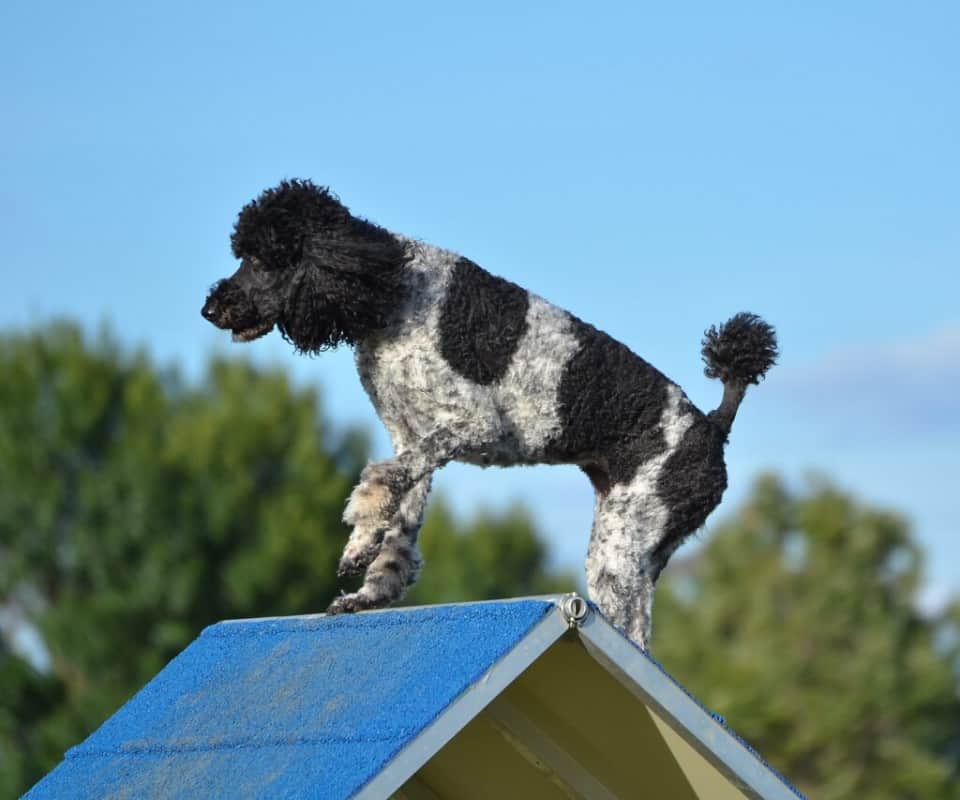
The white base of a Parti is a blank canvas. The patches can be any naturally occurring Poodle color, ranging from deep inks to soft pastels. Common hits include Black & White (the “Cow” look), Brown & White (Chocolate Partis), and Red & White.
But there is no such thing as a purebred Merle Poodle.
I’ll say it again for the people in the back: if a breeder is selling a “Merle Parti,” they are selling you a mixed breed—usually a Poodle crossed with an Australian Shepherd. According to the Poodle Club of America, merle is not a naturally occurring gene in this breed. Beyond the lack of purity, the “double merle” cross can lead to devastating health issues, including microphthalmia (shrunken eyes) and total deafness. It’s a genetic disaster zone fueled by “rare color” marketing. (I actually saw a ‘Merle’ Poodle once at a park; the poor thing had the structural health of a wet cardboard box).
5. The Genetics of Spotting
You don’t get a Parti by accident. It is determined by the “S Locus,” which controls the Microphthalmia-associated transcription factor (MITF). According to the UC Davis Veterinary Genetics Laboratory, the Parti trait is a simple recessive mutation (sp).
A puppy needs one copy from each parent to show the patches. If you pair a Parti with a solid dog that doesn’t carry the gene, you get exactly zero Parti puppies. But if you pair two carriers (Ssp)? Suddenly, you’re playing the lottery. You might get a 25% yield of Partis, but statistics are cruel; you could end up with an entire litter of solids that just happen to be hiding that recessive “s” for the next generation to deal with. This is why “surprise” Partis appear in solid litters—it’s pure math, hidden in plain sight for decades.
To go deeper into the weeds, you should also look at the UC Davis Coat Color Poodle testing panels. They show how other genes—like the K-Locus (dominant black) or the E-Locus (red/yellow)—interact with that white base. It’s not just about the spots; it’s about how vibrant the spots remain as the dog clears from a puppy into an adult.
6. Breed History
In the modern show world, solid Poodles are the “standard.” But historically? They are the newcomers. Look at any 15th-century woodcut or Rembrandt’s 1631 Poodle in Self-Portrait with Poodle. The dog at his feet is patched. These were not pampered lapdogs; they were rugged water retrievers.
Hunters in the dark marshes of Germany and France specifically favored the Parti pattern because the white splashes made the dogs easier to spot against murky water and dense reeds. The shift to solid colors was an elitist aesthetic choice made in the early 20th century. As the Poodle moved from the marsh to the parlor, breeders began to favor uniform colors that highlighted the “sculpted” look of the Continental Clip (which, let’s be honest, looks ridiculous to anyone outside the grooming circuit). We essentially spent a century trying to “erase” the original look of the breed for the sake of a ribbon.
7. Kennel Club Recognition
The two major kennel clubs have a fundamental disagreement on what a “real” Poodle looks like. The American Kennel Club (AKC) allows you to register a Parti Poodle as a purebred dog. You can even win titles in agility, dock diving, and obedience. But the conformation ring—the place where “Best in Show” is decided—is a closed door. A patched coat is considered a “disqualifying fault.” They’ve effectively banned the breed’s original color from the beauty pageant.
The United Kennel Club (UKC) takes a more “whole dog” approach. They recognize that the coat doesn’t dictate the dog’s structure or health. They allow Parti Poodles to fully compete for Grand Champion titles, judging them against the same structural standards as solid dogs. If you want a dog that can actually compete on its merits rather than its paint job, the UKC is where the real enthusiasts hang out.
8. Exercise and Training
If you are looking for a “purse dog” that happens to have cool spots, you are looking at the wrong breed. Beneath the flashy Parti coat is a high-octane working athlete. Historically, these dogs weren’t sitting on velvet cushions; they were jumping into freezing German marshes to retrieve waterfowl. If you don’t give them a job to do, they will find one—usually involving the systematic deconstruction of your drywall.
The 60-Minute Rule
A Parti Poodle requires a baseline of 60 minutes of vigorous activity every single day. A casual stroll around the block is essentially a warm-up. My Standard Poodle, Angus, required a mix of high-speed fetching and off-leash exploration just to reach a state of “calm” by dinner time. If you ignore this, the “Poodle Zoomies” will shift from a funny five-minute quirk to a destructive lifestyle. (Trust me, a bored Poodle is an architectural critic you don’t want in your house).
Mental Training Protocols
Because they are the second smartest breed in existence, physical exercise is never enough. They need mental “work” to prevent the boredom-driven anxiety Poodles are famous for.
- Puzzle Solvers: Food should never be free. Using snuffle mats or complex puzzle toys (the ones that require multi-step movements) is a baseline requirement, not a luxury.
- The “Job” Protocol: Teach them to “help” around the house. Whether it’s carrying the mail or picking up their own toys, giving a Poodle a sense of purpose prevents reactivity.
- Cognitive Flexibility: According to AKC Training Guides, Poodles excel in specialized tasks because they possess a high level of “cognitive flexibility”—they can generalize commands faster than almost any other breed.
9. Diet and Bloat Prevention
The way you feed a Parti Poodle is arguably more important than what is actually in the bowl. Because the Standard Poodle is a deep-chested breed, they are the “poster children” for Gastric Dilatation-Volvulus (GDV), or bloat. This is a condition where the stomach fills with gas and twists, cutting off blood supply. It is fast, it is fatal, and it is the leading cause of non-accidental death in the breed.
The Raised Bowl Controversy
There is a long-standing, somewhat heated debate in the research community regarding elevated feeders. While once thought to prevent bloat, more recent data suggests that for certain deep-chested dogs, eating from a height might actually increase the amount of air swallowed (aerophagia). Most modern researchers now recommend feeding from the floor or using “Slow Feeder” bowls to prevent the “vacuum effect” during mealtime.
Feeding Strategies for Longevity
- Multiple Small Meals: Never feed a Standard Poodle one large meal a day. Break it into two or three smaller portions to avoid overloading the stomach.
- The Post-Meal “Cool Down”: Strictly enforce a no-run, no-jump rule for at least one hour after eating. This isn’t just a suggestion; it’s a life-saving preventative measure.
- Managed Fiber: According to PetMD’s Guide to Large Breed Nutrition, a diet rich in highly digestible proteins and managed fiber levels can help mitigate some of the gastrointestinal stressors that lead to gas buildup.
10. Grooming and Coat Maintenance

The high-maintenance reputation of the Poodle is doubled when you add a white coat. White hair is a literal magnet for every piece of organic matter in your yard. Poodles are also prone to excessive tearing; on a white face, these tears oxidize and turn a rusty red. This requires daily wiping and a high-quality facial cleanser. If you aren’t prepared for daily facial maintenance and regular professional grooming every six weeks, a white-faced dog will break your spirit.
To keep the white “blinding,” many owners use blue-tinted whitening shampoos, but be careful—overuse can dry out the coat and leave your dog looking slightly violet if you don’t rinse properly. I’ve spent more money on whitening products than I care to admit, and sometimes a simple mud puddle can undo three hours of work in three seconds.
11. Price and Rarity
How much should a Parti Poodle cost? The market is flooded with “designer” breeders. A healthy, OFA-tested Parti should cost between $1,500 and $3,000. If a breeder asks for $8,000 because it is a “rare exotic phantom-parti,” they are likely a scammer prioritizing profit over the dog’s well-being. There is no such thing as an “exotic” Poodle. It is just recessive genetics at work.
Who is This Dog For?
It’s for the active researcher who loves hiking and training. It’s for the “Doodle” alternative seeker who wants the health testing of a purebred. And it’s for the snob-defier who enjoys bucking the traditional “solid-only” trends of the AKC. It’s a high-energy dog that happens to be a conversation starter.
12. Selecting a Breeder
The Home Test: Quality breeders raise puppies inside their homes, not in a barn or a “puppy room” you aren’t allowed to see. You can find a full list of these breed-specific risks at the Poodle Club of America Health Concerns page.
OFA Scores are Non-Negotiable: Ensure your breeder uses the Orthopedic Foundation for Animals (OFA) to check for Hip Dysplasia, PRA, and Sebaceous Adenitis (SA). If they don’t have them for the parents, walk away.
Ask About Ticking: A breeder who understands their lines will know if their dogs develop spots as they age.
Check the Lineage: Look for UKC titles. If a breeder is active in the UKC, they are likely dedicated to the Parti pattern as a legitimate breed standard.
13. FAQ (Frequently Asked Questions)
Are Parti Poodles rare? Less common than solids, but not “rare” in a biological sense. They are simply harder to produce because of the recessive nature of the gene. Don’t let a breeder upcharge you for “rarity.”
Can two solid Poodles produce a Parti? Yes—if they are both hidden carriers. This is why genetic testing for the S-Locus is vital for breeders who want to know what’s in their “toolkit.”
What is the rarest Parti color? Silver & White. It requires the dog to inherit both the recessive Parti gene and the recessive fading gene. It’s a double-genetic hit that takes years to clear from black to silver.
Can Parti Poodles be registered? Yes. Both the AKC and UKC register them as purebred Poodles.
Do Parti Poodles shed differently? No. It is the same low-shed, single-layer coat found on every other Poodle.
14. Conclusion: A Piece of Living History
Whether you love the asymmetrical look or just appreciate a dog that looks like a 17th-century hunting companion, the Parti Poodle is a fantastic choice. They are brilliant, athletic, and unique. They represent a time before the show ring prioritized uniformity over function.
Prioritize health testing over the spots. A well-bred Parti is a living piece of history. Don’t fall for the “Merle” scams, keep a brush handy, and prepare for a companion that is likely smarter than most of your neighbors. Just don’t expect the AKC to give you a trophy for it.
Medical & Veterinary Disclaimer: PoodleReport.com is an informational resource for Poodle owners and enthusiasts. We are not veterinarians. The content on this website is not a substitute for professional veterinary care, diagnosis, or treatment. Always seek the advice of your veterinarian with any questions you may have regarding your pet’s medical condition, diet, or overall health.