

Disclaimer: The information provided on PoodleReport.com is for educational purposes only and does not constitute veterinary medical advice; always consult your vet before changing your dog’s diet. Additionally, this post contains affiliate links. As an Amazon Associate, and other affiliate advertising programs, I earn from qualifying purchases at no extra cost to you.
While Poodles are famously celebrated as the “hypoallergenic” gold standard of the canine world, this biological perk hides a demanding and often misunderstood reality. Without a systematic, researcher-driven approach, that single-layered, ever-growing coat quickly transforms from a hallmark of elegance into a painful, matted liability that can compromise the dog’s physical well-being. It is a biological paradox: the very hair that stays off your furniture stays on the dog, interlocking with itself until it forms a structural “shell” if not mechanically addressed by the owner.
Grooming a Poodle at home requires a structured, step-by-step routine to effectively manage their dense coat. Always start by thoroughly line-brushing the dry hair to remove all mats before moving to the bath. Finally, blow-dry the curls completely straight for a smooth clipper cut, and finish with routine ear, nail, and dental care.
This comprehensive guide replaces purely cosmetic stereotypes with a precise, technical framework for mastering your dog’s complex coat. By mastering the science of the Poodle follicle and the psychology of cooperative care, you will ensure your grooming routine is efficient, safe, and professional—transforming a chore into a sophisticated maintenance system. Much like managing your Poodle’s health, this isn’t just about making your dog look like a show champion; it’s about respecting the physiology of a highly intelligent working retriever.
1. At a Glance: The Poodle Grooming System
| Metric | Clinical Description |
| Difficulty Level | Technical & Complex. Successfully grooming a Poodle at home requires a high level of technical skill and an understanding of the breed’s specific dermatological needs. It is not a task for the casual owner; it requires precision and patience to avoid injury. |
| Time Needed | Intensive Maintenance. A full system groom typically spans 2 to 5 hours depending on the dog’s size and coat length. This must be supported by 15-minute daily maintenance checks to ensure the coat remains free of micro-tangles that lead to compaction. |
| Required Tools | Professional Grade. To achieve a “snag-free” result, you must invest in professional machinery: a high-velocity (HV) dryer for stretch-drying, long-pin slicker brushes, a stainless steel Greyhound comb, and brushless motor clippers. |
| The “Golden Rule” | Dry-Only Brushing. Moisture is the enemy of a tangled coat. You must never introduce water to a mat; water acts as a setting agent that shrinks the hair fibers, tightening tangles into permanent, painful “pelts” that often require a medical shave. |
| Health Markers | Total Body Audit. A successful groom is measured by clinical indicators: ear canals free of debris and odor, nails trimmed to a silent length, healthy pink gums, and a coat that has been fully straightened and “puffed” to the skin. |
| Expert Note | Evidence-Based. This system is grounded in years of observational research with Standard Poodles, proving that consistency is the only variable that prevents the trauma of a full “strip-down” or emergency shave-off. |
2. The Biological Mandate: Why We Groom
The Poodle is a marvel of canine engineering, but their “low-shedding” label comes with a biological “fine print” that many owners misunderstand. While most dogs have a “resting phase” where hair falls out (telogen), a Poodle’s hair follicles are almost perpetually in the anagen (growth) phase. This means their coat behaves more like wool or human hair than traditional fur.
Neglecting this system doesn’t just result in a messy dog; it creates a medical emergency. Trapped dead hair, skin oils, and environmental debris knit together into “pelts” that restrict blood flow and harbor bacterial infections. A researcher recognizes that grooming is not about vanity; it is about preventative medicine and ensuring the structural integrity of the dog’s largest organ: the skin.
If left alone, a Poodle’s coat essentially becomes a biological tourniquet, pulling the skin tight and causing bruising or hematomas. If the AKC Poodle Breed Standard is the ideal, then the groomed coat is the biological baseline for health.
3. The Science Behind the Poodle Coat
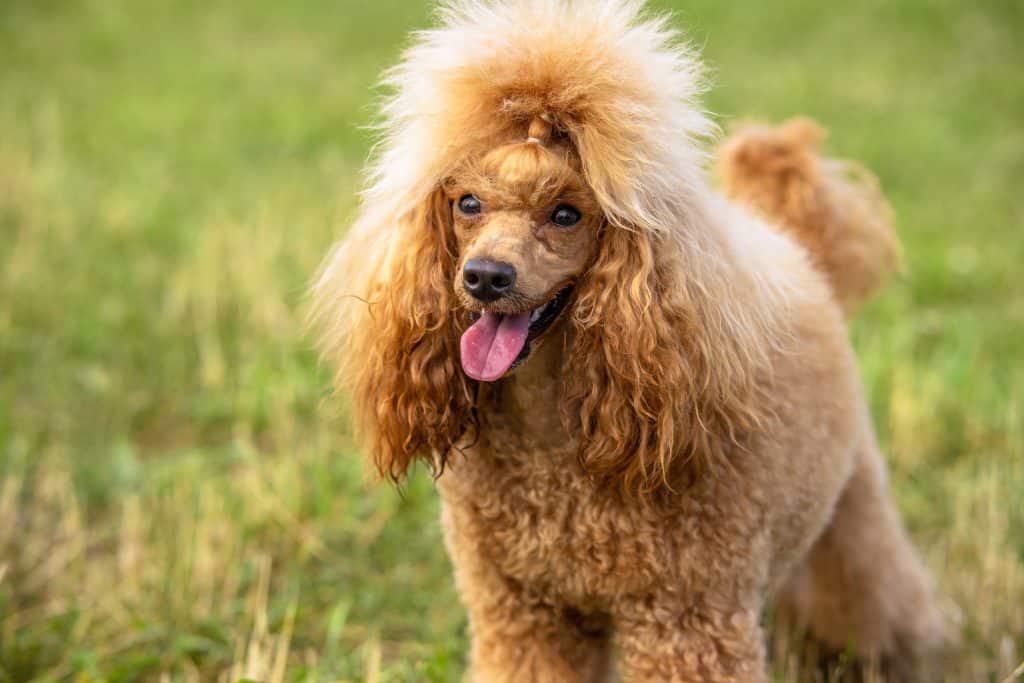
To manage a Poodle, you must understand the physics of their follicle. Poodle hair is a single-layered coat, meaning they lack the soft, insulating undercoat found in Labradors or German Shepherds. Instead, they possess a dense, curly “topcoat” that performs both protective and insulating functions.
How Keratin and Sulfur Affect the Coat
Poodle hair has a high concentration of sulfur-rich proteins, specifically keratin, which creates the signature tight curl. These curls act as a biological “net,” catching dander and preventing it from entering the environment—making them “hypoallergenic”—but also trapping dead skin cells and shedding hair within the coat. This is why a Poodle that hasn’t been brushed for a week may feel “thick”; you are feeling the accumulation of dead hair that has nowhere to go.
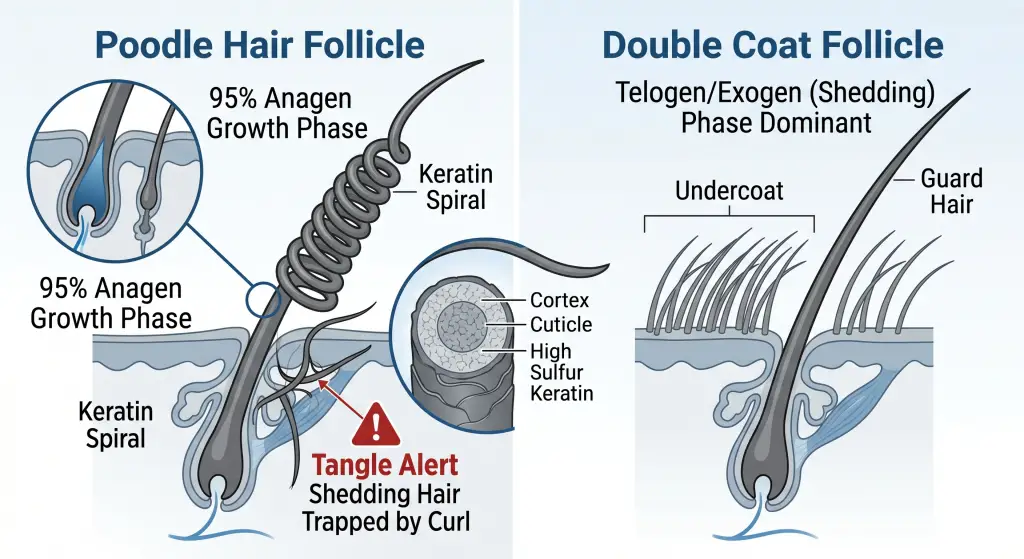
Diagram 1: Follicle Comparison. Note the Poodle’s predominant Anagen (Growth) phase (labeled 95%) and single, spiraled structure compared to the double coat. The “Tangle Alert” icon highlights the critical problem: shedding hair becomes trapped by the persistent curl, forming the nucleus of a mat.
Hair Density and Growth Cycles
The density of a Poodle’s coat—the number of hairs per square centimeter—is significantly higher than in most breeds. Because the hair is constantly growing, it requires external mechanical intervention to remove dead strands that would otherwise be trapped in the “corkscrew” of the living hair. According to Nature: The Genetics of Canine Coat Variation, the complex interplay of genes dictates this persistent growth, making manual intervention a scientific necessity rather than a stylistic choice.
4. History and Function of Poodle Clips
The traditional “frou-frou” look was once a high-performance wetsuit designed for the German Pudelhund (puddle dog). I look at the “Lion Cut” and see utility, not fashion.
The Original Poodle and the Lion Cut
German water retrievers required protection for vital organs (the chest) and joints (poms) while the rest of the body was shaved to reduce water drag and prevent the dog from becoming waterlogged. The “lion cut” was a suit of armor designed to keep the dog buoyant and warm in freezing marshes. The “poms” on the legs were specifically placed to protect the joints from rheumatism in cold water.
The Transition to Fashion Clips
As the breed moved into the French court, the functional clips evolved into the artistic “Continental” and “English Saddle” styles. While these look extravagant, they still follow the anatomical lines required for a working retriever. Understanding this history helps a groomer appreciate why Poodles have such high sensory awareness on their extremities—they were bred to feel the water and navigate complex environments.
5. Training Your Poodle to Enjoy Grooming
A 50-pound Standard Poodle who hates clippers is a safety hazard. We treat grooming as a trained, collaborative behavior through a “Cognitive-First” lens. Poodles are not passive participants; they are highly intelligent collaborators that require mental stimulation even during a bath.
Using the “Reset” Method for Stressed Dogs
Poodles have a high “cognitive load.” During long sessions, they can experience sensory burnout. In my years with Angus, my Standard Poodle, I learned that providing a “choice” to step off the table for a 60-second water break every hour transformed his demeanor from stoic endurance to active cooperation. If I saw the “Poodle side-eye” (that look of dignified judgment), I knew he’d hit his limit. He didn’t just tolerate the clippers; he understood the schedule and knew that his cooperation would be rewarded with a “reset.”
How to Desensitize Your Poodle to Tools
This involves pairing the vibration of clippers or the sound of the dryer with high-value rewards. We utilize “Classical Counter-Conditioning” to change the dog’s emotional response to grooming tools. Resources at Fear Free Happy Homes provide detailed protocols for this, ensuring the dog is a willing participant in their own health care rather than a prisoner to the brush.
6. Setting Up a Proper Grooming Area
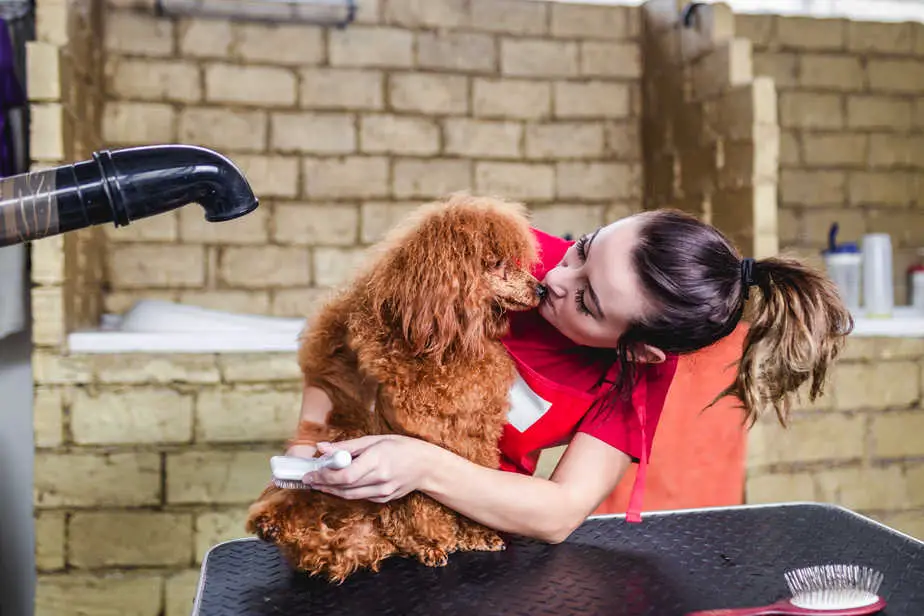
I’ve learned that environmental control is the first step in any successful procedure. You cannot safely or effectively groom a Poodle on a kitchen floor or a wobbly coffee table.
Choosing a Grooming Table
A hydraulic or electric table is not a luxury; it is a clinical necessity. It allows you to keep the dog at eye level, preventing back strain for the human and ensuring a stable, non-slip surface for the dog. When a dog feels unstable, they tense up, making it nearly impossible to get a clean clip on the legs or feet. Stability equals safety.
Managing Light and Noise Levels
Use 5000K (daylight) LED lighting to see the “line” of the skin through the dense coat. Additionally, minimizing background noise and using “Happy Hoodies” (ear covers) can significantly reduce a Poodle’s stress levels during the drying phase. Proper lighting ensures you spot minor skin irritations or parasites before they become major issues.
7. Essential Grooming Tools and Equipment
Success in grooming is 40% technique and 60% mechanical advantage. As an owner, you must analyze tools based on their performance metrics and durability.
Table 1: Professional Tool List
| Tool Category | Beginner Option | Professional System | Why It Matters (ROI) |
| Clippers | $30 Plastic Set | Brushless Motor (e.g., Wahl KM10) | Prevents “motor lag” which pulls hair and causes nicks. |
| Dryer | Human Hair Dryer | High-Velocity (HV) Blower | HV dryers “blast” water out, saving 2+ hours of labor. |
| Scissors | Kitchen Shears | 440C Stainless Steel Shears | Dull blades “crush” the hair tip, leading to split ends. |
| Brushes | Plastic Pin Brush | Long-Pin Slicker (e.g., Chris Christensen) | Reaches the “understory” of the coat without scratching. |
| Tables | Floor/Counter | Hydraulic Grooming Table | Safety and ergonomic health for the groomer. |
8. Maintaining and Cleaning Your Tools
Dull or dirty blades are the primary cause of “clipper burn” and skin irritation.
How to Clean and Oil Clipper Blades
Grooming professionals treat their blades like surgical instruments. Use a dedicated blade wash to remove hair, dander, and oil after every session. Blades should be oiled every 20 minutes of active use to reduce heat friction. A hot blade can reach temperatures that cause second-degree burns on a Poodle’s sensitive skin in seconds.
Sharpening Your Blades and Scissors
Professional sharpening is required once blades begin to drag. High-carbon steel blades hold an edge longer but are prone to rust, whereas ceramic blades run cooler but can shatter if dropped. Following the manufacturer standards at Andis: Professional Clipper Maintenance can extend the life of your kit by years.
9. Understanding Poodle Skin and pH Balance
The pH of human skin is roughly 5.5 (acidic), while canine skin is closer to 7.0–7.5 (neutral/alkaline).
Why Human Shampoo Damages Poodle Skin
Using human shampoo on a Poodle disrupts the “Acid Mantle,” stripping the skin of essential lipids and leaving the dog vulnerable to yeast (Malassezia) and bacterial infections. You should always choose a pH-balanced canine formula that supports the skin’s natural barrier rather than dissolving it.
How Conditioners Prevent Matting
High-quality conditioners use cationic surfactants that carry a positive charge. Since hair fibers are negatively charged, these surfactants bind to the hair, smoothing the cuticle. This is not just for shine; it is a functional requirement to prevent the static friction that leads to Level 4 matting.

10. The 12-Step Grooming Process
In the science of Poodle maintenance, sequence is the researcher’s shield against costly mistakes. Executing your at-home grooming routine in a strict, head-to-tail order ensures 100% coat coverage, prevents painful tangles, and maximizes your overall efficiency on the table.
Follow this exact workflow to guarantee a professional, snag-free result:
Step 1: The Pre-Groom Audit
Step 2: How to Line-Brush Your Poodle
Step 3: Identifying and Treating Mats
Step 4: Trimming Sanitary Areas and the Belly
Step 5: How to Clean Poodle Ears
Step 6: How to Bathe Your Poodle Properly
Step 7: Drying and Straightening the Coat
Step 8: Choosing the Right Clipper Blades
Step 9: Styling the Topknot and Tail Pom
Step 10: Trimming Your Poodle’s Nails and Paws
Step 11: Brushing Your Poodle’s Teeth
Step 12: The Health Audit Reward
👉 Step 1: The Pre-Groom Audit
Before you turn on a single clipper or pick up a brush, you must establish a clinical baseline. Think of this as a pre-flight safety check for your dog’s largest organ.
The Physical Palpation Baseline
Because Poodle coats are incredibly dense, visual inspections usually fail; your fingers must act as your primary diagnostic tools. Run your hands flat against the skin, moving methodically from the nose to the tail. Pay special attention to the high-friction “danger zones”: under the armpits, the groin, and behind the ears. You are feeling for anything that breaks the natural, smooth topography of the skin.
Identifying Subcutaneous Anomalies
You are actively hunting for embedded parasites, sebaceous cysts, or fatty lipomas. During a routine pre-groom audit on Angus, my fingers caught a tiny, grain-sized bump hidden deep behind his left ear—a deer tick that was entirely invisible to the naked eye through his thick curls. Finding these anomalies before you run a sharp steel #10 blade over them at high speeds prevents a painful, bloody emergency on your grooming table.
Protocol for Dermatological Hotspots
If your palpation uncovers an open sore or an angry, weeping red area—clinically known as acute moist dermatitis or a “hot spot”—the grooming session for that specific anatomical zone is immediately aborted. Running clippers or a slicker brush over inflamed dermatitis aggressively spreads the bacterial load and causes agonizing pain.
Following clinical veterinary standards, such as those outlined by VCA Animal Hospitals on Acute Moist Dermatitis, these areas require targeted medical intervention and topical treatments. Isolate the affected zone, proceed with the rest of the groom carefully, and call your vet.
👉 Step 2: How to Line-Brush Your Poodle
Surface brushing is the most common DIY failure. To reach the skin through the dense “poodle forest,” you must utilize Line Brushing.
Step-by-Step Line Brushing
Lift the hair with one hand and brush a “line” of hair down toward the skin with the slicker. Repeat this in layers, moving up the dog’s body. If you aren’t seeing skin with every stroke, you aren’t grooming; you are merely polishing the surface of a potential mat.
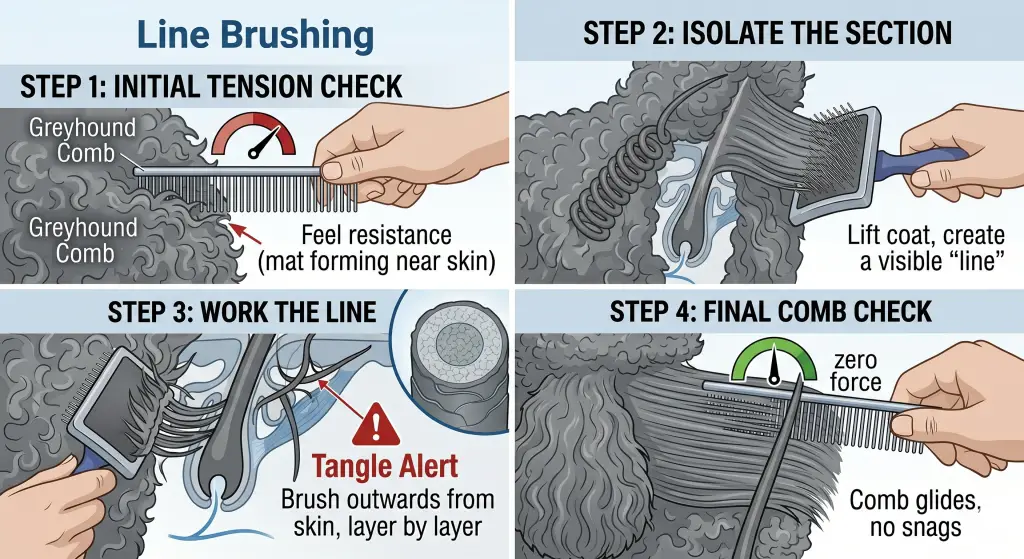
Diagram 2: Line Brushing Technique. A visual guide demonstrating systematic coat clearance. Panel 1 shows the Greyhound Comb detecting initial tension; Panel 2 shows the manual ‘line’ definition; Panel 3 demonstrates the skin-out brushing motion; and Panel 4 confirms a ‘zero force’ glide.
Managing Knots Without Pulling
The physics of brushing involves managing tension. When a slicker brush snags, don’t pull harder; they isolate the knot and work from the ends toward the root. Guides on PetMD suggest using a detangling spray to lubricate the hair shaft before intervention.
👉 Step 3: Identifying and Treating Mats
Mats are more than just tangles; they are a mechanical stressor on the skin. When hair mats, it pulls the skin tight, restricting blood flow and causing “mat burn” (dermatitis).
Table 2: Mat Severity and Treatment Guide
| Mat Level | Clinical Description | Recommended Intervention |
| Level 1 | Small snags, superficial | Slicker brush + detangling spray. |
| Level 2 | Knots in the “mid-shaft” | Finger-split the mat, then brush with a slicker. |
| Level 3 | Dense mats against skin | Do not brush. Use clippers (#10) to go under the mat. |
| Level 4 | “Pelting” (Solid sheet) | Immediate professional medical shave required. |
👉 Step 4: Trimming Sanitary Areas and the Belly
The “potty path”—the area under the tail and the belly—should be kept short using a #10 blade. This is purely for hygiene, preventing urine staining and fecal matter from becoming trapped in the coat, which can lead to skin infections and a high bacterial load in the home. It is the most practical part of the grooming system.
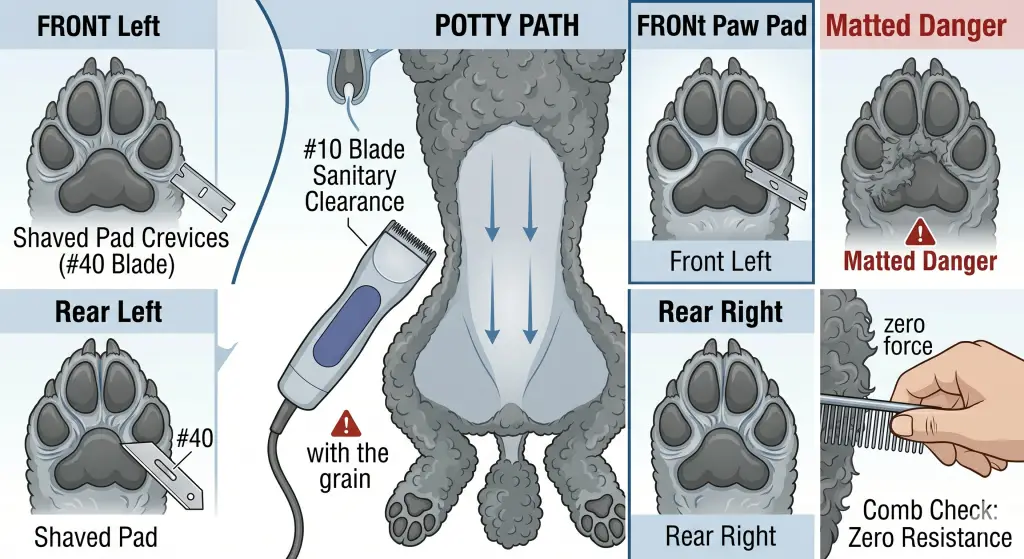
Diagram 3: Sanitary Zones. A technical diagram presenting a ventral (bottom-up) view of critical grooming zones. Panels detail the ‘Potty Path’ and paw pad clearance necessary for hygiene.
👉 Step 5: How to Clean Poodle Ears
Poodles grow hair inside the ear canal, which traps moisture, wax, and debris. This creates a perfect environment for yeast and bacteria.
Deciding Between Plucking or Trimming
While traditional advice suggests plucking all ear hair, modern research indicates that aggressive plucking can cause micro-trauma and inflammation. A “soft” approach involves trimming the hair at the entrance and using a pH-balanced ear cleaner to maintain the microbiome without causing trauma.
Signs of a Poodle Ear Infection
If the ear has a “yeasty” smell (like bread) or the wax is dark and chunky, it is a sign of infection (Otitis Externa) and requires a veterinary visit. Reviewing the AKC: Ear Infections in Dogs guide can help you identify symptoms early.
👉 Step 6: How to Bathe Your Poodle Properly

Bathing a Poodle is fundamentally a hydro-dynamic challenge. You aren’t just washing a dog; you are attempting to deep-clean the dermis through a dense, biologically engineered wall of water-resistant hair.
Remember, the Poodle was bred to retrieve waterfowl from freezing marshes without getting soaked to the skin. This evolutionary water resistance means simply spraying them with a showerhead is wildly insufficient; moisture and active cleansing agents must mechanically reach the skin to be effective.
Diluting Shampoo for Better Results
Diluting your professional canine shampoo (typically at a 10:1 ratio in a mixing bottle) alters the fluid dynamics of the soap. Instead of sitting on top of the curls like a thick sludge, the watery solution easily penetrates the keratin barrier to reach the trapped dermal oils and dander.
Application technique is equally critical: always use straight, downward strokes, squeezing the suds through the hair like you are hand-washing a delicate silk sweater. Never scrub in vigorous circles. Circular friction physically ties the hair shafts together, instantly creating “bird-nest” tangles that will require a humiliating surrender to the shears.
With Angus, I quickly learned that a gentle, downward massage bypassed his waterproof exterior effectively, whereas treating him like a dirty hubcap only resulted in a tangled disaster.
Why Rinsing is the Most Important Step
An experienced owner knows that the “rinse” is vastly more important than the “wash.” Leftover surfactants trapped against a Poodle’s skin are the primary culprits behind severe post-grooming itching, flaky dander, and sebaceous gland irritation. If your dog is scratching frantically 48 hours after a bath, it likely isn’t a sudden allergy—you just didn’t rinse them properly.
The rule is absolute: rinse until the water runs crystal clear, and then systematically rinse the entire dog for another full minute. Clinical literature, such as the Merck Veterinary Manual on Contact Dermatitis, confirms that chemical residues trapped against the skin are a leading cause of inflammation. A lazy rinse essentially undoes the entire health benefit of the bath, leaving the dog smelling fresh but feeling miserable.
👉 Step 7: Drying and Straightening the Coat
Air-drying a Poodle is a recipe for disaster. When hair air-dries, it returns to its natural “corkscrew,” allowing fibers to interlock.
Why You Should Stretch-Dry the Hair
As the high-velocity air hits the hair, you must brush it straight. This “sets” the hair linearly, making it easy to clip and less likely to tangle. In my experience, a proper stretch dry wasn’t just about the “poodle pouf”; it was about longevity. A “puffed” Poodle stays tangle-free for nearly three weeks, whereas air-drying results in mats behind the ears by the following Wednesday. It’s essentially “stretching” the keratin cortex into a manageable state.
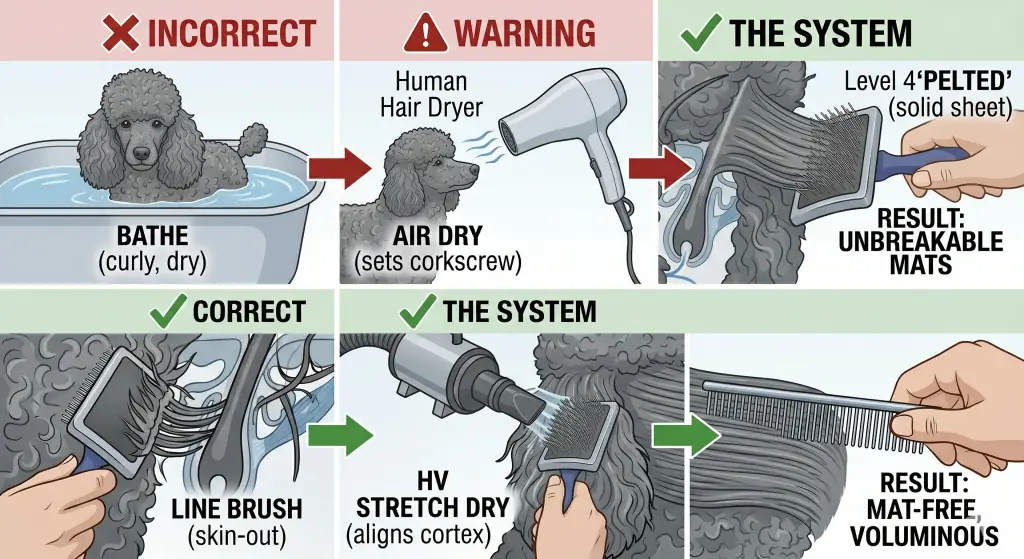
Diagram 4: Drying Sequence Comparison. This diagram compares air-drying vs. high-velocity (HV) stretch drying. Note how air-drying sets the natural curl into a matted shell, while HV drying aligns the cortex for a mat-free result.
Using Sprays to Protect the Hair
While high-velocity dryers use air force rather than heat, thermal protection sprays are still recommended to maintain the hair’s moisture balance and prevent the keratin from becoming brittle under the pressure of the air.
👉 Step 8: Choosing the Right Clipper Blades
Understanding blade lengths and metallurgy is critical for beginner safety. Poodles have sensitive skin that reacts quickly to “clipper burn.”
Table 3: Clipper Blade Length Chart
| Blade Number | Length Left | Typical Use Case |
| #10 Blade | 1.5mm (1/16″) | Face, feet, and sanitary. Safest for beginners. |
| #30 Blade | 0.5mm (1/50″) | Only used under snap-on combs. |
| #4 Blade | 9.5mm (3/8″) | Popular “Puppy Cut” body length. |
| #5 Blade | 6.3mm (1/4″) | The “Sport Cut”—low maintenance. |
| #7 Blade | 3.2mm (1/8″) | Short, smooth summer cut. |
👉 Step 9: Styling the Topknot and Tail Pom

This is the phase of the system where clinical hygiene transitions into applied geometry. Defining the Poodle’s silhouette requires moving away from the clippers and relying on the mechanical precision of stainless steel shears. A researcher doesn’t just cut hair; they calculate angles to highlight the dog’s underlying skeletal structure, ensuring the final visual result is symmetrical and biomechanically balanced.
How to Shape the Topknot
The topknot is the architectural crown of the breed, but its primary function is structural support for the eyes. Using a high-quality pair of curved shears, you must shape the head into a rounded dome that follows the natural radius of the skull, blending smoothly down past the occiput (the prominent bone at the back of the head).
The goal is to enhance the Poodle’s intelligent expression while rigidly clearing the orbital bone. If hair is left to hang over or irritate the eyes, it triggers chronic epiphora (excessive tearing), leading to localized yeast infections and deep red staining down the muzzle.
I quickly discovered that an improperly beveled topknot didn’t just ruin his aristocratic “breed look”; it literally blocked his peripheral vision, turning a highly capable retriever into a dog that couldn’t accurately track a thrown ball.
Creating Balanced Tail and Leg Poms
The “poms” are not arbitrary puffs of hair; they are structural accents designed to highlight the dog’s kinetic movement. To create a mathematically sound tail pom, you must physically palpate the tail to find the natural joint, typically leaving the bottom third of the tail base cleanly shaved. The resulting pom should be scissored into a perfect sphere or tight oval that is strictly proportionate to the dog’s overall mass.
Similarly, leg poms (or “bracelets”) must be set precisely above the hock and wrist joints to accentuate the breed’s natural angulation. A researcher looks for visual balance in the final silhouette: if the poms are left too large, they look like weighted boots that visually drag down the dog’s gait; if they are too small, they disrupt the breed’s legendary symmetry.
👉 Step 10: Trimming Your Poodle’s Nails and Paws
Poodle paws are sensitive, with highly developed pads for water retrieval. Overgrown nails cause “splaying” of the toes and significant joint pain.
Finding and Avoiding the Quick
Poodle nails are often black, making the “quick” (the blood vessel and nerve) invisible. Use a grinder to slowly “sand” the nail until you see a small dark dot in the center—this is your signal that you are approaching the quick and must stop immediately.
Shaving the Hair Between Paw Pads
Shave the hair between the pads using a #10 or #40 blade. This prevents the dog from slipping on hard floors—which is a major cause of ACL injuries in older Poodles—and keeps debris from being tracked into the coat. Clean pads are functional pads.
Step 11: Brushing Your Poodle’s Teeth
Poodles are prone to plaque buildup and gingivitis due to their jaw structure. Oral health is systemic health.
Choosing the Right Toothpaste
Use an enzymatic toothpaste designed for dogs. These pastes continue to work even after you stop brushing by breaking down the protein films that lead to tartar. Never use human toothpaste, as it often contains xylitol, which is toxic to dogs.
Why Oral Health Affects the Whole Body
Oral bacteria don’t stay in the mouth; they can enter the bloodstream and cause heart and kidney issues. Following the AVMA: Pet Dental Care protocols is the gold standard for Poodle longevity.
👉 Step 12: The Health Audit Reward
The final impression dictates the starting attitude for the next session. Once the physical labor is done, the most important step is entirely psychological and observational.
The Psychology of the “Jackpot”
Release the dog from the table with a clear, consistent release word (like “All done!” or “Free!”) and immediately deliver a high-value positive reinforcer. This shouldn’t be standard kibble; it needs to be a spoonful of peanut butter, a piece of plain chicken, or a premium treat.
With Angus, the groom wasn’t officially over until he received his post-table “jackpot.” This utilizes classical conditioning, ensuring your Poodle remembers the grooming system as a highly profitable collaboration rather than a localized zone of endless clipping.
The Unobstructed Visual Audit
With the coat freshly clipped and blown straight to the skin, you now have a rare, unobstructed view of the dog’s true biomechanics. Watch them walk away from the grooming table. Is there a slight hitch in their gait now that the heavy, unbalanced leg hair is gone?
Are they obsessively licking a freshly shaved paw pad, indicating your blade might have been too warm? The immediate post-groom audit is your clinical window to spot any micro-irritations, joint asymmetry, or weight loss that the dense curls previously masked.
Managing Post-Groom Decompression
After a two-hour sensory marathon of high-velocity air, vibrating metal, and forced stillness, your Poodle’s highly sensitive nervous system needs a minute to reboot. Expect the infamous “post-bath zoomies.” Let them run, shake violently, and rub their freshly shaved face on the carpet.
This is a natural, necessary canine stress-relief mechanism. Your active job as the researcher is complete; simply observe, validate their cooperation, and take note of any mechanical adjustments or blade-length changes needed for next month’s protocol.
11. Grooming for Summer and Winter
Poodles possess a highly efficient, built-in biological HVAC system. They thermoregulate through their dense coat, but this evolutionary advantage only functions if the hair is thoroughly brushed out and separated. A matted coat destroys natural air circulation, effectively trapping the dog in a stifling thermal shell. A researcher adjusts the grooming parameters as the seasons change to support this system.
Winter Maintenance
The winter “Ice Ball” phenomenon is a very real, mechanical nightmare. As the dog moves through deep snow, their body heat melts the snow into the leg curls, where ambient freezing temperatures quickly turn the moisture into heavy, solid ice blocks.
These chunks aggressively pull on the skin and can cause micro-tears or frostbite. I learned the hard way that letting a Poodle bound through snowdrifts with full leg poms can result in them carrying an extra five pounds of ice, requiring a tedious warm-water thaw in the bathtub. Keep the leg hair considerably shorter during the snowy months to eliminate the surface area where ice can anchor.
Summer Strategy
Every July, well-meaning owners make the clinical error of shaving their Poodle to the skin to “cool them off.” This is biologically counterproductive. A brushed-out, aerated coat actually acts as an insulating barrier against solar radiation, trapping a layer of temperate air next to the skin.
Shaving a Poodle down to the dermal layer with a #10 blade removes this vital UV shield, leaving them dangerously vulnerable to severe sunburn and heatstroke. You manage summer heat by ensuring the coat is 100% mat-free to allow maximum airflow to the skin, not by stripping away their natural environmental armor.
12. Grooming for Puppies and Seniors
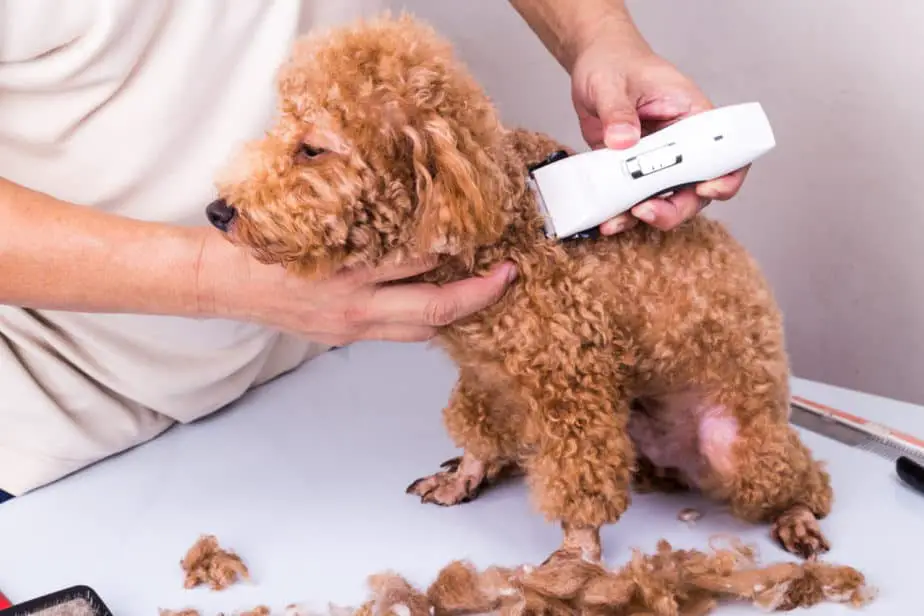
A static grooming routine is a flawed routine. A true researcher adapts the mechanical system to the biological life stage of the subject. A six-month-old puppy and a twelve-year-old senior require entirely different clinical approaches.
Managing the Puppy to Adult Coat Change
Between 8 and 18 months, the Poodle undergoes a dramatic follicular shift. The soft, wispy puppy coat sheds while the dense, coarse adult coat pushes through. This creates the ultimate anatomical “danger zone.” The dying puppy hair becomes physically trapped in the tightly coiling adult curls, acting like biological Velcro.
This brief but intense period requires daily, non-negotiable line-brushing to prevent a “felted” catastrophe. Think of it as a physiological changing of the guard that demands constant mechanical intervention to keep the coat functional.
Grooming Tips for Older Poodles
As a Poodle enters their twilight years, the protocol shifts entirely from aesthetics to ergonomics. For seniors, the governing philosophy is “Utility over Beauty.” Extended hours standing on a grooming table place unnecessary torque on arthritic hips, elbows, and stifles.
As a Poodle reaches their senior years, I highly recommend permanently retiring elaborate clips in favor of a short, uniform #7 blade utility cut, which cuts table time by more than half. Aligning with AVMA guidelines for senior pet care, a responsible owner prioritizes the orthopedic comfort of the aging dog over the geometric perfection of a fluffy topknot. If the dog is clean, mat-free, and comfortable, the groom is a flawless success.
13. Checking Skin Health During Grooming
Grooming is your early-warning system for a Poodle’s health. You are the first line of defense against disease.
Table 4: Health Red Flags to Watch For
| Observation | Location | Possible Health Issue |
| Yeasty Smell | Ears/Paws | Infection (Malassezia). |
| Red Gums | Mouth | Early Stage Periodontal Disease. |
| Hot Skin | Under a Mat | “Hot Spot” or localized dermatitis. |
| New Lumps | Body | Sebaceous Cysts or Lipomas. |
| Muscle Loss | Legs/Back | Potential joint or neurological issue. |
14. Solving Common Grooming Problems
Even with a perfect system, biological subjects are unpredictable. Don’t panic when things go wrong; they plan for the variables. Here is the clinical triage protocol for the most common mechanical and behavioral failures at the grooming table:
- The “Clipper Shy” Dog: Poodles have exceptional, elephant-like memories. If you accidentally nicked them or pinched a mat three months ago, they haven’t forgotten. When a dog becomes clipper shy, you must immediately halt the groom and backtrack to desensitization training. Turn the clippers on and simply lay them on the table. Reward. Touch the vibrating plastic body of the clipper (never the blade) to their shoulder. Reward. Never force a 50-pound Poodle through a stressful session; wrestling a dog with a 100-IQ only guarantees a much harder battle next month.
- Blade Overheating (Thermal Trauma): Friction creates heat, and the dense Poodle coat creates massive friction. A professional high-speed brushless motor can turn a steel blade into a branding iron in minutes. Check your blades against the sensitive skin on the inside of your wrist every 5 minutes. If it’s too hot for your skin, it will burn the dog. The solution is non-negotiable: use a “Cool Care” spray to instantly drop the temperature and lubricate the metal, or immediately swap the hot blade for a fresh, cool one to avoid thermal burns.
- The “Dryer Panic”: High-velocity (HV) dryers sound like jet engines and feel entirely unnatural. If your dog panics, do not chase them with the air nozzle. Instead, remove the concentrator cone to diffuse the air pressure, place a “Happy Hoodie” over their ears to muffle the high-frequency whine, and always start drying at the rear paws—the least threatening area—slowly working your way up the body.
15. How Diet Affects Your Poodle’s Coat
Hair is biologically expensive to produce, consisting of roughly 90% keratin protein. A “dull” or highly tangled coat is rarely just a grooming failure; it is often the primary diagnostic indicator of a systemic nutritional deficit. You cannot brush your way out of a bad diet.
- The Lipid and Keratin Connection: A diet lacking in highly bio-available protein and Omega-3 fatty acids results in brittle, porous hair. When the hair cuticle is porous and dry, it acts like microscopic Velcro, grabbing onto neighboring hairs and accelerating the formation of Level 3 mats.
- Zinc and Biotin Pathways: Zinc is essential for rapid cell replication during the Poodle’s perpetual anagen (growth) phase, while Biotin (Vitamin B7) strengthens the keratin infrastructure. If I ever noticed Angus’s coat losing its natural luster or feeling unusually “crispy” to the touch, my first clinical intervention was always a dietary audit and a temporary bump in Omega-3s.
- Clinical Assessment: Before spending hundreds of dollars on luxury detangling sprays, audit your dog’s kibble. Following the clinical guidelines in the Merck Veterinary Manual: Nutrition and Health can help you determine if your Poodle’s diet is actually supporting their demanding follicular output, and whether targeted biotin or zinc supplements are the true missing piece of your grooming system.
16. Frequently Asked Questions
How often should I groom my Poodle at home?
A full system groom is required every 4–6 weeks, with “line-brushing” maintenance every 2–3 days.
Can I use human shampoo on my Poodle?
No. Human shampoo is too acidic (pH 5.5) and will strip the protective oils from your Poodle’s skin (pH 7.5), leading to infections.
Why does my Poodle’s hair mat so quickly?
This is usually due to “surface brushing” instead of “line brushing.” If the hair near the skin isn’t clear, it will knot into a pelt.
Is professional grooming worth the cost?
While home grooming saves money, the tool investment is significant. Many owners choose a hybrid approach: daily brushing at home and a professional clip every 6 weeks.
How do I stop my Poodle from biting the brush?
This is a sign of overstimulation or fear. Use a “Lick Mat” with peanut butter during grooming to create a positive association and keep their mouth occupied.
17. Summary and Final Tips: The Researcher’s Verdict
To succeed in the Poodle grooming system, you must permanently adopt the researcher’s mindset: consistency always beats intensity. Grooming isn’t a chaotic monthly marathon to be endured—it is a daily, clinical habit that defines the bond between you and your dog.
By mastering the biology of the keratin curl, the pH chemistry of the skin, and the complex psychology of a 100-IQ canine, you ensure your companion remains as structurally sound as they are elegant. As I learned firsthand through years of managing the breed’s coat, the difference between a thriving Poodle and a matted emergency is just a few minutes of daily discipline.
- Order is non-negotiable: Always line-brush and comb before introducing a single drop of water.
- Depth is your metric: If you aren’t seeing skin with every stroke, you aren’t grooming; you’re just petting them with an expensive brush.
- Consistency wins the war: 15 minutes of proactive daily maintenance will save both of you from a stressful, five-hour rescue session.
- Grooming is diagnostic healthcare: Use this focused time to palpate for lumps, check for joint heat, and reinforce your bond through cooperative care.
Medical & Veterinary Disclaimer: PoodleReport.com is an informational resource for Poodle owners and enthusiasts. We are not veterinarians. The content on this website is not a substitute for professional veterinary care, diagnosis, or treatment. Always seek the advice of your veterinarian with any questions you may have regarding your pet’s medical condition, diet, or overall health.