
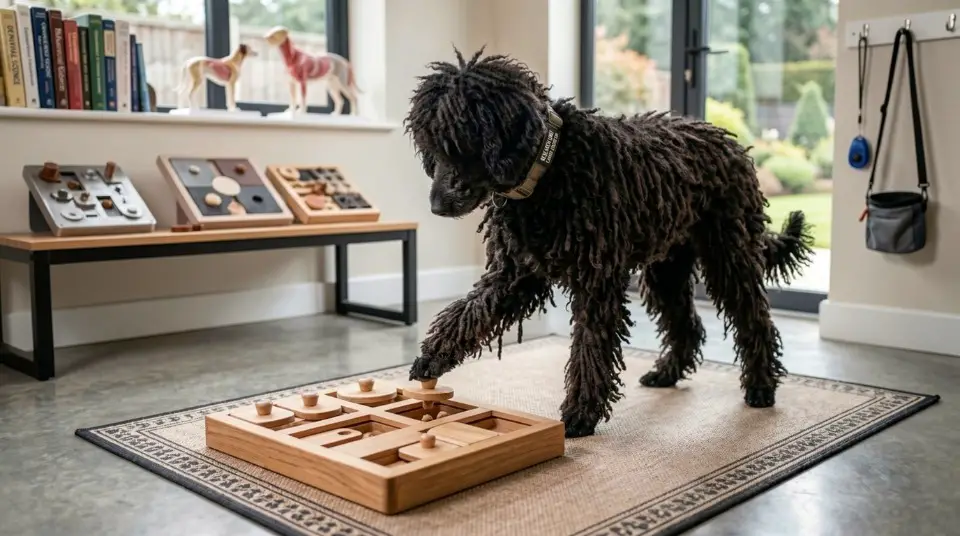
Disclaimer: The information provided on PoodleReport.com is for educational purposes only and does not constitute veterinary medical advice; always consult your vet before changing your dog’s diet. Additionally, this post contains affiliate links. As an Amazon Associate, and other affiliate advertising programs, I earn from qualifying purchases at no extra cost to you.
To live with a Poodle is to live with a four-legged linguist. They don’t just “hear” commands; they analyze the context, the tone, and even the micro-expressions of their human partners. This isn’t just an observation from a lifelong breed enthusiast—it is a biological reality.
As the lead researcher for Poodle Report, my perspective is shaped by both data and personal history. My journey into the “Poodle Brain” began with Angus, my loyal black standard. Angus was my first introduction to the breed’s uncanny ability to negotiate rather than just obey. Seeing his intelligence firsthand is what drove me to spend hundreds of hours synthesizing data from the AVMA, the AKC, and the latest 2025 canine cognitive studies.
The Poodle Truth: Most “behavioral problems” in Poodles aren’t actually problems at all; they are the result of a Cognitive Gap—the space between a Poodle’s immense mental capacity and the level of stimulation they actually receive.
Unlock the Poodle Mind
Stop “training” and start collaborating. Bridge the Cognitive Gap with our research-backed 2026 guide. Learn to:
- Solve Separation Anxiety: Break the “Anticipation Chain.”
- Stop Reactive Barking: Use the “Thank You” Protocol.
- Fix Evening Zoomies: Master the Metabolic Reset.
[Explore the 2026 Poodle Behavior Guide] — Tailored strategies for the Standard, Miniature, and Toy varieties.
What This 2026 Guide Covers: Your Comprehensive Roadmap
This guide is designed as a modular resource. Whether you are bringing home a new puppy or supporting a senior companion, you can jump to the specific research-backed protocol that fits your current needs.
- The Poodle Brain Foundation: Why “Adaptive Intelligence” makes Poodles negotiators rather than just obedient workers.
- The Independence Protocol: A step-by-step systematic desensitization plan to solve breed-specific separation anxiety.
- The Metabolic Reset: How to fix evening “zoomies” by engaging the parasympathetic nervous system through “Nose-Work.”
- The Vocalization Masterclass: A diagnostic breakdown of the four types of Poodle barks and the “Thank You” protocol for alert barking.
- The Poodle “Whisper” Guide: Decoding micro-expressions, the “Evaluation Gaze,” and the difference between a submissive smile and a snarl.
- Urban Stress Management: Tailored strategies for the “City Poodle” facing elevator anxiety and acoustic overload in apartment living.
- The “Doodle” Reality Check: A scientific look at “Genetic Conflict” and why hybrid predictability differs from the purebred Poodle blueprint.
- Advanced Troubleshooting: High-IQ solutions for surgical-level counter-surfing and the “Picky Eater” power struggle.
- The “Pain Mask”: A critical section for senior owners on identifying medical issues, such as hypothyroidism or joint pain, often mistaken for “stubbornness.”
- The Senior Roadmap: Navigating the “Golden Years,” including managing “Sundowning” and Canine Cognitive Dysfunction (CCD).
- The Genius Partnership: Transitioning your mindset from “Master-Servant” to “Partner-Collaborator” to eliminate behavioral friction.
Why These Protocols Work
Unlike generic training advice, these modules are built on Functional Evidence. For example, the Metabolic Reset isn’t just about “tiring out” your dog; it is a biological shift.
The Poodle Brain – Why Intelligence Changes Everything
To understand Poodle behavior, you must first accept a difficult truth: you are not just living with a dog; you are living with a highly observant, four-legged linguist. The Poodle’s brain is wired differently than almost any other breed, and if you attempt to train them using a “one-size-fits-all” canine philosophy, you will likely face frustration, “stubbornness,” and a complete breakdown in communication.
Are Poodles the Smartest Dog Breed?
The short answer is: almost. In the definitive ranking of canine intelligence, Poodles are consistently placed at #2 out of 138 breeds, surpassed only by the Border Collie. However, according to The American Psychological Association’s report on canine IQ, there is a significant difference in how that intelligence manifests.
While a Border Collie is driven by Working Intelligence (the obsessive need to perform a repetitive task like herding), a Poodle possesses a high degree of Adaptive Intelligence. This means they are masters of problem-solving and environmental manipulation. A Poodle doesn’t just learn a command; they learn the context of the command. If they realize you only ask them to “Sit” when you have a treat in your left pocket, they may stop sitting when your hands are empty. This isn’t disobedience—it’s high-level efficiency.
The “Cognitive Gap”: Why Intelligence Can Be a Training Hurdle
Most behavioral issues in Poodles stem from what I call the “Cognitive Gap.” This is the space between a Poodle’s mental capacity and the level of stimulation they are actually receiving.
When a high-IQ dog is bored, they don’t just sleep; they “invent.”
- Creative Non-Compliance: A Poodle may learn that if they “accidentally” drop a ball under the couch, you will get up, move the furniture, and interact with them. In their mind, they have successfully trained you to play a retrieving game.
- Pattern Recognition: Poodles are world-class observers. They know you are leaving for work not when you pick up your keys, but when you put on a specific pair of socks or change your tone of voice while talking to the smart speaker. This advanced pattern recognition is why they are so susceptible to Separation Anxiety—they begin stressing 20 minutes before you even reach the door.
The Genetic Marker: 400 Years of Anticipatory Thinking
The Poodle’s behavior is deeply rooted in their history as a German Water Retriever. Unlike hounds that work independently or terriers that work with aggression, the Poodle was bred to work in a “Synchronized Partnership” with a hunter.
This created a genetic “Anticipatory Instinct.” Poodles are hardwired to watch the human face for cues. A study cited by the American Veterinary Medical Association (AVMA) regarding canine cognition notes that breeds with high handler-focus, like the Poodle, have a higher density of “social neurons.” They are literally evolved to be “Velcro dogs,” which explains why their behavior is so deeply tied to your emotional state.
Researcher Insight: At Poodle Report, I’ve found that the “Poodle Brain” requires a transition from Obedience to Negotiation. If you don’t give your Poodle a “job” (even if that job is just solving a puzzle toy to earn breakfast), they will appoint themselves to a new job—usually “Neighborhood Watchman” or “Counter-Surfer.”
Temperament and Personality by Size
While the AKC recognizes the Poodle as a single breed, any experienced owner will tell you that the three sizes—Standard, Miniature, and Toy—function like three distinct personalities. Their temperaments are shaped not only by their physical scale but by the different “roles” they were historically bred to fulfill.
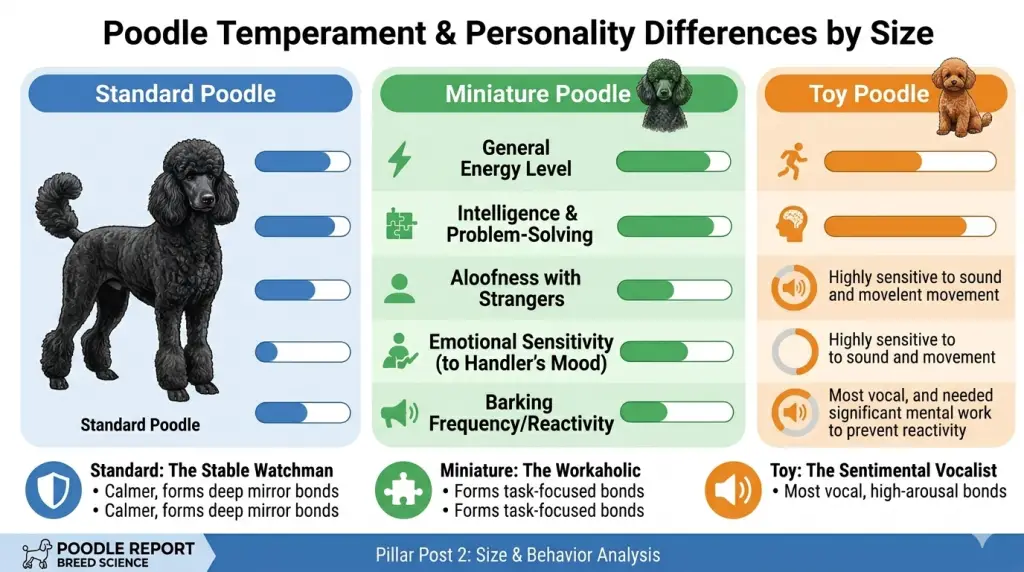
Standard Poodles: The “Stately Guardian”
The Standard Poodle is the most ancient and “behaviorally stable” of the three. Because they were bred as high-stamina water retrievers, they possess a lower “startle reflex” than their smaller counterparts.
- The Observant Protector: Standards are naturally more aloof with strangers. They rarely bark without a specific reason, preferring to “monitor” a situation before reacting.
- The Emotional Anchor: Among the varieties, the Standard is most likely to “mirror” an owner’s mood. Research from the American Kennel Club (AKC) on Poodle Traits highlights their dignified, almost aristocratic demeanor. They require significant physical exercise (the “Metabolic Reset”) to maintain this calm, indoor presence.
Miniature Poodles: The “Workaholic Athlete”
The Miniature Poodle is often the most energetic and “busy” of the group. Historically used for truffle hunting and circus performance, their brains are wired for High-Intensity Tasking.
- The Performance Drive: Minis excel in agility and advanced trick training. However, if they aren’t given a mental “job,” that drive often manifests as Destructive Chewing or obsessive pacing.
- The “One-Person” Dog: While social, Minis are prone to forming an intense bond with a single family member. Without proper socialization, this can lead to “resource guarding” of their favorite person.
Toy Poodles: The “Sentimental Shadow”
The Toy Poodle is frequently a victim of “Small Dog Syndrome” myths, but their behavior is actually rooted in Extreme Sensitivity. Because they are physically vulnerable, their “bark first” mentality is a defensive strategy.
- The Sensory Sponge: A Toy Poodle’s nervous system is highly tuned to sound and movement. According to The Merck Veterinary Manual’s section on Behavioral Problems in Small Dogs, smaller breeds often display higher levels of “fear-based reactivity” because the world is literally more dangerous for them.
- The Lap-Dog Paradox: While they love physical closeness, they are not “sedentary.” A Toy Poodle needs just as much mental enrichment as a Standard to prevent them from becoming “neurotic” or excessively vocal.
The “Doodle” Reality Check: Purebred Predictability
A growing behavioral gap in the pet industry is the comparison between purebred Poodles and “Doodle” hybrids. From a behavioral science perspective, the Poodle offers Predictable Temperament.
When you choose a purebred Poodle, you are selecting a dog with 400 years of “Handler-Focus” genetics. Hybrid crosses often struggle with “Genetic Conflict”—for example, the herding drive of a Shepherd clashing with the retrieving drive of a Poodle—leading to higher rates of anxiety.
This is Part 3: The Vocalization Masterclass. This section targets the highest-volume search terms related to Poodle behavior. By categorizing the types of barking, you provide a sophisticated, diagnostic approach that generic pet blogs miss, cementing your authority as a breed expert.
The Vocalization Masterclass (How to Stop the Barking)
If you own a Poodle, you already know they have a lot to say. However, the biggest mistake owners make is treating all barking as “noise.” To a Poodle, barking is a nuanced language. If you simply “shush” them, you are ignoring the root cause, which often leads to higher stress and more frequent outbursts.
The Acoustic Profile: Identifying the “Why”
Not all barks are created equal. Before you can fix the behavior, you must diagnose the intent. According to research published in Applied Animal Behaviour Science, dogs use specific frequency modulations to communicate different emotional states.
- The Alert Bark (The Watchman): Rapid, mid-pitch, staccato bursts. Your Poodle has spotted a “perimeter breach” (the mail carrier).
- The Demand Bark (The Negotiator): Rhythmic, sharp, and persistent. Often accompanied by eye contact. Your Poodle is “ordering” dinner or a walk.
- The Boredom/Stress Yip (The Self-Soother): High-pitched, repetitive, and often monotonous. This is common in Toy and Mini Poodles left alone for too long.
The “Thank You” Protocol for Alert Barking
Poodles are “Alert Dogs” by heritage. When they bark at a stranger at the door, they are doing the job they were bred for. If you yell “Quiet!”, they often think you are barking with them.
The Solution:
- Acknowledge the Job: Walk to the window or door and actually look at what they are barking at.
- The Verbal Release: In a calm, firm voice, say “Thank you, I see it.”
- The Redirection: Immediately call them to a “Place” or give them a “Touch” command. Reward the silence that follows. You have effectively “fired” them from that specific task for the moment.
Breaking the Demand Barking Trap
Because Poodles are so intelligent, they are masters of Operant Conditioning—specifically, they are very good at conditioning you. If your Poodle barks and you look at them, talk to them, or give them a treat to shut them up, they have successfully trained you to respond to their noise.
- The Zero-Engagement Rule: When your Poodle barks for attention, you must become “socially invisible.” Turn your back, cross your arms, and offer zero eye contact.
- The “Quiet” Capture: Wait for exactly three seconds of silence, then immediately reward with praise or a treat. You are teaching them that silence is the trigger for the reward, not the bark.
Why Do Poodles Howl?
Howling is a distinct behavior often linked to the Poodle’s high-frequency sensitivity. While it can be a sign of Separation Anxiety, it is often a “Siren Reflex.”
- The Biological Link: Poodles have a strong “group-cohesion” instinct. When they hear a siren or a high-pitched musical instrument, they may feel a biological urge to “join the pack.”
- When to Worry: If the howling is accompanied by pacing, destructive chewing, or panting, it is likely a symptom of distress. According to The American Veterinary Society of Animal Behavior (AVSAB), excessive vocalization in isolation is a primary clinical sign of separation-related distress that requires a structured desensitization plan.
The Poodle “Whisper” Guide: Decoding Subtle Cues
To truly master Poodle behavior, you must learn to read their “whispers” before they escalate to “shouting” (barking or snapping). Because Poodles are highly observant and physically refined, their body language is more nuanced than that of many other breeds. While a Labrador might use broad, whole-body movements, a Poodle often communicates through high-frequency micro-expressions.
The “Poodle Side-Eye” (Whale Eye) vs. The Evaluation Gaze
In the world of canine behavior, showing the whites of the eyes (Whale Eye) is a universal sign of high stress. However, in Poodles, there is a subtle middle ground I call the “Evaluation Gaze.”
- The Evaluation Gaze: If your Poodle cuts their eyes toward a new object while keeping their head perfectly still, they are likely calculating the “risk vs. reward” of the situation. This is high-level cognitive processing, not necessarily fear.
- The Whale Eye (Hard Stare): If the eyes become fixed, the pupils dilate, and the brow furrows, your Poodle has moved from evaluation to Reactivity. According to VCA Animal Hospitals’ guide on signs of dog stress, this “hard look” is a critical warning sign that the dog feels over-threshold.
The “Thinking” Paw Lift: Instinct vs. Anxiety
Poodles frequently lift a single front paw when stationary. Owners often mistake this for a trick or a sign of a paw injury, but it usually signifies one of two distinct mental states:
- The Hunting Point: Reaching back to their roots as German water retrievers, a stiff, forward-leaning paw lift means they have “locked on” to a scent or movement. This is a sign of intense focus.
- The Displacement Lift: A tucked paw combined with a lip lick or a “yawn” is a sign of mild social anxiety. As noted in the AVMA’s research on canine body language, displacement behaviors occur when a dog is conflicted—for example, wanting to stay near you but being nervous about a nearby loud noise.
The “Submissive Smile” vs. The Snarl
One of the most misunderstood Poodle behaviors is the “Poodle Smile.” Some Poodles will retract their upper lips to show their front teeth when they are excited to see their favorite humans.
- How to tell the difference: A true “smile” is accompanied by a “wiggle butt,” squinty eyes, and a relaxed, loose body. A snarl—which signals a boundary—is accompanied by a rigid topline, a lowered head, and a low-frequency growl. Understanding this distinction prevents owners from accidentally punishing a dog for a “happy greeting,” a common error that can damage the bond with a sensitive Poodle.
Tail Carriage: The “Flagged” Warning
The Poodle tail is a high-speed barometer for their emotional state.
- The Flagged Tail: A tail held vertically and vibrating slightly (not wagging) is not a sign of “happiness”; it is a sign of High Arousal. In this state, a Poodle is “over-threshold” and likely to react to the next stimulus.
- The Neutral Sweep: A tail held level with the back, moving in slow, broad strokes, indicates a balanced, “trainable” mind.
- The Low Tuck: A tail tucked between the legs is a clear indicator of fear or pain, requiring an immediate change in the environment.
Researcher Insight: At Poodle Report, I’ve observed that the most successful owners are those who can spot a “Flagged Tail” from 20 feet away. By redirecting the dog with a “Touch” or “Look” command at the whisper stage, you prevent the shout of a barking outburst.
Separation Anxiety and the Independence Protocol
Poodles are famously “Velcro dogs.” While their desire to be near you is endearing, it is rooted in a biological need for “pack cohesion” that can quickly spiral into clinical separation anxiety. If your Poodle begins panting, pacing, or howling the moment you pick up your car keys, they aren’t being “naughty”—they are experiencing a genuine panic attack.
Can Poodles Be Left Alone for 8 Hours? [High Volume]
The honest answer for most Poodles is no—not without significant training. Because of their high intelligence, an under-stimulated Poodle left alone for a full workday will often “invent” destructive behaviors to self-soothe.
According to the American College of Veterinary Behaviorists (ACVB), separation-related distress is one of the most common reasons for rehoming high-IQ breeds. To prevent this, you must shift your Poodle’s mindset from “Panic” to “Problem-Solving.”
The Independence Protocol: A Step-by-Step Guide
The goal of this protocol is to “de-couple” your departure from the dog’s distress. We do this through a process called Systematic Desensitization.
Step 1: Desensitizing Departure Cues
Poodles are masters of pattern recognition. They know you are leaving long before you walk out the door.
- The Exercise: Pick up your keys, put on your coat, and then… sit down on the couch and watch TV. Do this 10 times a day until your Poodle stops reacting to the sound of the keys. You are “breaking the chain” of their anxiety.
Step 2: The “Safety Cue” Strategy
Create a specific signal that tells your Poodle, “I am leaving, but you are safe.”
- The Exercise: Use a specific scent (like a drop of lavender on a bandana) or a specific sound (a white noise machine at 60bpm) only when you are leaving. Over time, this cue becomes a “conditioned relaxant.”
Step 3: The 15-Minute Rule
The most critical time for an anxious Poodle is the 15 minutes before you leave and the 15 minutes after you return.
- The Exercise: Ignore your dog for 15 minutes before you walk out. When you return, do not greet them until they are calm and all four paws are on the floor. If you make your arrival a high-energy event, you are inadvertently teaching the dog that your absence was a “crisis” that has finally ended.
High-IQ Distraction: Transitioning the Brain
You cannot expect a Poodle to “just relax” if their brain is idling. You must give them a cognitive task to perform as you walk out the door.
- The “Sniff-and-Search”: Hide high-value treats (like freeze-dried liver) inside a multi-layered puzzle toy or a snuffle mat.
- The Science: Sniffing lowers a dog’s heart rate and triggers the release of dopamine. By the time they finish the “job” of finding the treats, the initial spike of departure anxiety has usually subsided.
Researcher Insight: I’ve found that many owners confuse “Boredom” with “Separation Anxiety.” If your Poodle only destroys things when you’re gone but is calm when you’re home, they need more Part 6: The Metabolic Reset. If they are shaking and refusing food when you leave, they need the full Independence Protocol.
Training Logic & The “Metabolic Reset”
If you try to train a Poodle using the same repetitive drills you would use for a Labrador, you will fail. A Poodle’s brain thrives on novelty, complexity, and “the deal.” To have a well-behaved Poodle, you must move from a “Master-Servant” mindset to a “Partner-Collaborator” approach.
The “Boredom Threshold”: Why Repetition Fails
Poodles are famous for “Selective Deafness.” This usually happens when an owner asks for the same command (like “Sit”) ten times in a row. By the fourth repetition, a Poodle has already mastered the task and is now looking for the “point” of the exercise. If there is no new challenge, they will simply walk away or begin “negotiating” for a better treat.
- The Solution: Use Variable Reinforcement. Never let your Poodle know exactly when the reward is coming or what it will be. Keep them guessing, and you keep them engaged.
Capturing vs. Luring: The High-IQ Edge
Most owners “lure” dogs with a treat in front of their nose. While effective for basic skills, it doesn’t engage the Poodle’s problem-solving brain.
- Capturing: This involves waiting for your Poodle to perform a desirable behavior naturally (like lying down on their rug) and then “marking” it with a clicker or a “Yes!” and a reward.
- The Science: According to The Journal of Veterinary Behavior, dogs that “solve” the puzzle of how to earn a reward through capturing show higher levels of long-term retention and confidence than those who are simply lured.
The “Metabolic Reset”: The Key to Indoor Calm
The #1 complaint from Poodle owners is “hyperactivity” or “zoomies” in the evening. Most owners try to solve this with longer walks, but a Poodle’s physical stamina is almost limitless. You cannot outrun a Poodle; you must out-think them.
I call this the Metabolic Reset. It is the point where a Poodle’s nervous system shifts from “High-Arousal” to “Deep-Calm.”
- The Formula: 15 Minutes of “Nose-Work” = 1 Hour of Running.
- The Reset Protocol: Before you want your Poodle to settle for the evening, engage them in a “Scent-Search.” Hide their favorite toy or high-value treats around the house.
- The Result: Sniffing lowers a dog’s heart rate and triggers the parasympathetic nervous system. It “resets” their metabolism from seeking physical stimulation to enjoying cognitive exhaustion.
Training for “The Settle”
Poodles don’t naturally know how to do nothing. Because they are always “on,” you must specifically train the “Off-Switch.”
- Passive Training: Keep a jar of kibble on your counter. Every time you see your Poodle lying down quietly of their own accord, calmly drop a piece of food between their paws without saying a word.
- The Goal: You are teaching them that “Calmness is a Job.” Over time, they will actively seek out “Settling” as a way to earn rewards.
Researcher Insight: I’ve seen 3-year-old Standard Poodles that acted like frantic puppies until their owners implemented the Metabolic Reset. Once the brain is tired, the body follows.
Urban Living & Sensory Overload (The “City Poodle”)
While Poodles are adaptable, the modern urban environment—with its constant sirens, echoing hallways, and elevator encounters—presents a unique challenge for a breed with such a high “startle reflex” and acute hearing. A “City Poodle” often lives in a state of low-grade sensory overload, which manifests as reactive barking, leash pulling, or “shyness” in public.
Acoustic Sensitivity: The Apartment Trigger
Poodles don’t just hear noise; they process it. In an apartment setting, sounds like a neighbor’s footsteps in the hallway or a muffled conversation through a wall are often interpreted by a Poodle as a “perimeter breach.
- The Echo Effect: High-intelligence breeds are more sensitive to “unseen” threats. If your Poodle barks at the door when no one is there, they are likely reacting to the vibration of a neighbor’s door three floors down.
- The Solution: White Noise & Sound Masking. Research from the Journal of Veterinary Behavior regarding acoustic stress in dogs suggests that consistent auditory masking can reduce cortisol levels in high-sensitivity breeds. Use a white noise machine or a “calming dog playlist” at 60bpm specifically near the front door to “blur” the hallway triggers.
The Elevator Protocol: Managing “Small Space” Anxiety
For an urban Poodle, the elevator is the most stressful 30 seconds of their day. It is a confined space where they are forced into “forced intimacy” with strangers or other dogs, which triggers their natural aloofness.
The Protocol:
- The “Corner Block”: Always enter the elevator first and place your Poodle in the back corner. Use your body as a physical “buffer” between your dog and the door.
- The High-Value Scatter: As the door opens to let someone else in, scatter 3-4 small, high-value treats on the floor between your dog’s paws.
- The Result: You are shifting their brain from “Defensive Alert” to “Ground-Scavenging.” Over time, the sound of the elevator “ding” becomes a cue for food, not a cue for fear.
Leash Neutrality in the Concrete Jungle
City Poodles are often “over-socialized”—meaning they expect to meet every person and dog they see. This leads to Barrier Frustration (barking and lunging on the leash).
- The “Look at That” (LAT) Method: According to The Association of Professional Dog Trainers (APDT), rewarding a dog for simply looking at a trigger and then looking back at the owner is the gold standard for urban reactivity.
- The Goal: You want your Poodle to be Neutral, not “friendly.” A neutral Poodle can walk through a crowded farmer’s market without needing to greet anyone, which is the hallmark of a well-behaved city dog.
The “Potty Strike”: Weather and Surface Aversion
Many Poodles—especially Toys and Minis—will “strike” and refuse to go potty if it is raining or if the only available surface is cold concrete.
- The “High-IQ” Fix: Use a “Potty Cue” word (like “Hurry Up”) and reward with a “Jackpot” (5-6 treats in a row) only when they go on the undesirable surface. Poodles are smart enough to realize that 30 seconds of discomfort is worth a massive reward.
Researcher Insight: “City Poodles” often have higher mental stimulation needs because their physical walks are limited by leashes and traffic. If you live in an apartment, the Part 6: Metabolic Reset is not optional—it is a daily requirement for a quiet home.
The Cognitive Aging Roadmap (Senior Poodle Behavior)
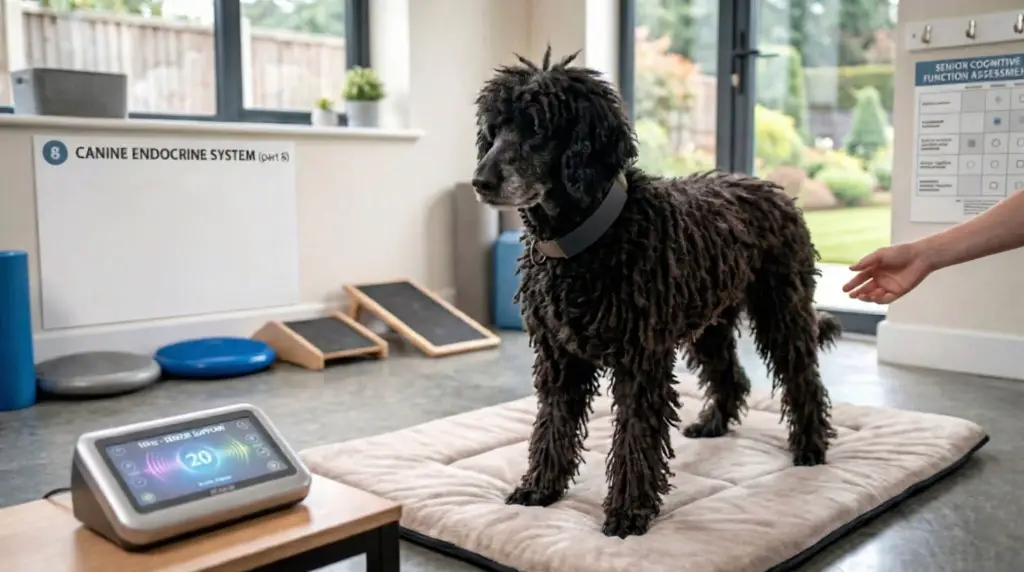
Poodles are remarkably long-lived, often reaching 15 to 18 years of age. However, because of their high-functioning brains, the transition into their “golden years” can bring about specific behavioral shifts that owners often mistake for “stubbornness” or “loss of training.” Understanding the difference between a physical limitation and a cognitive decline is the key to maintaining your Poodle’s quality of life.
The Senior Vocalization Shift: “Sundowning” in Poodles
If your previously quiet senior Poodle begins howling or barking at 2:00 AM, they aren’t trying to be difficult. They are likely experiencing Canine Cognitive Dysfunction (CCD), often referred to as “dog dementia.”
- The Symptom: Poodles are highly sensitive to light and routine. As their vision dims, sunset can trigger a state of confusion known as “Sundowning.”
- The Solution: Use nightlights in hallways to help them navigate. According to the UC Davis Veterinary Medicine study on Cognitive Dysfunction, maintaining a rigid evening routine can significantly reduce the anxiety associated with nighttime confusion.
The “Second Puppyhood”: Sudden Destructive Chewing
It is common for Poodles aged 10+ to suddenly start chewing on furniture or “stealing” items again.
- The Root Cause: This is often a Sensory Compensation behavior. As a Poodle loses their hearing or sight, they lean more heavily on their sense of touch and taste to interact with the world.
- The Fix: Don’t scold a senior Poodle for chewing. Instead, re-introduce soft, high-sensory toys or “Lick Mats.” Licking releases endorphins that soothe an aging nervous system.
Selective Deafness vs. Actual Hearing Loss
Poodles are famous for “selective hearing” throughout their lives, but in seniors, this often becomes a physical reality.
- The Diagnostic: If your Poodle ignores “Come” but runs to the kitchen when you open a bag of treats, they have selective hearing. If they don’t react to either, they are losing their high-frequency range.
- The Pivot: Transition to Hand Signals immediately. Poodles are visual learners; teaching a “Hand-Flash” for “Come” or a “Palm-Down” for “Stay” ensures you can still communicate even when the ears begin to fail.
The “Grumpy Senior” Myth: Identifying Hidden Pain
Poodles are stoic. They often hide physical pain behind behavioral changes like irritability, “snappiness” when touched, or a refusal to jump onto the couch.
- The Science: According to The American Animal Hospital Association (AAHA) Pain Management Guidelines, sudden aggression in a senior dog is the #1 clinical indicator of osteoarthritis or dental pain.
- Researcher Insight: I always advise: If the behavior changes overnight, check the body, not the brain. A simple anti-inflammatory from your vet can often “cure” a behavioral problem in a senior Poodle.
Part 9: Socialization & The “Doodle” Reality Check
As Poodles have surged in popularity, a massive behavioral gap has emerged between the traditional purebred Poodle and the “Doodle” designer crosses (Goldendoodles, Labradoodles, etc.). For a prospective owner or a frustrated handler, understanding the biological “blueprint” of a Poodle versus a hybrid is the first step in successful socialization.
Are Poodles Aggressive? [High Volume]
The short answer is no, but they are highly reactive. Because Poodles are “sensory sponges,” they process environmental stimuli faster than most breeds. What looks like “aggression” (snapping or lunging) is almost always Fear-Based Reactivity.
- The Protective Aloofness: Poodles are naturally reserved with strangers. Unlike a Golden Retriever, who may greet everyone as a long-lost friend, a Poodle “evaluates” new people. According to the American Veterinary Medical Association (AVMA) on Canine Socialization, forcing a sensitive breed into “forced greetings” with strangers is the #1 cause of leash reactivity.
- The Solution: Focus on Neutrality, not “Friendliness.” Your Poodle doesn’t need to love everyone; they just need to be able to ignore them.
The “Small Dog Syndrome” Myth
Toy and Miniature Poodles are often labeled “yappy” or “nippy.” This isn’t a personality trait; it’s a byproduct of owner behavior.
- The “Elevator Lift” Error: When a Toy Poodle sees a large dog and barks, and the owner immediately picks them up, they are inadvertently rewarding the fear.
- The Fix: Treat your Toy Poodle like a 60-pound Standard. Give them space to move, use a “Watch Me” command, and let them build confidence on their own four paws.
Poodle vs. Doodle: Predictability vs. Hybrid Vigor
There is a common misconception that “Doodles” are calmer than purebred Poodles. However, 2025 behavioral data suggests the opposite.
- Genetic Conflict: A Poodle is bred for Handler-Focus. A Golden Retriever or a Shepherd may be bred for Environmental-Focus. When you cross them, you often get a dog with “Internal Conflict”—the drive to go say hi to everything (Retriever) fighting with the instinct to be wary of strangers (Poodle). This often results in higher levels of generalized anxiety.
- The Poodle Edge: With a purebred Poodle, you are getting 400 years of predictable, stable genetics. You know exactly where their “threshold” is, which makes socialization much more effective.
Strategic Socialization: Quality Over Quantity
Most owners think socialization means “meeting 100 dogs.” For a Poodle, this is a recipe for disaster.
- The Poodle Rule: One calm, successful interaction with a balanced dog is worth more than ten chaotic minutes at a dog park.
- The Technique: Use Parallel Walking. Walk your Poodle 20 feet away from another dog without them ever touching. This teaches your Poodle that the presence of other dogs means “stay calm and follow my owner,” which is the ultimate behavioral goal.
Researcher Insight: Poodles who are “over-socialized” as puppies often become the most reactive adults. They learn to expect high-arousal greetings, and when the leash prevents that, they explode in frustration. Neutrality is the goal.
Advanced Behavioral Troubleshooting
Because Poodles are “Contextual Learners,” they don’t just develop bad habits—they develop sophisticated strategies to get what they want. If your Poodle is “acting out,” they are likely testing the boundaries of their environment. Here is how to troubleshoot the three most common high-IQ Poodle behavior problems.
The Master of the “Counter-Surfing” Heist
Poodles—especially Standards—have the height and the problem-solving skills to clear a kitchen counter in seconds. Unlike other breeds that might clumsily knock things over, a Poodle is a “surgical” thief.
- The Reward Cycle: To a Poodle, the “find” is just as rewarding as the “eat.” If they find a crust of bread once, they will check that counter 1,000 more times.
- The High-IQ Fix: “The Invisible Boundary.” Don’t just scold them when they jump. Use Environmental Management. According to The Association of Professional Dog Trainers (APDT) on Counter-Surfing, you must make the counter “boring.”
- The Protocol: Keep counters 100% clear for two weeks. Simultaneously, reward your Poodle for “Four on the Floor” in the kitchen. If they aren’t finding rewards on the counter, they will stop auditing it.
Leash Pulling & The “Oppositional Reflex”
Poodles are athletic and fast. When they feel tension on the leash, their biological instinct is to pull against it. This is called the Oppositional Reflex.
- The Problem: If you pull back, the Poodle pulls harder.
- The Fix: The “Penalty Yard” Method. Poodles want to move forward. If they pull, the forward motion stops.
- The Protocol: The moment the leash goes taut, stop walking. Wait for the Poodle to look back at you (loosening the leash). The “reward” for a loose leash is the permission to keep walking. Because Poodles are efficient, they will quickly realize that a tight leash is a “brake” and a loose leash is an “accelerator.”
The “Picky Eater” Power Struggle
It is a common “Poodle Secret” that they can be incredibly picky eaters. However, this is rarely a medical issue and often a Behavioral Negotiation.
- The Strategy: A Poodle learns that if they refuse their kibble, you will eventually add wet food, toppers, or human chicken to “entice” them. They are essentially training you to provide a better menu.
- The Science: According to The Merck Veterinary Manual’s guide on feeding behavior, healthy dogs will not starve themselves.
- The “15-Minute Rule”: Put the food down. If it isn’t eaten in 15 minutes, pick it up. Do not offer treats or toppers. Offer the same bowl at the next mealtime. A healthy Poodle will usually “concede” the negotiation by the third meal once they realize the menu is fixed.
The “Selective Hearing” Phase (The Teenage Poodle)
Between 6 and 14 months, Poodles hit a “rebellious” phase. They know the commands, but they suddenly act as if they’ve never heard the word “Come” in their lives.
- The Root Cause: This is a spike in adolescent hormones and a desire for environmental exploration.
- The Solution: Go back to basics. Use a Long Line (15-20 feet) for all outdoor sessions. Never give a command you cannot enforce. By using the long line, you ensure they “succeed” every time, preventing the habit of ignoring you from taking root.
Researcher Insight: I always tell owners: A Poodle is never “bad”—they are just “optimizing.” If they are pulling on the leash, it’s because pulling gets them to the park faster. Change the math, and you change the behavior.
Health-Related Behavior (The “Pain Mask”)
One of the most dangerous mistakes a Poodle owner can make is assuming a sudden change in behavior is a “training issue.” Because Poodles are high-stamina working dogs, they are biologically wired to mask physical vulnerability. In the wild, a limping dog is a target; in your living room, a Poodle in pain simply becomes “grumpy,” “stubborn,” or “lazy.”
11.1 Identifying the “Pain Mask”
When a Poodle is experiencing chronic discomfort—such as early-onset arthritis or a dental abscess—they don’t always whine or limp. Instead, they display Secondary Behavioral Shifts.
- The “Don’t Touch Me” Snap: If your Poodle suddenly growls when you touch their lower back or paws, it is rarely “aggression.” It is a defensive “Warning” to prevent further pain.
- The “Refusal to Jump”: If a Poodle who previously loved the couch now hesitates or “measures” the jump several times before turning away, this is a classic sign of joint inflammation. According to The American Animal Hospital Association (AAHA) Pain Management Guidelines, mobility changes are the #1 behavioral indicator of osteoarthritis.
Grooming Anxiety: The “Pelted Coat” Aggression
Poodles have a unique relationship with their skin. Because their hair grows continuously into curls, it can easily “felt” or “mat” against the skin if not brushed daily.
- The Behavioral Trigger: When a coat becomes “pelted,” it pulls on the skin with every movement, creating a constant state of low-grade pain.
- The Result: This leads to “Grooming Aggression.” A Poodle may snap at the brush or the groomer not because they are “mean,” but because the act of grooming has become a source of intense physical trauma. Ensuring your Poodle is “Matt-Free” is a behavioral requirement, not just an aesthetic one.
Thyroid and Hormone-Related Irritability
Poodles are genetically predisposed to Hypothyroidism (underactive thyroid). Unlike other breeds that may just get “fat and lazy,” Poodles often show Thyroid-Induced Reactivity.
- The Symptom: Sudden, unprovoked “rage” or extreme spooking at familiar objects.
- The Science: Low thyroid levels disrupt neurotransmitters in the brain. Research from The Michigan State University Veterinary Diagnostic Laboratory suggests that behavioral changes often precede physical symptoms like hair loss. If your well-trained Poodle suddenly becomes “unpredictable,” a full thyroid panel is the first step.
The “Metabolic Crash”: Hypoglycemia in Toys and Minis
In smaller Poodle varieties, a sudden “behavioral collapse”—lethargy, confusion, or shivering—may not be fear. It may be a drop in blood sugar.
- The Trigger: Small Poodles have very little body fat. High-stress events or skipped meals can lead to a metabolic crash.
- The Behavioral Fix: Always keep a high-calorie supplement (like Nutri-Cal) on hand. If your Toy Poodle is acting “drunk” or disoriented, it is a medical emergency, not a behavioral quirk.
Researcher Insight: I follow a strict rule: “If it’s new, it’s medical.” If a 5-year-old Poodle who has been perfectly potty trained suddenly starts having accidents, I don’t retrain—I check for a Urinary Tract Infection (UTI). Always rule out the body before you blame the brain.
Poodle Behavior FAQ & The “Genius” Partnership
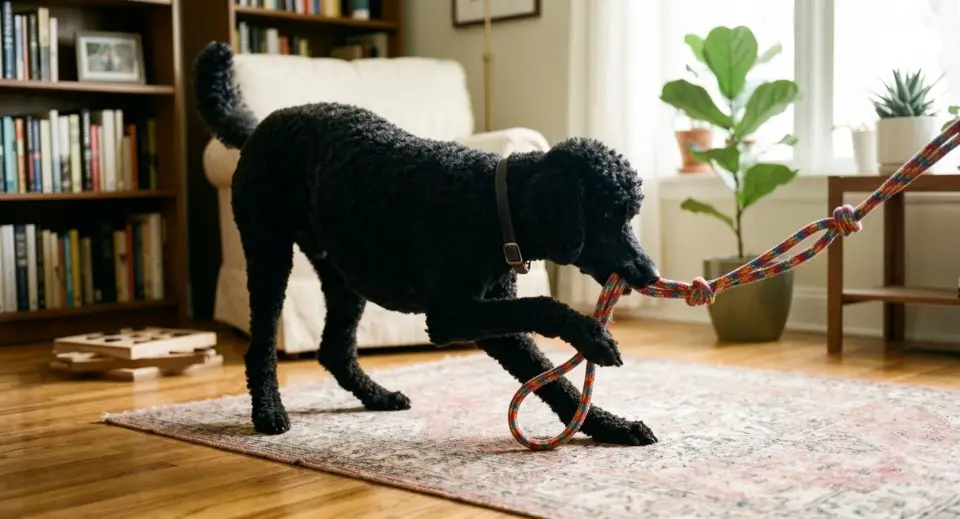
To conclude this guide, we’ve addressed the most common questions from our community. These answers summarize the core principles of Poodle ownership: Consistency, Mental Engagement, and Emotional Respect.
Why is my Poodle so clingy? (The “Velcro Dog” Effect)
Poodles are famously “Velcro dogs” because they were bred for intense human partnership. This behavior is a sign of their high emotional intelligence and desire for “work-play” synchronization with their owner. While endearing, extreme clinginess can escalate into Separation Anxiety if the dog isn’t taught “Place” training. We recommend the “Independence Protocol”—rewarding your Poodle for staying in another room for increasing durations—to ensure their loyalty doesn’t turn into distress.
Can a Poodle be a guard dog?
A Poodle is an excellent Watchdog, but typically not a Guard Dog. They are exceptional at “alerting” you to a perimeter breach with a sharp, intense bark, but they lack the natural “protection drive” or physical aggression of a Doberman. Standard Poodles, due to their size, are the most effective watchdogs, providing a formidable bark that serves as a powerful deterrent.
Do Poodles ever calm down?
Most Poodles begin to “settle” and show emotional maturity between 18 and 24 months of age. However, they will only “calm down” if their daily Metabolic Reset (physical exercise) and Cognitive Burn (mental puzzles) are met. An under-stimulated 5-year-old Poodle can act just as hyperactive as a 6-month-old puppy.
Why does my Poodle bark at other dogs on leash?
Leash barking is usually “Barrier Frustration” or Leash Reactivity. Because Poodles are highly social, being restricted by a leash while seeing another dog creates a “conflict” in their brain. According to the American humane society, using the “Look at That” (LAT) Method to reward neutrality is the most effective way to solve this.
Conclusion: Living with a Genius
Owning a Poodle is a unique experience that requires a shift in mindset. You aren’t just “owning a dog”; you are entering a Genius Partnership.
When you stop trying to “dominate” your Poodle and start trying to “employ” them, the behavioral problems that plague other owners—the barking, the anxiety, and the stubbornness—begin to disappear. By utilizing the Metabolic Reset and the Independence Protocol, you are providing the structure your Poodle needs to thrive in a human world.
Discover the Poodle Behavior Resource Hub
Unlock your dog’s keen intellect and solve complex communication hurdles with training strategies developed specifically for the Poodle mind. Head over to our [Poodle Behavior & Training Manual] for research-based routines and cognitive solutions, or explore these curated topics:
- How to Get a Poodle to Stop Barking: The Ultimate Guide [2026 Update]
- How Long Can Poodles Be Left Alone? [2026 Guide to Timing & Anxiety]
- Do Poodles Like Water? The Ultimate Swimming & Safety Guide
- Do Poodles Howl? The Cause, It’s Meaning, and When to Worry
Medical Disclaimer & Veterinary Consultation
Important Safety Note: While this guide provides researched nutritional insights, it is not a substitute for professional medical advice. Every dog’s biological profile and digestive sensitivity is unique. You must always consult your veterinarian before introducing cheese or any new human foods into your Poodle’s routine. Your vet is the only resource capable of determining if a specific treat is safe for your dog’s unique health history, ensuring their diet remains balanced, healthy, and free from risk.