

Disclaimer: The information provided on PoodleReport.com is for educational purposes only and does not constitute veterinary medical advice; always consult your vet before changing your dog’s diet. Additionally, this post contains affiliate links. As an Amazon Associate, and other affiliate advertising programs, I earn from qualifying purchases at no extra cost to you.
Owning a Poodle is a bit like living with a tiny, curly-haired professor. They are sophisticated, observant, and usually very fastidious. If your normally clean companion has suddenly started treating your favorite rug like a fire hydrant, it’s rarely a case of the dog being “bad” or “stubborn.” In fact, Poodles are the second smartest breed in the world, which means they don’t just “forget” the rules of the house.
Poodles usually pee in the house because of hidden medical issues like Addison’s Disease or emotional triggers like excitement and submissive urination. Because Poodles are exceptionally intelligent, they rarely “forget” their house training; instead, a physical problem or a stressful environment usually causes the behavior. To fix it, owners should rule out adrenal issues (like the Sodium-Potassium ratio), use enzymatic cleaners to remove old scents, and manage the dog’s excitement levels during greetings.
When a Poodle has an accident, they are usually sending an SOS. They are experiencing a “system error,” either in their body or their environment. As a researcher who spent years studying the quirks of my own Standard Poodle, Angus, I’ve learned that a little investigation goes much further than a loud scold.
Poodles value their dignity; yelling only adds anxiety to a “system error.” To decode these social signals, visit My comprehensive list of Poodle Behavior Guides. Today, we’re researching the variables behind the puddles—from metabolic hardware issues to the forensic way your dog “reads” your floor’s chemical history.
The Root Cause: Is it the Body or the Brain?
In the world of animal behavior, we have to distinguish between a physical problem and a behavioral one. I like to think of this as the “Hardware vs. Software” rule. Poodles are stoic. They are the “stiff upper lip” of the dog world and will often hide physical pain to keep up appearances. This means a puddle in the hallway might be the only way your dog can tell you that something is wrong inside.
Before you try to “re-train” your dog, you must be absolutely sure they are physically capable of holding it. If your Poodle has a Urinary Tract Infection (UTI) or bladder stones, no amount of positive reinforcement will help. It’s like trying to fix a leaky pipe by giving the house a fresh coat of paint—it doesn’t address the structural issue. In my work with Angus, I found that his rare accidents were almost always tied to a physical trigger he couldn’t control.
The Health vs. Habit Matrix
| The Clue | Likely a Health Issue (Body) | Likely a Behavioral Issue (Brain) |
| The Timing | Sudden, random, and frequent | Happens when guests arrive or during storms |
| The Volume | Floods or constant leaking | Small “targeted” marks or dribbles |
| The Thirst | Drinking much more than usual | Normal water intake |
| The Look | Surprised, dazed, or confused | Ears back, tail tucked, “guilty” look |
| The Physicals | Shaking, lethargy, or weakness | Pacing, whining, or staring |
The Medical Suspects: Addison’s and Cushing’s Disease

Poodles are prone to specific hormonal issues that act like a “broken faucet” in their bodies. If your Poodle’s internal thermostat is off, their kidneys can’t do their job.
The Addison’s Connection
Standard Poodles are genetically predisposed to Addison’s Disease. This happens when the adrenal glands don’t produce enough of the hormones that balance salt and water. When this balance is lost, the kidneys essentially “dump” water. Your Poodle isn’t choosing to pee in the house; their body is physically unable to hold onto the liquid.
The most important marker for this is the Sodium-Potassium Ratio. If you have your Poodle’s bloodwork, you can actually see this for yourself. In a healthy Poodle, the ratio of Sodium (Na+) to Potassium (K+) should be between 27:1 and 40:1.
Ratio=[K+][Na+]
If that number is below 27, it is a major red flag for Addison’s. Your dog isn’t being “naughty”—they are in a medical crisis. You can find more on this from the Colorado State University Veterinary Hospital.
The Cushing’s Variable
On the other side, older Poodles often deal with Cushing’s Disease, where the body makes too much cortisol. This leads to “extreme thirst.” If your dog is drinking the bowl dry and then peeing ten minutes later, you aren’t dealing with a training problem; you’re dealing with a hormonal overload. VCA Animal Hospitals notes that “pot-bellied” appearances often accompany this condition.
Senior Poodles and the “Mental Fog”
As Poodles get older, they can develop Canine Cognitive Dysfunction (CCD), which is very similar to Alzheimer’s in humans. I call this the “Senior System Error.” Poodles are so intelligent that when their memory starts to fade, it can be especially distressing for them.
A senior Poodle might stand in a corner and “stare” at the wall, forgetting where they are or how to get to the back door. This disorientation often gets worse at night (known as “Sundowning”). They might wake up at 3 AM and pee in the middle of the room because the “map” in their head of where the bathroom is has temporarily disappeared. The Purina Institute has done great research on how certain oils (MCTs) can help “re-fuel” an aging Poodle’s brain to help clear this fog.
Emotional Accidents: Submissive and Excitement Urination
If your Poodle is young and healthy, the “leak” is often emotional. Poodles are incredibly sensitive to your energy. They are like sponges for human emotion.
- Submissive Urination: This is a Poodle’s way of saying, “I’m not a threat! Please don’t be mad!” It usually happens when you stand over them, look them directly in the eye, or use a deep, booming voice. To a sensitive Poodle, this is a scary moment, and they “leak” to show they are peaceful. The AVSAB warns that scolding a dog for this only makes them more anxious, which leads to more peeing.
- Excitement Urination: This is the “Happy Leak.” It happens when the brain is so overwhelmed with joy (like when you get home from work) that it forgets to tell the bladder to stay closed. With Angus, I solved this by using “Low-Arousal Greetings.” I wouldn’t even look at him or speak to him until his heart rate slowed down and he was calm. Only then did I lean down for a quiet pat.
The Excitement Scale
| Energy Level | The Behavior | Risk of a Leak |
| Zen | Laying down, slow breathing | 0% |
| Interested | Head tilted, tail wagging slowly | 10% |
| Wiggly | Jumping, “Poodle dancing,” whining | 50% |
| Overdrive | Zoomies, frantic licking, barking | 95% |
The “Stress Shredding” Connection
Have you noticed that your Poodle is peeing in the house and suddenly shredding your napkins or mail? This isn’t a coincidence. When a Poodle is stressed about house training or their environment, they often look for a way to soothe themselves. For many, that “soothing” comes through their mouths.
This is a displacement behavior. If they feel anxious, they might shred a tissue box to burn off that nervous energy. If your dog is doing both, you’re likely looking at a high-stress environment. You can read my full study on why your Poodle is eating paper and napkins to see how stress links these two habits together.
Small Spaces and Apartment Living

If you live in a high-rise, the “math” of house training changes. If your Poodle has a small bladder and you have a slow elevator, you have a problem. Suburban dogs can be outside in ten seconds; apartment dogs might have a five-minute journey.
Managing a Poodle in a smaller home requires a strategic approach; you can find my full owner’s guide to Poodles in apartments and condos for tips on setting up “emergency” balcony spots. Giving your Poodle a “legal” place to go nearby can actually lower their anxiety, making them better at holding it when you finally do go for a full walk.
The Scent Map and the “Blue Rug” Paradox
Poodles don’t just see your house; they “smell” its history. They have a high-resolution nose that can detect “Ghost Marks”—the tiny, invisible chemical signatures left behind by old accidents.
I once had a rug that Angus loved to pee on. I cleaned it with everything. It looked spotless. But every time the humidity went up, he would go right back to it. I finally used a UV blacklight and realized that a previous tenant’s dog had marked that rug years before. To Angus, that rug was a “public restroom” because the old scent told his brain it was a safe spot.
Standard soaps don’t work because they don’t break down the uric acid crystals. You need an enzymatic cleaner that actually “eats” the proteins. The AKC is very firm about this: avoid anything with ammonia, because urine is ammonia. If you clean with it, you’re basically putting up a neon sign that says “Pee Here!”
Modern Tools: Using Technology as “Extra Eyes”
In 2026, we have tools that can help us catch accidents before they happen. You don’t need to be a tech genius to use them; they are just “helpful eyes” for when you’re busy.
- Smart Cameras: Many modern pet cameras have “AI detection.” They can recognize when a dog is “circling” or “pacing” in a way that suggests they need to go. They’ll send a little “ding” to your phone so you can get them outside in time.
- Biometric Collars: Some collars track how much your dog is pacing or if their heart rate is spiking. If your dog is suddenly active in the middle of the night, it’s a good sign they need a bathroom break.
- Smart Gates: You can use simple electronic gates to keep your Poodle out of “high-risk” rooms (like the guest bedroom) until they have a few weeks of “dry data” under their belt.
The Plan for a Dry Home: 5 Easy Steps
To fix the issue, we need a simple, consistent plan. Poodles love routines—it makes them feel safe.
The 5-Step Logic
| Step | What to Do | Why it Works |
| 1 | Enzymatic Cleaning | Erases the “scent map” so the dog doesn’t get confused. |
| 2 | Limit Space | Keeps the dog in the same room as you so you can catch the signs. |
| 3 | Check Nutrition | Adds calming nutrients like Magnesium to lower stress. |
| 4 | The 2:1 Rule | Give two potty breaks for every “risky” hour. |
| 5 | Calm Hellos | Prevents the excitement leaks during greetings. |
The Resolution Protocol: 5 Practical Steps to Stop the Leaks
Understanding the “why” is a researcher’s joy, but drying the carpet is an owner’s priority. Identifying a “system error” is only half the battle; the real work lies in executing a clean, data-driven patch that preserves your Poodle’s dignity.
This protocol moves us from theory into practice, providing five actionable steps to recalibrate your Poodle’s internal and external systems through environmental engineering rather than bossing.
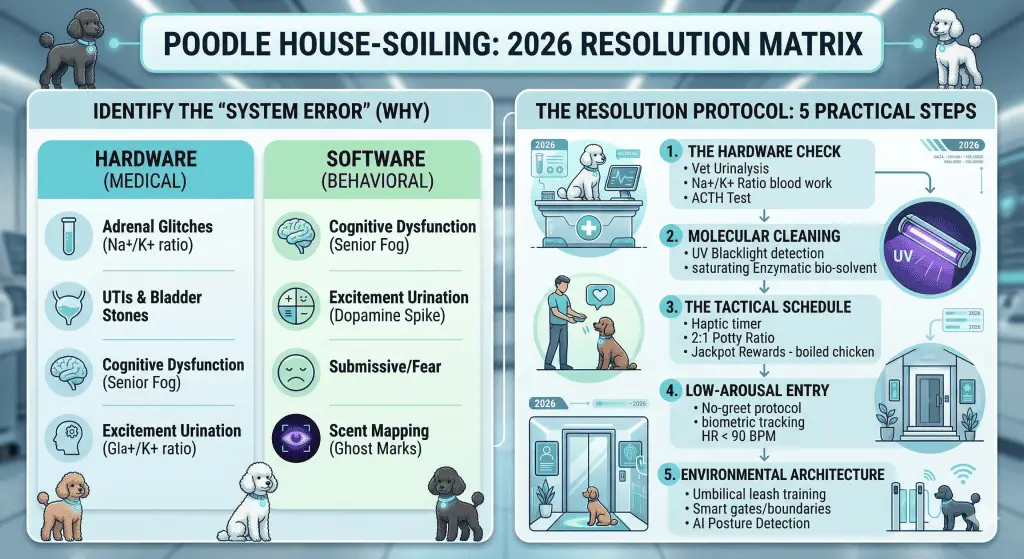
Step 1: The Hardware Check (The Vet Visit)
Before you try a single training trick, you must prove your Poodle is physically capable of holding it. Poodles are stoic—they often hide pain to keep up appearances. A puddle is frequently their only way to signal a physical failure.
- What to do: Schedule a vet appointment for a urinalysis and a blood panel. Specifically, ask to rule out Urinary Tract Infections (UTIs) or bladder stones.
- The Adrenal Variable: If your Poodle is drinking significantly more water than usual, ask for an ACTH Stimulation Test. Poodles are prone to Addison’s Disease, which causes the kidneys to “dump” water regardless of training.
- The Researcher’s Metric: If you have bloodwork in hand, check the Sodium-Potassium ratio. If the ratio is below 27, the problem is medical, not behavioral. You need a prescription, not a leash.
Step 2: Molecular Cleaning (Wiping the Scent Map)
Poodles don’t just see a room; they “read” its history with their nose. If a spot on your carpet still smells like a bathroom to them at a molecular level, their brain tells them it is a bathroom.
- What to do: Buy a UV blacklight and an industrial-grade enzymatic cleaner.
- The Technique: Turn off the lights and use the UV light to find “Ghost Marks.” Even if a spot looks clean, the UV light will reveal dried proteins.
- The Rule: Avoid ammonia-based cleaners. Since urine contains ammonia, cleaning with it is essentially putting up a “Pee Here” neon sign for your dog.
- The Angus Method: When Angus had a senior-year relapse, we discovered he was returning to a specific spot on a blue rug. We had to saturate the area with enzymes and let it sit for 24 hours to fully dissolve the uric acid crystals. Once the UV signature hit zero, the habit broke.
Step 3: The 2:1 Success Ratio (The Tactical Schedule)
A Poodle’s brain learns through successful data sets. To overwrite the memory of “Indoor Accidents,” you must flood their memory with “Outdoor Success.”
- What to do: Set a haptic timer on your smartwatch for every 2 hours.
- The Rule: For every 1 hour you expect them to hold it, provide 2 opportunities for success. If they are currently having accidents every 4 hours, you must intercept them at the 2-hour mark.
- The Jackpot Reward: Use a “High-Value” reward—like boiled chicken or freeze-dried liver—that they only get for going outside. This creates a powerful positive data point in their neural mapping.
Step 4: The Low-Arousal Entry (Greeting Protocol)
Excitement urination is a software glitch where the brain’s joy overrides the physical signal to hold the bladder. This is very common in sensitive, high-intelligence breeds.
- What to do: Implement a “No-Arousal” entry for the first 5 minutes you are home.
- The Technique: When you walk through the door, do not look at, speak to, or touch your Poodle. I know it’s hard, but your energy is the trigger for the leak.
- Biometric Interception: In 2026, we use tech to monitor the “surge.” Check your Poodle’s smart collar; do not offer pets until their heart rate drops below 90 bpm. Once they are biologically calm, offer a quiet chin scratch.
Step 5: Control the Laboratory (Management)
If you cannot actively watch your Poodle, they should not have the “freedom” to fail. You must manage their environment until the new “Outdoor Only” software is fully installed.
- What to do: Use Umbilical Training. Keep your Poodle on a 6-foot leash attached to your belt while you are home.
- The Benefit: This ensures they stay within your “sensor range.” You will see the “Pre-Potty Posture”—a specific 30° spinal arch—the second it starts, allowing you to intercept and lead them outside immediately.
- Smart Boundaries: Use Matter-integrated smart gates to block off “High-Risk Zones” (like carpeted bedrooms) until you have recorded 14 days of clean data in your tracking app.
Troubleshooting the “System Errors”
| Problem | Potential Root Cause | Practical Fix |
| Rainy Day Accidents | Surface Preference Error | Use dog boots or a covered potty area. |
| Peeing when Scolded | Submissive Urination | Stop scolding; focus on confidence building. |
| Marking New Furniture | Territorial Stress | Use enzymatic spray; increase mental enrichment. |
| Nocturnal Accidents | Senior Cognitive Decline | Consult vet about MCT oil diets or Senior Care. |
Frequently Asked Questions (FAQ)

Q: Why does my Poodle only pee on the rug and never on the hardwood? A: Poodles are very clean animals. They don’t like it when urine “splashes” back on their legs or paws, which happens on hard floors. Rugs absorb the liquid and the splash, making it a much more “pleasant” experience for them—even if it’s a nightmare for you.
Q: Can a UTI make my dog act mean? A: Yes! Pain makes everyone cranky. If your sweet Poodle is suddenly snapping or growling and having accidents, they are likely in pain. See a vet immediately.
Q: Is my dog being spiteful? A: No. Dogs don’t have the “spite” software. They live in the moment. If they pee when you leave, it’s usually Separation Anxiety, not a plan to get back at you.
Q: How long does re-training take? A: If it’s behavioral, expect 2 to 3 weeks of strict routine to “reset” their brain. If it’s medical, it should stop as soon as the medication kicks in.
Conclusion: Engineering Peace
Solving house soiling in Poodles isn’t about being a “boss”; it’s about being a researcher. Once you rule out health issues like Addison’s and learn to manage their sensitive emotions, your Poodle will naturally want to keep their home clean. They value their dignity just as much as you value your rugs.
By following the 2:1 rule and using the right cleaners, you aren’t just fixing a habit—you’re building a deeper bond of trust with your dog. For a full dive into the Poodle psyche, you can always check out My Ultimate Guide to Poodle Behavior.
Medical & Veterinary Disclaimer: PoodleReport.com is an informational resource for Poodle owners and enthusiasts. We are not veterinarians. The content on this website is not a substitute for professional veterinary care, diagnosis, or treatment. Always seek the advice of your veterinarian with any questions you may have regarding your pet’s medical condition, diet, or overall health.