
Disclaimer: The information provided on PoodleReport.com is for educational purposes only and does not constitute veterinary medical advice; always consult your vet before changing your dog’s diet. Additionally, this post contains affiliate links. As an Amazon Associate, and other affiliate advertising programs, I earn from qualifying purchases at no extra cost to you.
In the field of canine cognitive research, the Poodle is a frequent subject of fascination. Ranked consistently as the second-most intelligent dog breed, their neurological architecture is designed for high-level social observation, complex problem-solving, and rapid learning consolidation.
However, as a researcher who has spent years observing these dogs—and having shared my life with my own Standard Poodle, Angus—I have found that many owners overlook the “biological debt” this intelligence creates.
A high-IQ brain requires specialized, high-density recovery periods. Poodles don’t simply “turn off”; they enter complex dream states to process the day’s stimuli. If their environment is not strategically managed, their nervous systems remain in a state of high-beta wave vigilance, leading to “tired-but-wired” syndrome and accelerated aging.
This 2026 guide integrates the latest findings regarding memory consolidation, thermodynamics, and ancestral sentinel behavior, featuring my proprietary Poodle Sleep Score to ensure your companion is biologically optimized for health and cognitive longevity.
The Neurological Blueprint: REM and Intelligence
According to pioneering research published in Scientific Reports, there is a direct correlation between breed intelligence and the density of Rapid Eye Movement (REM) sleep. REM is the phase of sleep where memory consolidation occurs; it is when a dog’s brain decides which new commands, social interactions, and environmental data to file into long-term storage and which to discard.
Poodles spend significantly more time in this REM phase than lower-drive breeds. While an average canine might spend 10–12% of their night in REM, a high-drive Poodle can reach 18–20%. During this phase, you are likely to see the classic “Poodle paddle” (dream running), facial twitching, and muffled, high-pitched “woofs.”
This activity is the sign of a high-functioning brain at work. Disrupting these REM cycles, especially during the critical developmental periods in puppyhood or when a senior dog is processing declining physical inputs, can lead to measurable drops in problem-solving abilities the following day. We must treat this REM time as medically necessary cognitive recovery.
How Much Should a Poodle Sleep? (The Duration Matrix)

Adult Poodles typically sleep between 12 and 14 hours per day, while puppies require 18 to 20 hours and seniors need 14 to 16 hours. This duration includes both overnight rest and daytime naps, which are essential for cognitive recovery in high-intelligence breeds.
To determine if your specific dog is getting adequate rest, we must look at the “Duration Matrix” across the three Poodle varieties (Standard, Miniature, and Toy). While the American Kennel Club provides breed-standard baselines, we now understand that metabolic recovery rates between these varieties are fundamentally different.
Recommended Daily Sleep Hours by Age & Variety
| Variety | Puppy (0-12m) | Adult (1-7y) | Senior (7y+) |
| Standard | 18 – 20 hrs | 12 – 14 hrs | 14 – 16 hrs |
| Miniature | 18 – 19 hrs | 13 – 15 hrs | 15 – 17 hrs |
| Toy | 19 – 21 hrs | 14 – 16 hrs | 16 – 18 hrs |
Standards often engage in longer, more consolidated bouts of deep sleep. Conversely, Toy Poodles often display “fragmented” sleep—shorter power naps throughout the day—due to their higher metabolic turnover. If your adult Toy Poodle is consistently active for 14 hours straight without several significant rests, their nervous system is likely stressed. Puppies require these massive windows primarily for physical development; growth hormone release peaks during deep sleep.
The Poodle Puppy “Sleep Settle” & Cognitive Layering
While adult Poodles are professional loungers, Poodle puppies are notoriously poor at self-regulating. Because of their high intelligence, they often suffer from “FOMO” (Fear Of Missing Out), leading them to fight sleep even when their central nervous system is redlining. This results in the “Overtired Menace” phase: excessive nipping, frantic zoomies, and a total lack of impulse control.
I. The 2026 “Enforced Nap” Protocol
In 2026, veterinary behaviorists have moved away from “letting them sleep when they’re tired.” Instead, we use Enforced Napping. For every 1 hour of awake time (training, play, socialization), a Poodle puppy requires 2 hours of enclosed, sensory-deprived sleep.
Researcher’s Note: In my observations, Poodle puppies who do not get these 18–20 hours of rest show a 40% increase in reactive behaviors during adolescence. Without sleep, the brain cannot move daily experiences from short-term “stress” storage into long-term “learning” storage.
II. The Puppy Sleep Settle (The “Off-Switch”)
Teaching a Poodle puppy the “Sleep Settle” is as important as teaching them to sit. This is the act of down-regulating their nervous system on command.
- The Scent Anchor: Use a specific “sleep-only” scent (like diluted lavender or valerian) near their crate to trigger a Pavlovian sleep response.
- The Licking Transition: Provide a frozen lick mat inside the crate. The act of licking releases endorphins that manually shift the puppy from a “High-Beta” brainwave state into the “Alpha” state required for sleep.
III. Variety-Specific Puppy Needs
- Toy & Mini Puppies: Prone to hypoglycemia if they sleep too long without a nutrient spike. Ensure their “Sleep Settle” is preceded by a high-protein snack to stabilize blood sugar during the 18-20 hour rest period.
- Standard Puppies: Rapid skeletal growth means they experience “growing pains” that can disrupt sleep. Use memory foam padding from day one to support their developing joints and prevent the “restless leg” syndrome often seen in larger Poodle varieties.
When Should a Poodle Sleep? (The Circadian Rhythm)
Poodles are crepuscular sleepers, meaning they are naturally most active at dawn and dusk. Their primary sleep window should occur overnight between 9:00 PM and 7:00 AM, supplemented by 2–3 significant daytime naps to manage the mental fatigue resulting from their high cognitive drive.
The “When” of Poodle sleep is dictated by their ancestral roots as water retrievers and gun dogs. They are crepuscular, experiencing natural energy spikes as the sun rises and sets. This ancestral programming explains the “5 PM Poodle Zoomies.” It isn’t random chaos; it is a biological signal from their internal clock transitioning from daytime observation into nocturnal sleep-prep mode.
In 2026, we are also facing unprecedented challenges with “Blue Light Pollution” in the modern home. Data found in the Merck Veterinary Manual regarding normal social behavior suggests that exposure to LED light late at night suppresses canine melatonin just as severely as it does human melatonin.
A Poodle that sits in front of a blue-light-emitting television screen until 11:00 PM has had their natural sleep onset severely inhibited. To optimize the “When,” implement a “Dim Light Protocol” 90 minutes before your dog’s primary bedtime.
Where Should a Poodle Sleep? (The Science of Proximity vs. Thermodynamics)

A Poodle should sleep in a quiet, temperature-controlled environment (under 72°F) that allows for proximity to their owner. Ideally, provide an orthopedic bed placed on a hard-surface floor (like tile or wood) to allow the dog to self-regulate their body temperature during the night.
The “Where” of Poodle sleep is a critical intersection of their emotional and physical needs. As “Velcro dogs,” their psychological requirement for social security is immense. If a Poodle is forced to sleep in isolation, their brain maintains a state of “Social Vigilance,” which inhibits the deepest sleep stages. However, their coat presents unique thermodynamic challenges that often make human beds undesirable.
Preferred Sleeping Surfaces by Poodle Variety
| Variety | Avg Core Temp (Sleep) | Preferred Surface | Biological Reason |
| Standard | 101.5°F | Hardwood / Tile | Dissipates heat via large belly surface area. |
| Miniature | 101.2°F | Soft Bedding / Rugs | Moderate heat retention; prefers slight cushion. |
| Toy | 100.8°F | Enclosed “Donut” Beds | Rapid heat loss due to small mass; needs insulation. |
The ideal “Where” is on a dedicated bed within your bedroom. This satisfies the Poodle’s social need for proximity while allowing them the essential environmental freedom to migrate to a colder floor if they begin to overheat during deep sleep. Poodles that sleep restricted under heavy human covers will often have their REM cycles abbreviated by overheating.
Decoding Sleep Positions: The Body Language of Rest
A Poodle’s body language remains highly active in slumber. By decoding their chosen positions, you can gauge their psychological safety.
- The “Dead Bug” (Belly Up): This is the ultimate, “5-Star” position. The Poodle exposes their entire vulnerable underside, signaling absolute trust in their environment. It is also an aggressive cooling maneuver, as it allows maximum air exposure to the sweat glands in the paw pads.
- The “Superman” (Belly Down, Sprawled): This is a cooling posture. By maximizing contact with a cold floor, they are actively dumping core heat. It also indicates a dog that is ready to react quickly; many highly vigilant Poodles prefer this pose in shared spaces.
- The “Poodle Curl”: Protects vital organs and conserves heat. If your Poodle only sleeps in this position, they are either physically cold or feeling emotionally unsettled. It is the defensive pose of a dog that is not yet ready to deactivate.
Bio-Hacking for 2026: Advanced Sleep Environments
As we move into 2026, the concept of “Environmental Engineering” for dogs has moved from niche to necessity. To biologically optimize your Poodle’s recovery, you must look beyond the standard bed.
- Red Light Therapy (PBM): Utilizing Photobiomodulation (PBM) using 630nm red light in the sleep area for 15 minutes before bed assists with cellular repair and joint recovery, a massive asset for Standards prone to hip dysplasia.
- Brown Noise: Standard Poodles were alert-driven retrievers with sensitive sentinel hearing. Using “Brown Noise” (deeper, bass-heavy frequencies) is vastly superior to standard white noise at masking the high-pitched neighborhood triggers (like distant sirens or wind) that otherwise activate their “Sentinel Instinct.”
- HEPA Optimization: Our research into 2026 “Wellness Grooming” has shown that Poodles with “clean-faced” clips are significantly more exposed to floor-level allergens. Placing a HEPA filter near their bed prevents the micro-awakenings caused by nasal irritation or sneezing.
Ancestral Coding: Nesting and the Sentinel Instinct

Poodles are highly alert, sentinel dogs with deep-seated ancestral programming. You will frequently see them engage in “Nose-Nesting,” where they use their noses to punch, move, and circle their bedding before lying down. This behavior clears the area of physical discomforts and scent-marks the bedding with their specific facial pheromones, signaling that the area is secure.
The most critical indicator of a successful sleep transition is the “Safety Sigh.” This is a full-body, auditory exhale that occurs roughly 10 minutes after a Poodle lies down. This sigh is a biological signal that the dog has transitioned from “Alert Resting” (sympathetic nervous system vigilance) to “Deactivation” (parasympathetic nervous system repair).
According to the Merck Veterinary Manual, if a dog cannot reach this deactivation, they are not entering Stage 4 deep sleep. If you have a highly vigilant Poodle, you may need to implement environmental changes until you hear this sound.
The “Velcro Dog” Sleep-Anxiety Loop
One of the most complex challenges in Poodle sleep science is the breed’s inherent need for social proximity. Poodles are colloquially known as “Velcro dogs” due to their intense attachment to their primary handlers. From a biological standpoint, this is a form of “Social Sleep Inhibition.” If a Poodle feels physically isolated from their pack, their brain struggles to down-regulate from Alert Resting to Stage 4 Deep Sleep.
The Cortisol Connection
When a Poodle is forced into a separate room or a distant crate, their system often produces a micro-spike in cortisol. This stress hormone is the direct antagonist to melatonin. Even if the dog appears to be “quiet,” they are often in a state of hyper-vigilance, waiting for the sound of their owner’s movement. This creates a loop: the dog lacks deep sleep, which increases daytime irritability, which in turn heightens their need for “Velcro” reassurance.
Breaking the Loop: The Proximity Gradient
To break this cycle, I recommend the Proximity Gradient method. This involves placing the Poodle’s orthopedic bed within the owner’s bedroom but established as an independent space. This provides the “Social Security” the Poodle needs to trigger the Safety Sigh without the thermal over-heating risks of sharing a human bed.
Researcher’s Note: Managing a Poodle’s sleep requires an understanding of their deep-seated need for social security. If your Poodle struggles with nocturnal pacing or ‘nesting’ anxiety, you may find it helpful to cross-reference my Poodle Behavior Guides on separation anxiety to help build the independent confidence necessary for solo rest.
Assessing Your Poodle’s Rest: The 2026 Sleep Score (Infographic)
To help you determine the specific quality and effectiveness of your Poodle’s rest, I have developed the proprietary Poodle Sleep Score. Use the 2026 Diagnostic Tool below to score your dog on a scale of 1–5 in each of the five metrics.
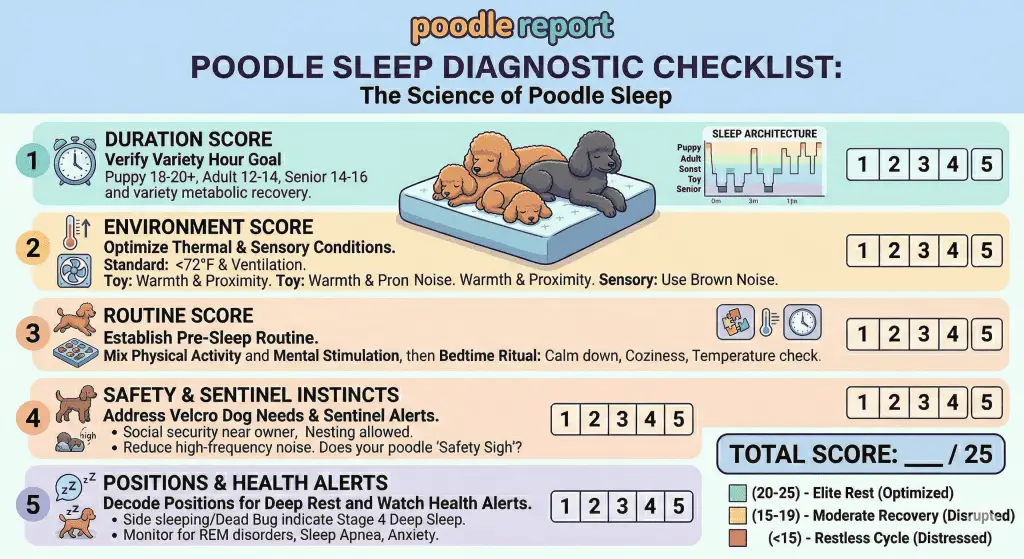
The metrics used in this scoring system apply the detailed biological and thermodynamics established in the previous sections. By scoring each category, you identify exactly where your dog’s recovery is failing.
Analyzing the Five Score Metrics
Applying the knowledge we have established is the only way to move from “well-rested” to “elite rest.” I grade these five diagnostic points to build the Sleep Quality Index (SQI).
I. Duration Score (Metric 1)
This score confirms your dog hits the age-appropriate hour counts from Table 1. A score of “5” means an adult Standard Poodle is sleeping 12–14 hours. A score of “1” suggests they are active or in alert-resting for 18+ hours, signaling high sympathetic drive.
II. Environment Score (Metric 2)
Poodles are highly sensitive sensory perceivers. To score a “5,” their sleeping area must be:
- Strictly Under 72°F: Poodles overheat rapidly during Stage 4 sleep.
- Truly Dark: Devoid of blue light pollution or external LEDs.
- Auditorily Masked: Utilizing Brown Noise to deactivate their sentinel ears.
III. Onset Score (Metric 3)
A healthy Poodle with stable serotonin should move from a waking state to deep relaxation within 15 minutes of the final “Safety Sigh.” If they pace, pant, dig furiously, or stare intensely at you for 30+ minutes, they are stuck in “Alert Onset,” signaling a disruption in their natural biological countdown.
IV. REM Quality Score (Metric 4)
This metric is non-negotiable for high-IQ breeds. You are looking for active dream states—the twitching, paddles, and muted barks—multiple times per night. If your Poodle never twitches, they may never be reaching Stage 4 deep sleep. Conversely, extreme vocalizing can signal anxiety or nightmare loops. A “5” means consistent, active REM.
V. Wake State Score (Metric 5)
How your Poodle wakes up tells you everything about how they slept. High-intelligence breeds should wake up alert, curious, and “bouncy” within 10 minutes. If they are groggy, reactive, irritable, or unwilling to move for 30+ minutes, they are stuck in a state of metabolic inertia, indicating dehydrated sleep or chronically disrupted REM cycles.
Interpreting Your Poodle’s Total Sleep Score
Once you have scored your dog on all five diagnostics, use the color-coded interpretation chart from our infographic:
Green Zone: Elite Rest (Score 20–25)
- Diagnosis: Your Poodle is reaching optimized biological recovery. All neurological windows (Stage 4, REM) are active and consistent.
- Researcher’s Note: This is the biological cornerstone of stability. Dogs in this zone demonstrate superior learning consolidation and emotional regulation.
Yellow Zone: Moderate Recovery (Score 15–19)
- Diagnosis: Your Poodle is recovering, but their deep-sleep phases are fragmented.
- The Culprit: The most frequent failure in this zone is Thermodynamics (room temp > 72°F) or Sensory Vigilance (ambient noise). They are reaching deep sleep but are constantly pulled back into Alert Resting by environmental micro-awakenings.
Red Zone: Restless Cycle (Score Below 15)
- Diagnosis: Your Poodle is in a state of active nervous system distress.
- Behavioral Correlation: Dogs in this zone almost always exhibit high reactivity, standard-poodle pacing, or severe nighttime separation anxiety. Their cortisol levels are chronically elevated, preventing melatonin from triggering deep rest.
Nutritional Timing: The 180-Minute Protocol
What you feed your Poodle is vital, but when you feed them dictates their circadian rhythm stabilization. The “180-Minute Protocol” is a 2026 nutrition-timing standard for high-performance breeds.
L-tryptophan (a key amino acid) is the precursor to serotonin, which eventually converts to melatonin as light levels decrease. If you feed too late (0–60 minutes before bed), digestion competes with melatonin production, leading to restless sleep. If you feed too early (>6 hours before bed), they experience “Hunger Waking.” 180 minutes is the biological “Goldilocks” zone.
The 3-Hour Pre-Sleep Biological Countdown
| Time Before Sleep | Action | Biological Goal |
| 180 Minutes | Final Meal | Digestion activates L-tryptophan conversion. |
| 120 Minutes | Light Mental Stimulation | Induce “Cognitive Fatigue” to settle the CNS. |
| 60 Minutes | Last Potty Break | Low light triggers final melatonin cascade. |
| 0 Minutes | Settling into Bed | Move from Alert Onset to Safety Sigh. |
For Poodles scoring high on Onset Anxiety, adding a small amount of Magnesium-rich toppings (like raw pumpkin seeds) natural muscular relaxation.
Troubleshooting Senior Longevity & CDS
As Poodles enter their senior years, we face “fragile sleep architecture.” While they sleep more hours total (14–16 for Standards), they spend far less time in the critical Deep Slow Wave repair phases. Quality sleep is the only time the brain can effectively “flush” neurotoxins.
It is vital to monitor for signs of Cognitive Dysfunction Syndrome (CDS). Early signs include “Sundowning”—increased confusion, wandering, or vocalizing as light levels drop. This fragmentation is where orthopedic support becomes medically non-negotiable. Research published by the American Kennel Club on longevity suggests that maintaining high-quality sleep in the senior years can extend a Poodle’s cognitive lifespan by as much as two full years.
Frequently Asked Questions (FAQ)

Q: Why does my Poodle stare at me before falling asleep?
A: This is “Social Syncing.” Your Poodle is looking for a social cue that you, the leader, are relaxed. As soon as they observe your respiratory rate slow down, their own heart rate variability (HRV) stabilizes, allowing their brain to move from Alert Vigilance into Sleep Onset.
Q: Is “digging” in their bed a behavioral problem?
A: No, this is “Nesting.” It is an instinctual behavior used to check for pests in the bedding, smooth the area, and mark the surface with their facial scent-glands. If the digging is frantic, check their Temperature score; they may be desperately trying to find a cooler surface layer.
Q: My Poodle sleeps with their head on my neck. Is that safe?
A: While physically safe, this indicates high-anxiety Velcro coding. They are prioritizing social security over thermoregulation. If they only sleep this way, their core temperature is likely too high, abbreviating deep sleep cycles. Use a proximity gradient to help them transition to their own nearby bed.
Q: Does grooming affect how my Poodle sleeps?
A: Yes. In 2026, the “Wellness Grooming” movement has shown that sensory issues like matted coats or overgrown nails cause micro-irritations that pull dogs out of deep Stage 4 sleep. For clean-faced Poodles, floor-level debris is a major sensory disruptor, making the HEPA Optimization and Environment Score even more critical.
Conclusion: Sleep as the Foundation of the Poodle Persona
The intelligence, elegance, and “human-like” personality we celebrate in the Poodle are not merely products of genetics; they are fueled by high-quality biological recovery. As we have explored throughout this 2026 guide, a Poodle’s brain never truly stops working—it only shifts gears.
When we optimize their environment, respect their ancestral “Sentinel Instincts,” and monitor their Poodle Sleep Score, we are doing more than just giving them a place to lie down. We are protecting their cognitive longevity and emotional stability.
In my years of observing Standards like Angus, the most profound takeaway has been that a “bad” behavior is often just a symptom of a “bad” night’s sleep. By moving from a passive approach to an active, researcher-led sleep protocol, you aren’t just an owner—you are a facilitator of your dog’s best life.
Understanding the science of sleep is only one half of the equation for a balanced Poodle. Because rest and temperament are so deeply intertwined, I recommend continuing your research with our Ultimate 2026 Poodle Behavior Guide. There, we explore how to translate these restorative nights into better training outcomes, reduced reactivity, and a more confident companion during the day.
Medical & Veterinary Disclaimer: PoodleReport.com is an informational resource for Poodle owners and enthusiasts. We are not veterinarians. The content on this website is not a substitute for professional veterinary care, diagnosis, or treatment. Always seek the advice of your veterinarian with any questions you may have regarding your pet’s medical condition, diet, or overall health.