
Disclaimer: The information provided on PoodleReport.com is for educational purposes only and does not constitute veterinary medical advice; always consult your vet before changing your dog’s diet. Additionally, this post contains affiliate links. As an Amazon Associate, and other affiliate advertising programs, I earn from qualifying purchases at no extra cost to you.
Let’s be honest: in a world of “designer everything,” choosing a dog can feel a bit like scrolling through an endless app—lots of cute faces, but which one actually fits your life long-term? When my Poodle, Angus, was with me, I saw firsthand that his calm, predictable nature wasn’t just a lucky break. It was a specific set of traits literally written into his DNA over hundreds of years.
Today, the big debate for families is often Poodle vs. Doodle. Both share that iconic curly charm, but underneath the fluff, they operate like very different machines. While purebred Poodles represent refined, stable genetics, Doodles are inherently a “genetic coin flip.”
In this guide, we are going to peel back the layers and look past the marketing. By examining the actual skeletal, metabolic, and genetic data that sets these two apart, you will have a clear picture of how they function on a daily basis.
If you want to start decoding your own dog’s unique “operating system” and instincts, check out our full library of Science-Backed Behavior Guides.
Key Takeaways
- The Predictability Factor: Purebred Poodles are a “fixed” breed with stable, highly predictable genetics. Doodles are a first-generation hybrid, meaning their adult size, coat type, and temperament are always a genetic lottery.
- The “Hypoallergenic” Reality: Poodles possess a continuously growing, single-layer coat that traps dander. Doodles often inherit a mixed coat that traps shedding undercoat against the skin, creating an allergen sponge and increasing matting risks.
- Skeletal Mechanics: The Poodle’s “square” frame and compact “cat feet” offer a highly efficient, shock-absorbing stride. Doodles often inherit a heavier, longer back and splayed “hare feet,” making them tire faster during rigorous exercise.
- The Intelligence Paradox: While both are highly intelligent, Poodles possess an analytical, “working” intelligence focused on their owner. Doodles often inherit a high-arousal, easily distracted drive that makes them harder to train in busy environments.
- Health and “Hybrid Vigor”: Mixing two breeds does not guarantee a healthier dog. A Doodle can inherit the combined genetic risks of both parents, making OFA health clearances absolutely vital.
The Ultimate Poodle vs. Doodle Biological Cheat Sheet
| Feature / Trait | Purebred Poodle | Doodle Hybrid (F1/F2) |
| Genetic Profile | Homozygous (Highly predictable) | Heterozygous (A genetic coin flip) |
| Coat Structure | Single-layer, continuous growth | Often mixed (Shedding undercoat + curly top) |
| Allergy Friendliness | Extremely High (Traps dander) | Variable (Can trap allergens against skin) |
| Grooming Intensity | High (Every 6–8 weeks) | Very High (Prone to severe, impacted matting) |
| Ear Anatomy | Hairy canal, but light ear flap | Hairy canal + heavy flap (High infection risk) |
| Skeletal Geometry | Square (1:1 ratio), efficient | Rectangular (Longer back), heavier gait |
| Paw Shape | Compact “Cat foot” (Shock absorbing) | Splayed “Hare foot” (Traps ice and burrs) |
| Swimming Mechanics | Horizontal and naturally buoyant | Vertical and energy-intensive (Rear-heavy) |
| Learning Style | Analytical, observational, focused | Trial-and-error, high-arousal, energetic |
| Distraction Level | Low (Attuned to handler) | High (Attuned to environment / Neophilic) |
| Vision Field | Wide peripheral | Shielded (Blocked by broad skull/facial hair) |
| Alone Time | Independent and emotionally resilient | Prone to “Velcro” separation anxiety |
| Appetite | Excellent self-regulation | Prone to overeating (Labrador POMC mutation) |
| Health Predictability | High (Decades of OFA tracking) | Low (Subject to “Genetic Doubling” of risks) |
Genetic Predictability: Heritage vs. The Hybrid Wildcard
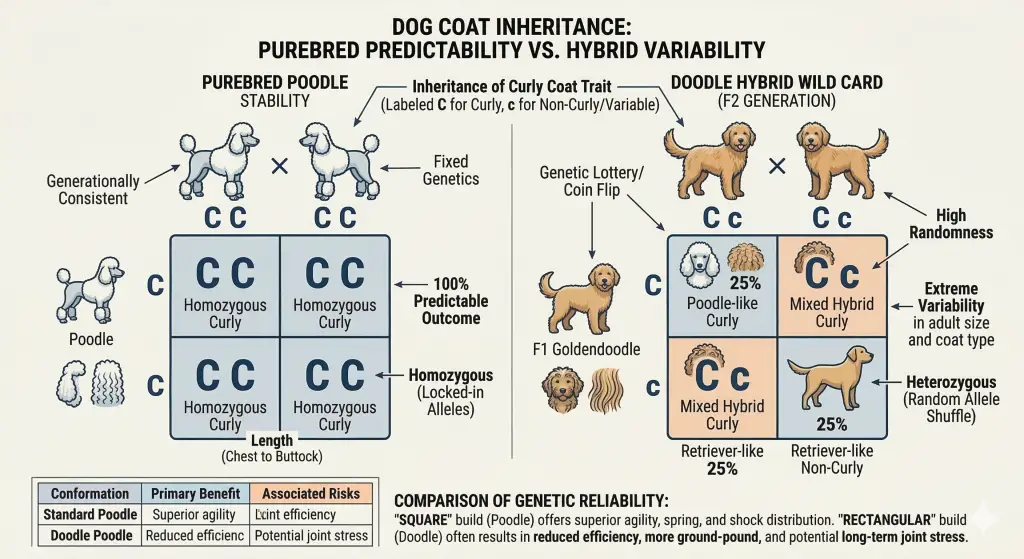
The biggest divide between a Poodle and a Doodle essentially comes down to “knowns” versus “unknowns.” When we look at canine genetics, breeds act like biological roadmaps. Poodles are what we call a fixed breed. Because they have been carefully refined over centuries, their core traits are homozygous—which is just a scientific way of saying their internal “instruction manual” is highly consistent.
When you bring home a Poodle puppy, you aren’t just getting a cute dog; you are getting a highly predictable set of behaviors, adult sizes, and coat types that have been locked in for generations.
Doodles, on the other hand, are the ultimate biological wildcard. When you cross two entirely different breeds, you are essentially tossing two different instruction manuals into a blender. According to the foundational principles of Mendelian inheritance, first-generation (F1) hybrids do not simply “split the difference” right down the middle. Instead, they inherit a random shuffle of alleles.
“Choosing a dog is ultimately a choice between biological predictability and the genetic lottery.”
This genetic lottery explains why one puppy in a Goldendoodle litter might end up with the sleek, shedding fur of a Retriever, while its sibling inherits the Poodle’s tight, non-shedding curls. Without the generations of selective stability that a purebred lineage offers, the Doodle remains a genetic coin flip.
The Genetic Blueprint Comparison
| Trait Blueprint | Purebred Poodle | F1/F2 Doodle Hybrid |
| Genetic Status | Homozygous (Fixed) | Heterozygous (Variable) |
| Adult Coat Type | 100% Predictable | 25% – 75% Variable |
| Size Stabilization | High (Strict Standards) | Wide Range (Hybrid Growth) |
| Trait Reliability | Generationally Consistent | High Randomness |
Daily Life Impact: If you need absolute certainty about your dog’s adult size or shedding level—perhaps due to a strict lease agreement or severe allergies—a fixed breed provides a biological guarantee that a hybrid simply cannot.
The Maintenance Reality
When people talk about the difference between these dogs, the conversation usually stops at “they both need haircuts.” But looking at maintenance as a biological equation reveals a deeper truth. Grooming isn’t just about aesthetics; it is about managing the unique physical biology of the dog you bring into your home.
Coat Physics and the “Hypoallergenic” Spectrum
To understand why Poodles are the gold standard for allergy sufferers, we have to look at the physics of their follicle growth cycle. Most dogs possess a double coat that cycles through the resting and shedding phase relatively quickly. Poodles, however, have a single-layer coat with an exceptionally long Anagen (growth) phase. Because their hair grows continuously and rarely falls out, dander stays put rather than floating through your home’s air vents.
Doodles often present a “coat conflict.” If a Doodle inherits a Retriever’s shedding undercoat but the Poodle’s curly topcoat, the dead fur becomes physically trapped. This creates impacted matting near the skin, which restricts airflow and creates a trap for allergens.
Daily Life Impact: You might not find hair on your couch with a Doodle, but if anyone in your home has severe allergies, a hybrid coat can actually trigger worse reactions during petting because it acts like a sponge for trapped dander.
Biological Microclimates: Ear Anatomy
Another nuanced biological factor is the “microclimate” of the dog. Poodles have hair that grows deep within the horizontal ear canal, usually offset by a relatively light ear flap that allows for decent airflow. Doodles frequently inherit a biological mismatch: the Poodle’s hairy ear canal combined with the heavy, thick, and oily ear flap of a Retriever.
According to experts at VCA Animal Hospitals, this dark, moist environment is the primary driver for chronic yeast and bacterial infections.
The Maintenance Matrix
| Factor | Purebred Poodle | Doodle Hybrid |
| Coat Layer | Single (Hair) | Often Double (Hair/Fur Mix) |
| Professional Grooming | Every 6–8 Weeks | Every 4–6 Weeks |
| Matting Risk | Low (with basic brushing) | High (Trapped undercoat) |
Daily Life Impact: Over a 10-to-15-year lifespan, a Doodle’s complex coat can easily cost you significantly more in professional grooming and dematting fees than a purebred Poodle.
Physical Mechanics & Athletics
When we talk about a dog’s “conformation,” we are really talking about mechanical engineering. A dog’s frame dictates every move they make.
Skeletal Geometry and the “Square” Athlete
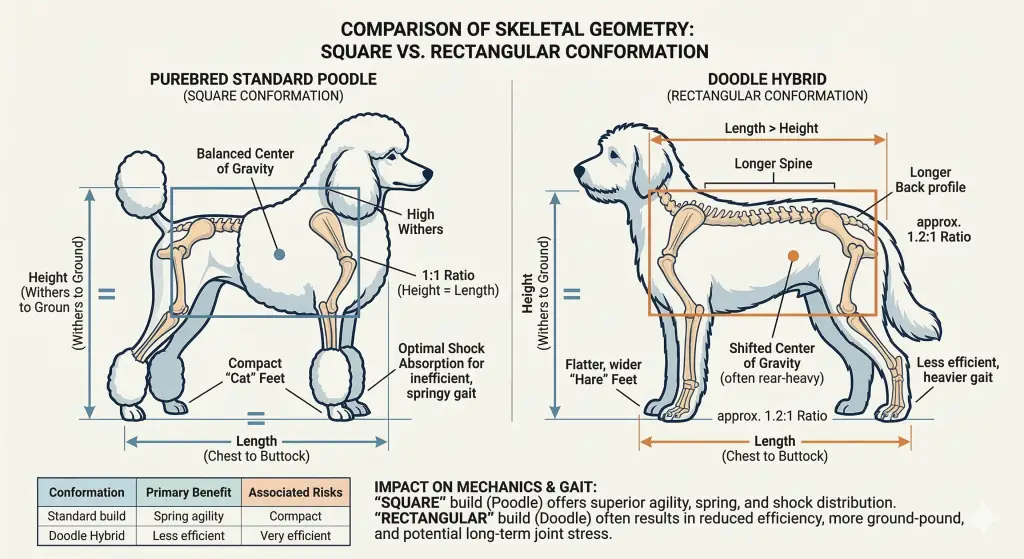
A purebred Standard Poodle is essentially a “square” athlete. If you were to measure a Poodle from the shoulder to the ground, and then from the front of the chest to the rear, those two numbers would be almost identical. This 1:1 ratio is the secret behind their iconic, effortless, “prancing” gait.
Doodles often inherit a “rectangular” geometry because most breeds they are crossed with possess longer backs designed for different types of pulling or carrying work. Doodles tend to have a heavier, more flat-footed walk compared to the light, suspended trot of a Poodle. According to basic canine structural science, a well-proportioned, square frame is naturally more efficient at distributing weight evenly over the joints.
Paw Pad Anatomy and Terrain Versatility
Poodles possess tight, heavily arched “cat feet.” These are high-performance shock absorbers that allow them to navigate uneven terrain with pinpoint agility. Many Doodles inherit the flatter, wider “hare foot” typical of a Retriever. These paws naturally splay further apart when the dog puts weight on them.
Daily Life Impact: The splayed hare foot of a Doodle is a magnet for winter ice balls and summer burrs, meaning you will spend much more time picking debris out of their toes after walks.
Brain Power & Behavior
It is no secret that both Poodles and Doodles are marketed as “brainy” dogs, but the type of intelligence they possess is entirely different.
The Intelligence Paradox: Focus vs. Drive
Poodles are analytical “fixers.” When faced with a problem or a new command, they tend to pause, observe their handler, and wait for instruction. They possess what behaviorists call “working intelligence.”
Doodles often inherit “neophilia” from their Retriever or Spaniel parentage—an intense, high-arousal excitement for new people, smells, and environments. While this makes them incredibly fun at the dog park, it can make them harder to “reach” in high-distraction environments.
“When you mix two high-intelligence breeds, you don’t always get a ‘double-smart’ dog; sometimes, you get a dog prone to cognitive overload.”
Sensory Processing & Vision Fields
A Poodle’s narrower skull, with eyes set slightly more to the side, provides a wider peripheral field of vision. Doodles often inherit a broader, “blockier” head. When you combine this forward-facing eye set with the “Teddy Bear” facial hair that often grows directly into their line of sight, they can experience sensory shielding, making them more easily startled by sudden movements from the side.
Health & Longevity
Understanding the actual genetic and metabolic realities of these two types of dogs is crucial for preparing for their senior years.
The “Hybrid Vigor” Myth
The idea that mixing breeds automatically makes a dog healthier sounds incredibly appealing, but genetic reality is much more complex. For example, both Standard Poodles and Golden Retrievers are genetically predisposed to Hip Dysplasia and Progressive Retinal Atrophy (PRA). When you cross them, the offspring doesn’t magically become immune. If both parents carry the genetic markers for these conditions, the hybrid puppies are just as likely to develop them.
Metabolic Efficiency & Bloat Risks
Poodles have a notoriously high metabolic rate and are excellent at self-regulating their caloric intake. Doodles, particularly those with Labrador Retriever parentage, frequently inherit a specific genetic anomaly that essentially turns off their brain’s ability to feel satiated. When you combine this insatiable appetite with a deep, narrow chest cavity, you create a significantly higher biological risk for Gastric Dilatation-Volvulus (Bloat).
Daily Life Impact: To prevent dangerous digestive emergencies, a Doodle owner will almost certainly need to invest in slow-feeder bowls and enforce strict, lifelong portion control.
While understanding the biological differences between a purebred and a hybrid is crucial, it is just one piece of the puzzle. If you are leaning toward getting a hybrid and want a complete breakdown of the different crosses available, check out my 50 Best Poodle Mix Guide, where I dive into the specific traits, sizes, and temperaments of today’s most popular Doodle breeds
The Lifestyle Compatibility Matrix

How does all of this science translate to your actual living room? Here is a rapid-fire compatibility matrix based on the structural and cognitive differences we’ve discussed:
- Best for Severe Allergy Sufferers: Purebred Poodle. The purebred’s homozygous genetics guarantee a single-layer coat that traps dander rather than acting as a shedding allergen sponge.
- Best for Urban & Apartment Living: Purebred Poodle. The Poodle’s shock-absorbing frame handles pavement efficiently, and their independent mindset makes them less prone to separation anxiety in smaller spaces.
- Best for Fenced-in Yards & Casual Play: Doodle Hybrid. Their “neophilic” drive makes them fantastic, tireless companions for chaotic outdoor family fun where strict obedience isn’t the primary goal.
- Best for Avid Hikers & Runners: Purebred Poodle. Their arched feet offer superior terrain protection, and their self-regulating metabolism provides sustainable stamina for long trails.
FAQ: Science-Based Answers
Are Doodles actually healthier than purebred Poodles?
Not inherently. If a Doodle’s parents both carry the genetic markers for common joint or eye issues, the puppies are just as likely to inherit those conditions. For true health predictability, both purebreds and hybrids require comprehensive genetic health testing and OFA clearances prior to breeding.
Do Doodles really not shed?
There is no biological guarantee. Because a Doodle is a hybrid, their coat type is determined by a genetic lottery. They have a high probability of inheriting the shedding undercoat of their non-Poodle parent.
Why do groomers charge more for Doodles?
Grooming a Doodle is often much more labor-intensive due to their complex “coat conflict.” When a shedding undercoat mixes with a tightly curled topcoat, it creates severe tangles and mats right against the skin.
Do Doodles smell different than Poodles?
Yes. Poodles naturally produce very low levels of sebum (skin oil). Doodles frequently inherit the oily, water-resistant skin chemistry of a retrieving parent, which can create a noticeable “wet dog” odor when trapped in curly hair.
Summary: Respecting the Science of Selection
Choosing a dog is a 10-to-15-year commitment, and the decision between a purebred and a hybrid goes far beyond their curly coats. Poodles are a refined, homozygous masterpiece of consistency. From their shock-absorbing square frames to their analytical minds, they offer a reliable blueprint stabilized over centuries. Doodles are a modern, high-energy experiment; while they can absolutely be wonderful companions, their heterozygous nature means that their grooming needs, joint health, and daily behavior are often left to chance.
Respecting the science of canine genetics allows you to make an informed choice that truly fits your daily life. If you want a deeper dive into responsible ownership, cross-reference these principles with resources like the American Kennel Club (AKC).