
Disclaimer: The information provided on PoodleReport.com is for educational purposes only and does not constitute veterinary medical advice; always consult your vet before changing your dog’s diet. Additionally, this post contains affiliate links. As an Amazon Associate, and other affiliate advertising programs, I earn from qualifying purchases at no extra cost to you.
There is a plethora of features and hair characteristics in a Goldendoodle’s coat, though my years researching my late Poodle, Angus, proved that “low-maintenance” is often a marketing myth. Whether a dog is truly hypoallergenic or prone to shedding depends entirely on the specific genetic traits they inherit. According to the AKC, these inherited characteristics dictate your entire grooming protocol. So, that being said, what types of hair do Goldendoodles actually have?
Goldendoodles possess four main hair types: flat, straight, curly, and wavy. Potential Goldendoodle owners should consider these coat attributes carefully before purchase as these different hair types should be handled differently when grooming.
There are several factors that play a role in the Goldendoodle’s hair type and the resulting traits that come with each one. Read on to discover what you need to know about the different Goldendoodle hair types and see which is right for your family.
The Four Goldendoodle Hair Types
Your Goldendoodle’s genetics will determine what kind of coat type he will inherit. That being said, the most common Goldendoodle hair types include:
1. Flat (or improper coat) Goldendoodle Hair Type
Flat hair is also referred to as an improper coat. Flat hair in Goldendoodles is most similar to a purebred Golden Retriever’s coat. As a result, it tends to be rather easy to comb through and maintain. This hair type doesn’t have the curly or wavy features that characterize many Goldendoodle coats.
2. Straight Goldendoodle Hair Type
When a Goldendoodle has a straight hair type, it is referred to as a loose coat. This type of Goldendoodle hair occurs when both of the parents give a non-curl gene. Goldendoodles with straight hair likely won’t have a beard around the face as the hair in this area is shorter.
A big difference between the straight hair type and the flat hair type is that the straight hair type tends to be more fluffy than the flat hair type.
This hair type leans more towards the appearance of purebred golden retriever hair, as opposed to purebred Poodle hair.
Something really nice about this hair type is the relative ease of care and grooming. In fact, out of all the Goldendoodle hair types, Straight hair requires the least amount of maintenance.
Obviously, the longer your Goldendoodle’s coat grows out, the more often your dog will need to have its hair brushed. However, the straight hair type is overall pretty easy to maintain and only needs to be combed through about once a week.

3. Curly Goldendoodle Hair Type
The curly hair type, also known as the woolly coat, occurs when both of the Goldendoodle’s parents contribute a curly hair gene. This type of Goldendoodle hair is the closest of the four types to purebred Poodle hair, as these curls are denser than in any other Goldendoodle hair type.
There are two types of curls the Goldendoodle might have:
- A loose barrel curl
- A tight, dense, kinky curl, most similar to Poodle hair.
It is typically best to brush your Goldendoodle once or twice a week if he has the curly coat type, especially if the hair around the face grows quickly.
However, Goldendoodle’s should be groomed more frequently than this, at least half an hour every single day.
Luckily, the hair around the face doesn’t get as long as most other areas of its body. The shorter the hair is kept, the less time and effort it takes to maintain.
Curly hair in Goldendoodles may not be as easy to maintain as straight hair, but this wavy hair type can be fairly easy to maintain with regular daily brushing.
4. Wavy/Shaggy Goldendoodle Hair Type
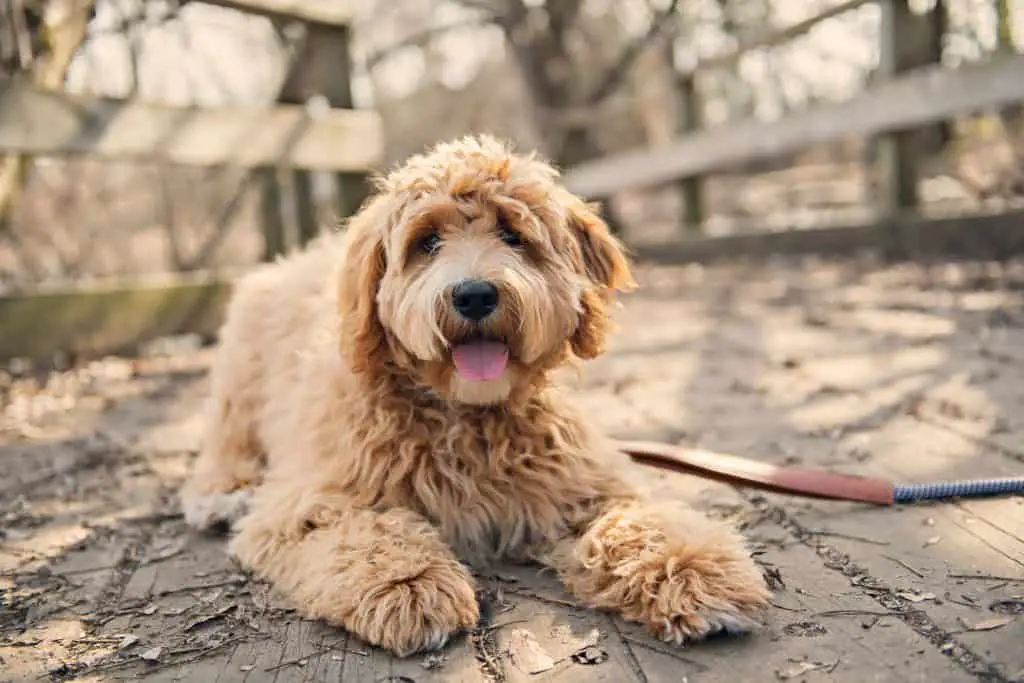
When one of the Goldendoodle’s parents gives a curly hair gene and the other gives a non-curly hair gene, the Goldendoodle’s hair type results as wavy and/or shaggy hair. This hair type tends to have longer, wavy, or straight hair around the mouth, typically resembling a beard.
This wavy or shaggy Goldendoodle hair type is referred to as a “fleece coat” and is most similar to the feel and texture of human hair.
Wavy hair in Goldendoodles resembles a teddy bear, which might be why it is the most common and popular of the Goldendoodle hair types.
When a Goldendoodle’s wavy hair grows out without being cut, it will grow to a length of anywhere between 4 and 8 inches long.
This coat type results in shorter hair on a Goldendoodle’s face and will be less dense than their Goldendoodle counterparts with the curly hair type.
This hair type usually stays pretty clean, but Goldendoodles still need to have their hair combed through no less than the minimum of once a week.
However, knots in this hair type can get pretty tangled, so it’s a good idea to brush more than the recommended once a week. Groomers actually recommend grooming a Goldendoodle with shaggy hair two to three times a week.

Goldendoodle Hair Type Features
Shedding Vs Non-Shedding Goldendoodles
Goldendoodles with straight hair do tend to shed typically. In fact, this straight hair type sheds more than any other Goldendoodle hair type, and therefore, needs to be properly groomed more frequently than other Goldendoodle hair types.
On the other hand, if your Goldendoodle has the curly hair type, it is very likely that he won’t shed. As for the wavy, shaggy hair type, these Goldendoodles are usually non-shedding and tend to shed very minimally.
Of course, there is some variance from dog to dog when it comes to shedding.
Goldendoodles: Hypoallergenic or Non-Hypoallergenic?
Goldendoodles with the straight hair type can cause allergic reactions in some people. However, if your Goldendoodle has the curly hair type, it sheds very little, and therefore, is pretty hypoallergenic.
Goldendoodles that are shaggy or curly hair are considered hypoallergenic. However, while they don’t shed much, all Goldendoodles will shed small amounts of hair that may cause slight allergic reactions in some people.
Goldendoodle Hair Length
There are a couple of things that play a role in how long a Goldendoodle’s hair is. In terms of genes, the long coat gene is recessive and the short coat gene is dominant in dogs.
However, with Goldendoodles, the long coat gene will appear more dominant because both the purebred golden retriever and the purebred poodle have long coats. Purebred poodles hide their long coats due to their dense, curly hair.
As such, there isn’t a heterogenous gene combination or a short and long gene mix. Instead, even the early generations of Goldendoodles had a recessive homogenous combination. So in English, a long hair gene is inherited from each parent.
While Goldendoodles are often the primary focus for those seeking hypoallergenic companions, they are just one example of the vast aesthetic diversity found in Poodle hybrids. To see how these coat textures and furnishings manifest across other lineages, our comprehensive guide to the 50 best Poodle mixes provides a helpful visual baseline for any dedicated owner.

The Six Main Goldendoodle Coat Color Types
1. Solid Color Coat Types
There are a few solid colors that are common to see with Goldendoodles, no matter which hair type (curly, straight, flat, or wavy) they have.
The most common solid coat colors found in Goldendoodle include:
- Cream (Gold)
- Chalk (White)
- Cafe (Brown)
- Lavender (starts chocolate but changes)
- Silver
- Parchment
- Apricot
- Red
- Chocolate (sometimes speckled with white)
- Black
2. Brindle Coat Color Type
What makes the Goldendoodle’s brindle hair color type so easy to spot is the presence of a stripe in the coat.
Now, the stripe doesn’t have to be a specific length and can vary greatly in size. A Goldendoodle that has this brindle hair color type, and any of the potential coat colors (cream, apricot, red, chocolate, or black) is fair game for this color type.
3. Parti Coat Color Type
For a Goldendoodle to be considered as a parti hair-colored Goldendoodle, they have to be at least 50% white (if not more). As for the rest of their coat, it can be any other of the initial five color options including cream, apricot, red, chocolate, or black.
4. Abstract, Mismarks, or Chrome Coat Color Type
The Abstract, mismark, or chrome Goldendoodle hair color type is incredibly similar to the parti Goldendoodle hair color type. The biggest difference is that the fifty percent minimum white in the coat that is required to qualify as a parti Goldendoodle hair color type isn’t required.
Less than 50% of the abstract, mismarked. or chrome Goldendoodle’s coat is white, and over 50% of the coat consists of one of the other color options including cream, apricot, red, chocolate, or black.
5. Merle Coat Color Type
A Goldendoodle with a merle hair color will have more variance in hair color than their Goldendoodle counterparts with the parti hair color coat. In fact, that is essentially what the Goldendoodle merle hair type is.
Merle coloration is a random pattern variation in a Goldendoodle’s coat. Most often, this merle pattern results from suppression of color intensity randomly in a Goldendoodle’s hair.
There are a couple of potential health risks that come with this type of hair color type for Goldendoodles.
Thankfully, technological and scientific advances allow us to do genetic tests to help mitigate the risk in today’s world. If both Goldendoodle’s parents have the merle gene for this hair color type, the dog may suffer deafness or blindness as a result.
These health risks can easily be avoided, but it still is definitely something to keep in mind, especially for any and all Goldendoodle breeders.
6. Phantom Coat Color Type
A Phantom Goldendoodle’s coat consists of two colors in very distinct coat patterns. The primary color covers most of the body, while a secondary color is found on the inside of the dog’s legs, underneath the tail, on the chest, above the eyes, and/or on the sides of the mouth.
Additionally, the background hair color underneath the pattern is always solid.

Goldendoodle Hair Care
Goldendoodle Grooming Specifics
The first thing to keep in mind is to brush and comb through your Goldendoodle’s hair at least once a week. However, Goldendoodle owners with curly hair or shaggy hair type should consider at least two to three times a week.
More in-depth grooming should occur every six to eight weeks by taking your dog to the groomer, especially for Goldendoodles with curly or wavy hair.
When deep grooming your Goldendoodle, first trim between the dog’s footpads, eyes, and beard. Then Trim the nails and remove excess hair from the ears. Finally, give your dog a sanitary trim (a sanitary trim is a trim underneath the dog’s tail and on the belly).
Bathing and Shampooing Your Goldendoodle’s Hair
You should give your Goldendoodle a bath no less than once a month, and probably more than that. The longer the hair, the more frequently your Goldendoodle should be having a bath.
When it comes to shampooing, it is good to keep in mind that baby shampoo can be used since it is gentler on your Goldendoodle’s skin.
You can use a 2 in 1 dog shampoo and conditioner as this can help prevent dryness. However, I find Shampoos made specifically for dogs tend to dry out the skin and are harsher than baby shampoo. Whichever you choose to utilize, be sure the shampoo is rinsed out well to avoid irritation.
Common Mistakes in Goldendoodle Hair Care
Navigating the genetic lottery of a Goldendoodle’s coat often leads to pitfalls that can turn a “teddy bear” into a tangled mess. As a researcher focused on high-intelligence breeds, I’ve found that many issues arise from treating these hybrid coats with a “one-size-fits-all” mentality.
- The Water-First Fallacy: One of the most frequent errors is bathing a Doodle before a thorough de-matting. Water causes the hair shafts to swell and “lock” existing tangles into dense bricks. Always ensure the coat is 100% knot-free before it gets wet.
- Surface-Level Brushing: Spending twenty minutes brushing the top layer often leaves a thick “pelt” of mats against the skin. My Standard Poodle, Angus, was a master at hiding knots under a perfectly fluffed exterior; if I didn’t use the “line-brushing” technique to reach the skin, he’d end up needing a total shave.
- The pH Mismatch: Using human shampoo is a common but risky shortcut. A dog’s skin pH is significantly higher (more alkaline) than ours. Stripping their acid mantle with human products leads to chronic itching and secondary bacterial infections.
- Ignoring the “Furnishings” Factor: Assuming every Goldendoodle is hypoallergenic is a mistake. “Flat” or straight-coated Doodles often lack the continuous growth cycle of a Poodle, meaning they shed significantly more dander than their curly-coated counterparts.
When to Worry: Red Flags for Your Doodle’s Health
Because Goldendoodle coats are so dense, they can easily mask underlying medical issues. Grooming should be viewed as a weekly diagnostic scan rather than just a cosmetic chore.
Senior Coat Shifts: If a dog that has always had a manageable coat suddenly starts matting excessively, it may indicate an endocrine shift or a “Metabolic Reset” issue. Rapid texture changes in senior dogs warrant a veterinary checkup for potential thyroid or adrenal concerns.
Persistent Ear Odor: Goldendoodles often inherit heavy, floppy ears combined with dense inner-ear hair. If you notice a “yeasty” smell or your dog winces during cleaning, they likely have otitis externa. Moisture trapped in these hairy canals is a primary cause of chronic ear infections.
Rapidly Expanding Hot Spots: If you find a patch of red, oozing skin—especially tucked under a mat—this is likely acute moist dermatitis. These spots can spread from the size of a coin to the size of a hand in just a few hours.
The “Double Merle” Sensory Risks: If you are looking at a Merle-patterned puppy, ensure the breeder has conducted genetic testing. Crossing two Merle carriers can result in puppies with congenital deafness or blindness.
Frequently Asked Questions
- Which Goldendoodle coat is truly hypoallergenic? The curly (or wool) coat is the most reliable choice for allergy sufferers. Because it closely resembles the Poodle parent’s hair structure, it traps dander and shedding within the curls rather than releasing them into your home. According to AKC grooming guidelines, no dog is 100% allergen-free, but curly coats are the gold standard for minimizing environmental triggers.
- What does “Improper Coat” actually mean? This term refers to a Goldendoodle that inherited two copies of the “flat coat” gene, resulting in a dog that lacks a beard and eyebrows (furnishings). While these dogs look more like Golden Retrievers, they will shed significantly more than their wavy or curly counterparts.
- Why is my red Goldendoodle turning apricot or cream? This is a natural genetic process called “clearing.” Many Poodle-hybrids carry a fading gene that causes their vibrant birth color to lighten as they reach physical maturity. It is a cosmetic shift and does not indicate any underlying health issues or nutritional deficiencies.
- How often should I brush a wavy/fleece coat? While the wavy coat is often considered “low maintenance,” it is prone to friction mats. You should perform a thorough “line-brushing” session at least two to three times a week to ensure the hair remains tangle-free down to the skin.
Conclusion
Navigating the diverse world of Goldendoodle hair types requires a researcher’s eye and a consistent commitment to maintenance. Whether your companion sports a tight Poodle-like wool coat or the iconic “teddy bear” fleece, understanding the underlying genetics of their fur is the first step in effective long-term care. These dogs are a fascinating study in hybrid variety, and their grooming needs are a direct reflection of that genetic lottery.
In my time researching and living with my late Standard Poodle, Angus, I learned that a high-IQ dog’s physical comfort is inextricably linked to their behavioral health. A matted coat isn’t just an aesthetic issue; it creates physical tension that can lead to irritability and stress.
By establishing a structured maintenance protocol early on, you bridge the “Cognitive Gap” and turn grooming into a seamless, bonding experience. Whether your Doodle is black, red, or parti-colored, your dedication to their specific coat type ensures they remain as healthy on the inside as they look on the outside. To see how the Goldendoodle fits into the larger picture of designer breeds and their varied needs, you can explore my full list of Poodle Mix guides.
Medical & Veterinary Disclaimer: PoodleReport.com is an informational resource for Poodle owners and enthusiasts. We are not veterinarians. The content on this website is not a substitute for professional veterinary care, diagnosis, or treatment. Always seek the advice of your veterinarian with any questions you may have regarding your pet’s medical condition, diet, or overall health.