

Disclaimer: The information provided on PoodleReport.com is for educational purposes only and does not constitute veterinary medical advice; always consult your vet before changing your dog’s diet. Additionally, this post contains affiliate links. As an Amazon Associate, and other affiliate advertising programs, I earn from qualifying purchases at no extra cost to you.
The sun is shining and the conversation is flowing until a sudden social catastrophe unfolds before your eyes: your refined female Poodle is mounting a Golden Retriever with an intensity that leaves you toggling between total mortification and hysterical laughter. While the AKC notes that this is a standard entry in the canine behavioral playbook for both genders—fixed or not—it doesn’t make the sight any less jarring. It forces every stunned owner to confront a question that the breed manuals often skip: Why do female Poodles hump?
Female Poodles hump as a natural displacement behavior to release high energy, handle stress, or navigate social rank. This mounting response is often a physical outlet for a nervous system that has become overstimulated during intense play or social interaction. By determining if the cause is a behavioral habit or a medical issue like a UTI, owners can move past the embarrassment and apply a clear, evidence-based management strategy.
Through my ongoing synthesis of breed-specific behavioral data, I’ve found the answer is far from a singular trigger; it is a nuanced interplay of social cues, biological overflows, and hidden stressors. By dissecting the “data” behind this behavior—ranging from pack dynamics to clinical irritations—we can shift from reactive embarrassment to proactive, evidence-based management. Let’s look at the research to determine which of these seven distinct drivers is behind your Poodle’s unexpected public display.
Decoding the Data: Seven Core Reasons for Female Humping Behavior

To move past the initial embarrassment of a public mounting incident, we have to look at the underlying mechanics of the behavior. Mounting is rarely a random act of rebellion; rather, it is a highly specific response to internal or external stimuli. By categorizing these triggers, we can shift our perspective from reactive scolding to proactive, data-driven management.
As we explore the following sections, you’ll find that your Poodle’s seemingly scandalous behavior is usually a physiological signal that she has reached a limit—be it emotional, social, or physical. Identifying which of these seven catalysts is at play allows you to tailor your training and ensure your Poodle remains the refined companion she was meant to be.
Comparative Overview: The Seven Primary Mounting Catalysts
| Behavioral Catalyst | Common Trigger Scenario | Researcher’s Strategy |
| 1. Social Boundaries | Meeting a new, high-energy dog at the park. | Consistent hierarchy training and firm “place” cues. |
| 2. Over-Stimulation | Post-game “Zoomies” or high-stakes fetch. | Mandatory cool-down periods to lower heart rate. |
| 3. Anxiety/Stress | Seeing a suitcase or hearing a thunderstorm. | Desensitization and counter-conditioning protocols. |
| 4. Tactical Play | Wrestling or chasing games with peers. | Interrupt and redirect before the “redline” is reached. |
| 5. Attention-Seeking | Feeling ignored while the owner is on the phone. | Total withdrawal of attention; reward the settle. |
| 6. Biological Drive | Residual hormones or standard physical release. | Distraction with high-value puzzle toys or exercise. |
| 7. Medical Issues | Persistent licking or sudden frequency shifts. | Immediate veterinary consultation to rule out UTIs. |
1. Pack Dynamics: Navigating Social Boundaries and Mounting
While the “Alpha” theory is often debated in modern behaviorism, dogs within a group still work to determine social standing and personal space. For a Poodle, a breed known for its sharp intellect and keen social awareness, mounting can be a physical assertion of confidence or an attempt to claim a “boss” role in a confusing social setting.
Understanding these social nuances is just one part of coexisting with such a high-drive breed. For a broader look at how these traits influence daily life, explore our full library of research on Poodle Behavior.
Social Hierarchies in Multi-Dog Environments
In households with multiple dogs, mounting often surfaces when a new animal is introduced or when the existing hierarchy is challenged. It isn’t necessarily about aggression; rather, it is a way of saying, “I am here, and I am in charge of this specific interaction.” If your Poodle tends to have a dominant personality, she may use mounting to test the “patience threshold” of her peers.
Quick Reference: Mounting Triggers and Responses
| Reason for Humping | Primary Sign | Recommended Action |
| Excitement | Occurs during play or when guests arrive. | Use a “Settle” or “Sit” command. |
| Stress | Linked to storms, suitcases, or separation. | Desensitize the stress trigger. |
| Attention Seeking | Behavior stops when ignored. | Ignore the hump; reward the calm. |
| Dominance | Testing social boundaries with other dogs. | Consistent “Alpha” role training. |
| Medical | Accompanied by licking or frequent urination. | Consult a veterinarian immediately. |
2. The Sensory Redline: Managing Excitement and Over-Stimulation
Poodles are high-energy athletes, and their nervous systems can sometimes “redline” during moments of intense excitement. This is a classic case of a biological “overflow.” When a Poodle becomes overstimulated, the brain looks for any physical outlet to discharge that surging adrenaline.
The Displacement Response
Think of it as a teakettle whistling. When the pressure gets too high, the energy has to go somewhere. For many Poodles, this manifests as a sudden bout of humping. It’s a displacement behavior—a way to burn off steam that doesn’t have a constructive channel.
This is why you’ll often see it happen right after a high-stakes game of fetch or when a favorite guest walks through the door. Because Poodles are bred for high-intensity work, their baseline for “arousal” is much higher than that of a lethargic breed. Research indicates that displacement behaviors like mounting are more common in working breeds that lack a clear “off switch.”
3. The Anxiety Outlet: Navigating Stress-Induced Behaviors

As a researcher, I’ve found that Poodles often manifest internal stress through repetitive physical behaviors. Just as humans might pace or bite their nails, a Poodle may hump to self-soothe when feeling overwhelmed. It is a coping mechanism for an animal that feels a loss of control.
Environmental Stressors
According to VCA Animal Hospitals, mounting is a common compulsive outlet for a dog who doesn’t know how else to handle internal pressure. Common triggers include:
- Thunderstorms and loud noises.
- Separation anxiety or changes in the owner’s routine.
- The sight of a suitcase or specific departure cues (like grabbing keys).
Redirection Strategies for Anxious Dogs
Identifying these environmental stressors allows you to treat the root cause—the anxiety—rather than just the behavioral symptom. Replacing the hump with a “place” command or a calming task gives the dog’s brain a new way to process the stress without resorting to mounting.
4. Tactical Play: Using Mounting as a Social Pacing Tool
During high-intensity play, mounting is frequently used as a tactical move rather than a social statement. It is the canine equivalent of a “power play” during a hockey game—a way to slow down the action or gain a physical advantage over a playmate.
Mounting as a Game Mechanic
When dogs race around at top speed, the physical contact of mounting can serve to “anchor” another dog. In the Poodle brain, this is just another way to win the game. However, it can quickly lead to a fight if the other dog doesn’t appreciate the maneuver. To manage this, researchers at the Merck Veterinary Manual suggest monitoring playtime and implementing mandatory “cool-down” breaks to lower the heart rate.
5. The “Look at Me” Strategy: Addressing Attention-Seeking Tactics
If a Poodle feels ignored, she may resort to “unacceptable” behaviors because she knows they will garner an immediate reaction from you. These are remarkably smart animals; they know exactly which buttons to push to get you to drop your phone or stop watching TV.
Breaking the Negative Reinforcement Loop
Even negative attention—like a scold or a push—is still an interaction. If she learns that mounting the sofa gets you to stop what you’re doing and look at her, she has effectively trained you to pay attention. You have unintentionally reinforced the behavior by providing the “payoff” she was looking for. To break this cycle, you must ignore the mounting completely. Walk out of the room or turn your back. Once she stops and settles, wait a beat, then provide the positive attention she was originally seeking.
6. Instinctual Drives: Biological Realities and Sexual Release
While spaying eliminates the risk of pregnancy, it does not remove the natural physiological sensations associated with certain physical movements. It is a biological reality that many owners find difficult to discuss, but it is a standard part of canine existence.
Residual Hormonal Influences
Even after spaying, some residual hormones may persist, especially if the dog was fixed later in life. For younger, spayed females, mounting can occasionally be a simple biological fact of nature. As noted by The Spruce Pets, just because a dog has been fixed doesn’t mean their anatomy or their brain’s pleasure centers are completely unresponsive to physical stimulation. It’s often less about reproduction and more about the physical release of energy.
7. Clinical Triggers: Identifying Underlying Medical Conditions
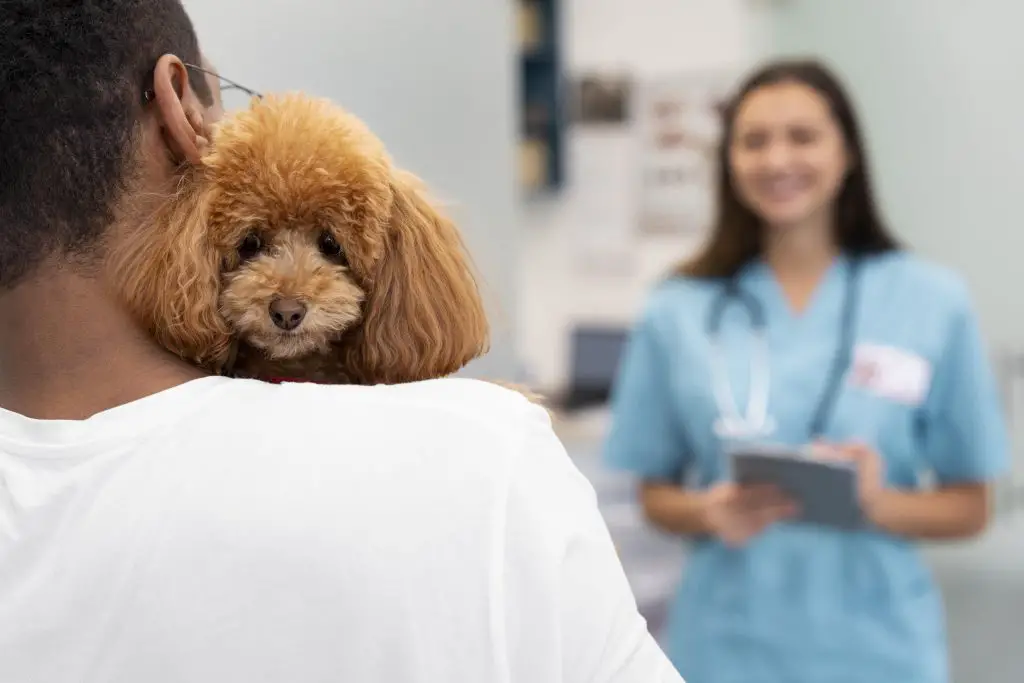
If the humping behavior is sudden, persistent, or accompanied by frequent licking, it may not be behavioral at all. Before you reach for a training clicker, you need to rule out physical discomfort that might be driving the act.
When Physical Irritation Mimics Behavior
Several medical issues can cause irritation in the genital or pelvic area, leading a Poodle to mount objects for relief. It is essentially their way of “scratching an itch” that they can’t reach with their paws. Common culprits include:
- Urinary Tract Infections (UTIs): The burning sensation can cause a dog to rub against objects.
- Skin Allergies: Localized infections or contact dermatitis can make the skin extremely itchy.
- Incontinence: Constant dampness can lead to skin scald and irritation.
Consulting a veterinarian is vital if you notice any redness, discharge, or a change in urination habits, as recommended by PetMD.
When to Worry: Clinical Indicators of Compulsive Humping
While mounting is generally a benign behavior, there are instances where it indicates a more serious pathological issue. I look for the “interruptibility” of the act to determine its severity.
| Condition | Observation | Recommended Action |
| Compulsive Fixation | Poodle cannot be distracted or interrupted from humping. | Possible doggie OCD; seek vet help. |
| Aggression | Mounting is followed by snapping or growling when moved. | Hierarchy issue; professional training. |
| Physical Harm | Skin irritation, hair loss, or sores on the abdomen. | Immediate medical exam. |
| Senior Onset | Sudden start of humping in an older dog (7+ years). | Check for cognitive shift or pain. |
Pathological Compulsions
If your Poodle enters a “trance-like” state where she ignores your voice, treats, and physical presence, the behavior has crossed the line into something concerning. Constant humping can lead to skin irritation, hair loss, or sores on the abdomen that require medical intervention.
Common Mistakes: Training Errors Every Owner Should Avoid
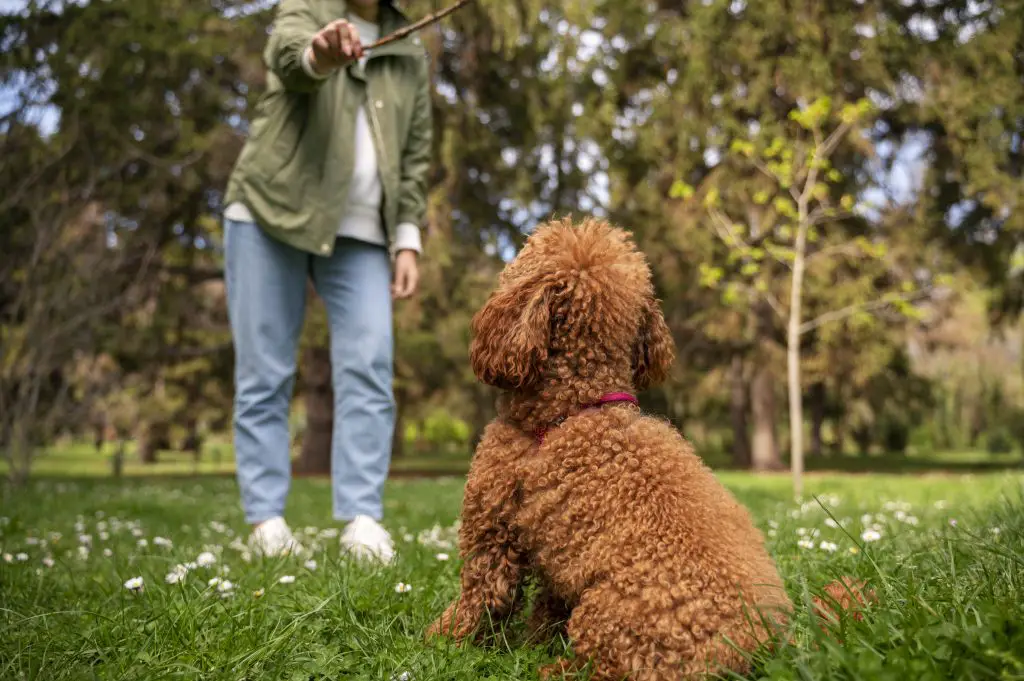
When attempting to curb mounting, many owners inadvertently reinforce the behavior or increase the dog’s stress levels. According to the AVMA, behavioral health is as important as physical health, and many “bad habits” are actually caused by poor human response.
The Pitfall of Over-Correction
Yelling or physical punishment is the most common mistake. This increases cortisol levels, which often drives the dog to hump more to relieve the new stress you’ve just created. Another mistake is using a “high-pitched” or frantic tone. Excitedly saying “No, no, stop!” can be misinterpreted as play-noises. To a high-drive Poodle, your excitement just adds fuel to her fire.
Effective Solutions: Implementing Training and Management
Correcting this behavior requires a focus on mental enrichment and clear leadership. While individual tips are helpful, long-term success often requires a systemic overhaul of how you communicate with your dog. For a step-by-step roadmap to building a healthier bond, I recommend my Poodle Behavior Guide for roven research-Based training.
Implementing NILF (Nothing in Life is Free)
The “Nothing In Life is Free” (NILF) method is exceptionally effective for Poodles. This strategy dictates that she must obey a command—like “sit” or “down”—before she receives food, treats, or play. I have utilized a variation of this in my own work to reinforce that the owner is the one in control of the resources. By making a dog “settle” before we go to the park, we keep arousal levels manageable from the start.
The Power of Redirection
The goal isn’t to stop the energy; it’s to redirect it. Keep a high-value toy nearby. The moment you see the “pre-hump” signs—the glazed eyes or intense sniffing—interrupt with a noise and offer the toy. You are giving her brain a new task to solve rather than a habit to repeat.
FAQ: Frequently Asked Questions About Mounting
Is mounting always a dominance thing?
No. While it can be social, it is more frequently tied to excitement, play, or stress. Dominance is just one piece of the puzzle and often the least likely cause in a stable home environment.
Will spaying my Poodle stop her from humping?
Not necessarily. While it removes the hormonal drive, humping is often a learned behavior or a reaction to arousal that persists long after surgery.
How do I stop her from humping guests?
Use her leash when guests arrive. Before she can reach the guest, use a “settle” command and reward her for keeping all four paws on the floor. This prevents the habit from forming in the first place.
Can humping be a sign of a UTI?
Yes. Any irritation in the urinary tract or genital area can cause a dog to rub against objects for relief. See a vet if the humping is sudden and accompanied by frequent licking.
What is the best way to interrupt the behavior?
Avoid yelling. Instead, use a distinct sound like a “clap” or a whistle to break her focus, then immediately redirect her to a “sit” or a high-value toy.
Conclusion: Understanding the Poodle Brain
Mounting is rarely the “scandal” owners make it out to be. Whether it was a dog blowing off steam after a long day or a puppy testing their social legs at the park, the key is redirection rather than reprimand. By focusing on mental enrichment and keeping a well-informed eye on their physical health, you can ensure your Poodle’s energy is spent on more appropriate—and less awkward—activities.
Medical & Veterinary Disclaimer: PoodleReport.com is an informational resource for Poodle owners and enthusiasts. We are not veterinarians. The content on this website is not a substitute for professional veterinary care, diagnosis, or treatment. Always seek the advice of your veterinarian with any questions you may have regarding your pet’s medical condition, diet, or overall health.