
Disclaimer: The information provided on PoodleReport.com is for educational purposes only and does not constitute veterinary medical advice; always consult your vet before changing your dog’s diet. Additionally, this post contains affiliate links. As an Amazon Associate, and other affiliate advertising programs, I earn from qualifying purchases at no extra cost to you.
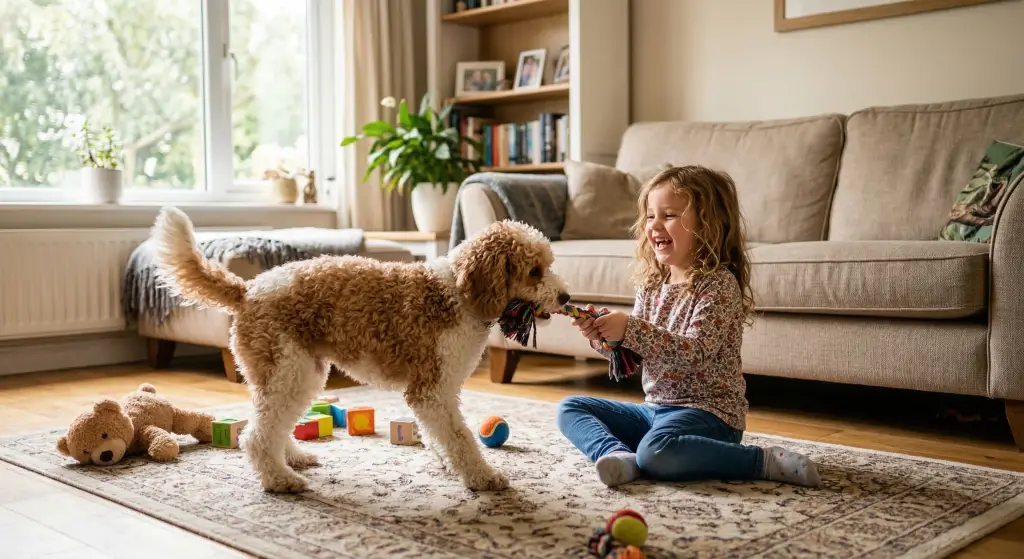
Bringing a dog into a home with children raises the stakes. You are not just looking for a cute, fluffy face. You need a temperament that can safely handle sudden loud noises, erratic toddler movements, and the inevitable clumsy tail-pull.
Many breeders push a dangerous misconception: that every Poodle mix is an automatic, ready-made nanny dog.
While Poodle hybrids are universally praised for their intelligence and low-shedding coats, mixing a brilliant Poodle with the wrong breed can result in chaos. Throwing a high-drive or fragile dog into a loud family environment often leads to stress for both the pet and your children.
I know this firsthand. My own Standard, Angus, was incredibly smart and gentle, but his solid 60-pound frame meant I had to be highly intentional about training him not to jump when neighborhood toddlers enthusiastically ran up to him. I quickly learned that when it comes to kids, a dog’s size and physical sturdiness matter just as much as their breed.
To help you make the safest choice for your household, I have broken down the 10 best family Doodle mixes based on the age of your children, the dog’s physical sturdiness, and the reality of their daily care.
Explore More From Poodle Report:
Understanding the distinct differences between various Doodle breeds is crucial before bringing a puppy home.
Browse my Poodle Mix Guides to compare temperaments, examine energy levels, and find the hybrid that perfectly fits your family’s unique lifestyle and home.
Quick Guide: The 10 Best Poodle Mixes by Family Need
| Poodle Mix | Best For… | Size Category | Energy Level |
| Bernedoodle | Toddlers & Chaos | Large (50-90 lbs) | Low / Moderate |
| Goldendoodle | First-Time Owners | Medium / Large | High |
| Newfypoo | Gentle “Nanny” Dog | Giant (70-120 lbs) | Low |
| Cockapoo | Active Playmates | Small / Medium | Moderate |
| Cavapoo | Emotional Support | Small (15-25 lbs) | Moderate |
| Schnoodle | Backyard Athletes | Small / Medium | High |
| Whoodle | Hiking & Outdoors | Medium (30-45 lbs) | Very High |
| Maltipoo | Quiet Study Buddy | Toy (5-12 lbs) | Low |
| Shih-poo | Apartment Living | Toy (8-15 lbs) | Low |
| Mini Labradoodle | Teaching Tricks | Small (15-25 lbs) | High |
Why Not Every Doodle is Safe for Kids (The Size & Sturdiness Rule)
Before we look at specific breeds, parents must understand the physical and behavioral realities of mixing a Poodle with another dog. You cannot simply look at a cute, curly coat and assume the dog will tolerate a chaotic household.
When matching a dog to a family, the two biggest risks parents overlook are physical fragility and genetic drive. According to the American Veterinary Medical Association (AVMA), children are the most common victims of dog bites, and these incidents most frequently occur during everyday activities with familiar dogs. To protect your kids and your pet, you must understand these two behavioral realities:
1. The Fragility Risk (Toy Breeds)
Toy Poodle mixes weighing under 10 pounds—such as tiny Yorkipoos or Teacup Maltipoos—are incredibly delicate.
- The Danger: A clumsy toddler tripping and falling onto a small dog can easily cause severe skeletal injuries.
- The Bite Risk: Dogs are highly intuitive. When a small dog feels physically vulnerable around unpredictable children, they are highly prone to “fear-biting” as a basic defense mechanism to protect themselves.
2. The Herding Nip (Working Breeds)
On the opposite end of the spectrum are mixes bred from high-drive herding dogs, such as Aussiedoodles (Australian Shepherd mix) or Bordoodles (Border Collie mix).
- The Danger: These dogs inherit a deep, genetic instinct to corral fast-moving objects.
- The Bite Risk: In a busy backyard setting, running, screaming children quickly become the “flock.” This high prey drive often results in the dog chasing and nipping at the children’s heels, which is terrifying for young kids and frustrating for parents to manage.
To ensure safety, you must match the physical robustness and genetic instincts of the dog to the age and coordination level of your children.
The Poodle Mix & Child Age Matching Matrix
Use this chart as your baseline rule before falling in love with a specific Doodle aesthetic:
| Child Age Group | Ideal Doodle Size | Behavioral Requirement | Mixes to Avoid |
| Toddlers (0–4) | Medium/Large (40–80 lbs) | High pain tolerance, low startle reflex, sturdy frame. | Toy Mixes (Fragility risk), Herding Mixes (Nipping risk). |
| Young Kids (5–10) | Small/Medium (15–40 lbs) | Tireless energy, fetch-oriented, high trainability. | Giant Mixes (Knock-down risk during play). |
| Pre-Teens (11+) | Toy/Small (5–15 lbs) | Affectionate, lap-oriented, capable of gentler handling. | High-drive working mixes (Requires too much adult-led exercise). |
Canine Body Language & Temperament Testing
Even if you choose the perfect breed and the right size, genetics only go so far. A dog’s individual personality plays a massive role in how they tolerate a busy, loud household.
Before bringing a puppy home, you need to understand how to read their stress signals and how to test their natural temperament.
Recognizing the Warning Signs Before a Bite
A dog rarely bites without warning. Instead, they communicate their discomfort through subtle body language that young children (and many adults) easily miss. When a dog feels overwhelmed by a toddler’s hug or a loud playroom, they will display specific stress signals.
If you see your Poodle mix displaying any of the following behaviors, immediately separate the dog and the child:
- Whale Eye: You can see the whites of the dog’s eyes as they turn their head slightly away but keep their gaze fixed on the child.
- Lip Licking & Yawning: These are self-soothing behaviors. If the dog is not tired or hasn’t just eaten, a sudden yawn or lip lick means they are anxious.
- Tucked Tail & Pinned Ears: A dog shrinking away with their ears flat against their skull is telling you they are scared and want to escape.
- The “Freeze”: If a dog suddenly goes completely stiff when a child approaches or touches them, this is the final warning before a growl or a snap.
The Breeder Test: The Volhard Puppy Aptitude Test
When looking for a family dog, do not just pick the puppy that runs up to you first. That puppy is often the most dominant and high-energy of the litter, which can be exhausting for a family with young children.
Instead, ask the breeder if they perform the Volhard Puppy Aptitude Test (PAT).
According to the American Kennel Club, the Volhard PAT is a standardized behavioral assessment conducted when the puppies are exactly 49 days old.
It scores a puppy’s reactions to loud noises, strange objects, and human handling to assess their baseline personality.
What to look for:
- The Ideal Family Score: You want a puppy that scores mostly 3s and 4s on the Volhard scale.
- Why it matters: These puppies are adaptable, easy to train, and possess a “forgiving” temperament. They are not overly dominant (which can lead to reactivity) and not overly submissive (which can lead to fear-biting).
By finding a breeder who actively tests for temperament, you take the guesswork out of finding a gentle family companion.
The Hypoallergenic Myth: Kids, Allergies, and Asthma
Many parents specifically seek out a Poodle mix because their child suffers from allergies or asthma. While Doodles shed significantly less than a standard Golden Retriever, you must manage your medical expectations before bringing a puppy home.
The Science: Hair vs. Dander
A common misconception is that a dog’s hair is what causes an allergic reaction. In reality, pet allergies are triggered by specific proteins found in a dog’s dander (dead skin flakes), saliva, and urine.
When a dog licks itself, these proteins dry on the coat and flake off into the air, eventually settling into your home’s carpets and furniture.
According to the American College of Allergy, Asthma, & Immunology (ACAAI), a 100% allergy-free dog simply does not exist. Because a Doodle still produces dander and saliva, they can still trigger a sensitive child’s immune system, regardless of how tightly curled their coat is.
The Asthma Reality Check
If your primary goal in buying a Doodle is to prevent your child from developing asthma, you need to look at the data.
A massive Swedish cohort study tracking over one million children revealed that exposing children to so-called “hypoallergenic” breeds did not actually lower their risk of developing asthma compared to standard dog breeds.
- The Takeaway: If your child has severe asthma or allergies, do not rely on breed labels to keep them safe.
- The Action Step: Always arrange a “meet and greet” with the specific puppy or adult dog for several hours to test your child’s reaction before committing to bringing them home.
Top 3 Sturdy & Patient Mixes for Toddlers (Ages 0–4)
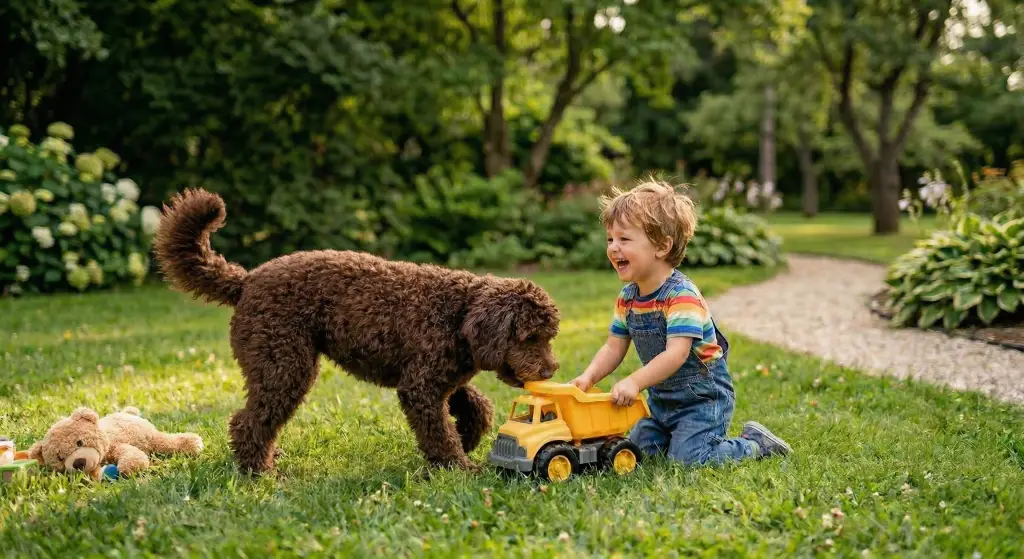
Toddlers are unpredictable, loud, and completely lack fine motor control. They are prone to grabbing handfuls of fur, tripping over sleeping pets, and dropping loud toys.
For this age group, you need a dog with a highly “forgiving” temperament. The ideal mix has a robust frame (40–80+ lbs) capable of withstanding a clumsy fall, a low startle reflex, and an incredibly high threshold for patience.
Here are the three best Poodle mixes built to handle the chaos of the toddler years:
1. The Bernedoodle (The Gentle Giant)
Mixing the brilliant Poodle with the fiercely loyal Bernese Mountain Dog creates one of the most tolerant family pets on the planet.
- The Temperament: Bernedoodles are famously goofy and deeply bonded to their “pack.” They have a very low prey drive, meaning they are far less likely to chase a running toddler than a herding mix.
- Why They Fit Toddlers: Their thick, sturdy frames can easily absorb the impact of a stumbling child. They tend to lean into hugs rather than panic when crowded.
- The Reality Check: They can be notoriously stubborn during the puppy phase. You will need to invest in consistent, positive-reinforcement training early on.
2. The Standard Goldendoodle (The Classic Family Dog)
There is a reason the Goldendoodle is everywhere. By combining a Golden Retriever with a Standard Poodle, you get a highly trainable, eager-to-please companion.
- The Temperament: The defining trait of a well-bred Golden Retriever is a “soft mouth”—a genetic predisposition for bite inhibition. This makes the Goldendoodle naturally gentler when taking treats from tiny, clumsy hands.
- Why They Fit Toddlers: They are highly empathetic and tend to naturally adjust their play style when interacting with smaller, more vulnerable family members.
- The Reality Check: You must insist on a Standard Goldendoodle (50+ lbs) if you have toddlers. Miniature Goldendoodles (under 30 lbs) are too fragile for this age group and are at a much higher risk of injury.
3. The Newfypoo (The Nanny Dog)
If you have the physical space in your home, mixing a Poodle with a giant Newfoundland creates the ultimate canine babysitter.
- The Temperament: Newfoundlands are legendary for their sweet, lumbering, and protective nature. The Newfypoo inherits this incredibly low-energy, low-startle personality.
- Why They Fit Toddlers: Weighing anywhere from 70 to over 100 pounds, a Newfypoo is essentially a living piece of furniture. They are practically unfazed by loud noises, dropped toys, or children crawling over them while they sleep.
- The Reality Check: A dog this massive requires serious obedience training so they don’t accidentally knock a toddler over with a happy tail wag. They also drool significantly more than other Poodle mixes.
Top 4 Energetic Mixes for Active Kids (Ages 5–10)
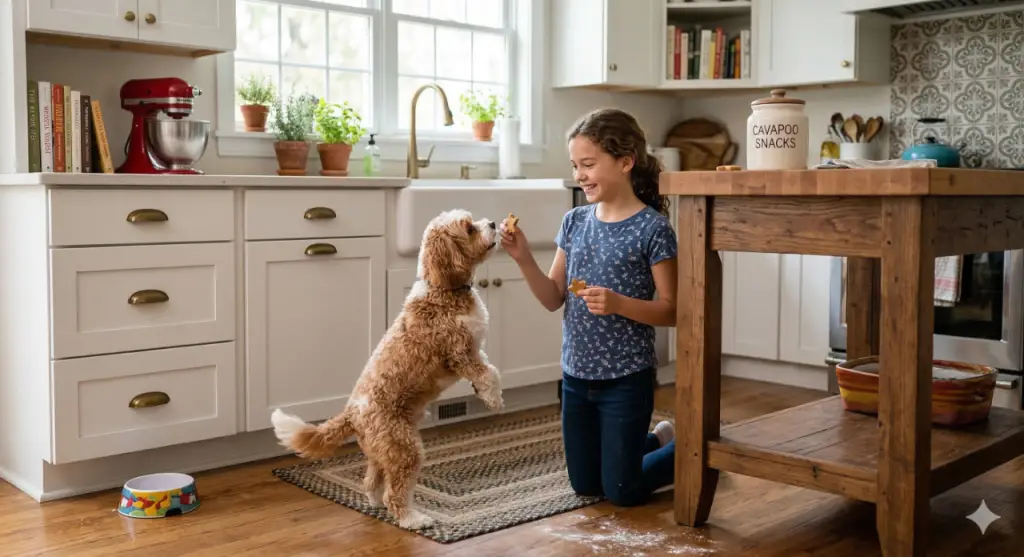
Elementary-aged children have endless energy. They want a dog that will play fetch in the backyard for hours, go on family hikes, and learn fun tricks. But they are still small enough that a giant, clumsy dog could accidentally knock them over during a game of tag.
The sweet spot for this age group is a medium-sized (15–40 lbs), sturdy, and tireless companion. Here are the four best options:
4. The Cockapoo (The Established Companion)
Mixing a Poodle with a Cocker Spaniel gives you one of the oldest, most established Doodle breeds in the world.
- The Temperament: Cockapoos are incredibly sweet-natured, heavily human-focused, and famously eager to please.
- Why They Fit Active Kids: They have a very sturdy, compact build that holds up well to active play, and they possess exactly enough energy to match a game of fetch without becoming hyperactive indoors.
- The Reality Check: Because they are so bonded to their families, they are highly prone to separation anxiety. They do best in a household where someone is usually home.
5. The Cavapoo (The Empathetic Best Friend)
By combining the Poodle with the Cavalier King Charles Spaniel, you get a dog that is practically tailor-made for emotional connection.
- The Temperament: According to the American Kennel Club (AKC), Cavaliers are famously affectionate and highly adaptable. Cavapoos inherit this remarkable ability to “read the room” and mirror a child’s energy level.
- Why They Fit Active Kids: They will happily run around the yard for an hour, but the second your child sits down to read a book, the Cavapoo will immediately settle into their lap.
- The Reality Check: Cavalier King Charles Spaniels have a high rate of genetic heart issues (specifically mitral valve disease). You must insist on seeing clear cardiac health screens from the breeder for the Cavalier parent.
6. The Schnoodle (The Loyal Playmate)
Mixing a Miniature or Standard Schnauzer with a Poodle creates an athletic, highly loyal backyard watchdog.
- The Temperament: Schnoodles are brilliant, robust, and full of personality. They lack the high prey drive of a herding breed but retain a strong, protective loyalty to their family pack.
- Why They Fit Active Kids: They are incredibly sturdy and love having a “job” to do, making them perfect partners for kids who want to set up backyard agility courses or teach advanced tricks.
- The Reality Check: Schnauzers can be vocal. If you live in an apartment or have close neighbors, you will need to actively train the Schnoodle from puppyhood not to bark at every squirrel or delivery driver.
7. The Whoodle (The Soft-Coated Athlete)
Combining a Poodle with a Soft Coated Wheaten Terrier results in a medium-sized dog with a famously bouncy, joyous personality.
- The Temperament: Wheaten Terriers are known for the “Wheaten Greetin'”—an exuberant, happy welcome. They completely lack the “sharpness” or aggression sometimes found in other terrier breeds.
- Why They Fit Active Kids: Whoodles are tireless, highly durable athletes. They are one of the few medium-sized Doodles that can effortlessly keep pace with a 10-year-old on a long hike or a bike ride.
- The Reality Check: That signature bounce can be overwhelming for toddlers, which is exactly why this breed is securely placed in the 5–10 age group. They need an older, more coordinated child who can handle a highly enthusiastic playmate.
Top 3 Calm Mixes for Older Children & Teens (Ages 11+)

Older children and teenagers have outgrown the loud, chaotic play of their younger years. They are usually looking for a quiet study buddy, a lap dog to watch movies with, or a highly trainable companion they can work with themselves.
This is where the smaller, more fragile Toy mixes finally shine. Weighing between 5 and 15 pounds, these dogs require the physical awareness and gentle handling that only older kids can consistently provide.
Here are the three best Poodle mixes for pre-teens and teenagers:
8. The Maltipoo (The Ultimate Lap Dog)
By crossing a Toy or Miniature Poodle with a Maltese, you get a dog that is bred strictly for companionship and comfort.
- The Temperament: Maltipoos are deeply affectionate and highly sensitive to household moods. They quickly become a “shadow” to their favorite person, following them from room to room.
- Why They Fit Teens: Middle school and high school can be emotionally exhausting. A Maltipoo provides quiet, non-judgmental comfort and will happily sit on a lap for hours while a teenager does homework.
- The Reality Check: Because they are so small and fine-boned, they are easily injured if accidentally stepped on or dropped. They also demand a lot of attention and can develop severe separation anxiety if ignored by a busy teen.
9. The Shih-poo (The Quiet Couch Potato)
Mixing a Poodle with a Shih Tzu creates a deeply loyal, low-energy companion with a famously stubborn streak.
- The Temperament: Unlike the bouncy Whoodle or the retrieving Goldendoodle, the Shih-poo is perfectly content doing absolutely nothing. They are sturdy little dogs, but they lack high exercise demands.
- Why They Fit Teens: If your older child prefers reading, gaming, or watching TV over hiking and running, the Shih-poo is the perfect match. They are happy to simply exist in the same room as their person.
- The Reality Check: That Shih Tzu genetics brings a lot of stubbornness. Housebreaking a Shih-poo often takes significantly longer than other Poodle mixes, requiring maturity and patience from the older child helping to train them.
10. The Miniature Labradoodle (The Eager Learner)
When you combine a Labrador Retriever with a Miniature Poodle, you get a highly intelligent, food-motivated dog in a much smaller, more manageable package (usually 15–25 lbs).
- The Temperament: They are eager to work, highly focused on their handlers, and pick up on new commands incredibly fast.
- Why They Fit Teens: Older kids finally have the focus and coordination to actively train a dog. A Mini Labradoodle is the perfect size for a pre-teen who wants to take the lead on teaching advanced tricks, or even setting up a backyard agility course.
- The Reality Check: A brilliant dog needs a job. They require mental stimulation just as much as physical exercise. If a teenager gets bored and stops training them, this smart mix will quickly find destructive ways to entertain themselves.
The Reality of the “Low-Maintenance” Family Dog
A non-shedding coat is a massive selling point for families. Keeping your house clean and free of tumbleweeds of dog hair sounds like a dream for a busy parent.
But there is a hidden catch that breeders rarely emphasize: a non-shedding coat is a high-maintenance coat. I learned this reality very quickly with my own black Standard Poodle, Angus. The lack of dog hair on our furniture was amazing, but a Poodle’s hair grows continuously.
When you mix that continuously growing Poodle hair with the shedding coat of a retriever or spaniel, the dead hair doesn’t just fall away. Instead, it gets trapped inside the tight curls, rapidly forming painful, tight mats close to the dog’s skin.
Grooming is a Parenting Chore
To prevent this matting, you cannot just run a cheap brush over the top of the dog’s back. You have to learn a technique called “line-brushing,” which involves parting the hair and brushing from the root outward.
If you are a busy parent already balancing soccer practices, meal prep, and homework, you must factor this daily grooming time commitment into your decision.
The Doodle Grooming Time Commitment Chart
Depending on the generation of your Poodle mix (and how you ask the groomer to cut their hair), your daily labor will vary wildly. Use this chart to set realistic expectations:
| Coat Type | Daily At-Home Requirement | Professional Grooming Frequency | Best For… |
| F1 Wavy (Fleece) | 10–15 minutes of thorough line-brushing. | Every 6 to 8 weeks. | Families wanting the classic “teddy bear” look who have time for moderate daily upkeep. |
| F1b Curly (Wool) | 20+ minutes of strict, deep line-brushing. | Every 4 to 6 weeks. | Allergy sufferers (due to higher Poodle genetics), but requires immense, daily hands-on labor. |
| The “Puppy Cut” | 5 minutes of light surface brushing. | Every 4 to 6 weeks (clipped very short). | Busy parents who want zero matting headaches, maximum playtime, and don’t mind a shorter coat. |
Frequently Asked Questions (FAQ)
Q: Which Poodle mix is the easiest for a first-time family to train? A: Generally, the Goldendoodle and the Labradoodle are considered the easiest for first-time owners. Both parent breeds (Retrievers and Poodles) rank in the top five for canine intelligence and “biddability”—the desire to work with and please their handlers. This makes them highly responsive to positive reinforcement training compared to more stubborn mixes like the Shih-poo.
Q: Are Poodle mixes actually hypoallergenic for kids? A: No dog is truly 100% hypoallergenic. While Poodle mixes shed significantly less than other breeds, they still produce dander and saliva, which are the primary triggers for allergies. For children with sensitivities, an F1b generation (75% Poodle) is often the safest bet, but you should always consult with an allergist and perform a “meet and greet” with the specific dog first.
Q: What is the calmest Poodle mix for a quiet household? A: If you are looking for a “chill” companion, the Bernedoodle (Standard size) and the Shih-poo are typically the calmest. The Bernese Mountain Dog and Shih Tzu genetics act as a natural “mute button” for the high-energy, high-strung nature often found in purebred Poodles, resulting in a dog that is happy to lounge around the house.
Q: Are Poodle mixes aggressive toward children? A: Aggression is rarely a breed trait in Doodles; it is usually a result of poor socialization or fear. Because Poodle mixes are highly sensitive, they can become reactive if they are teased or handled roughly by children. This is why choosing a sturdy mix like a Newfypoo or Standard Goldendoodle is vital for younger kids—these dogs are less likely to feel threatened by accidental rough play.
Q: Do Doodles bite more than other dogs? A: There is no scientific evidence that Doodles bite more than other breeds. However, like all puppies, they go through a “land shark” phase during teething. Because many Poodle mixes have a “retrieving” instinct, they are naturally more mouthy. Providing appropriate chew toys and consistent bite-inhibition training is essential during the first six months.
Q: Which Poodle mix is best for a small apartment with kids? A: The Cavapoo and the Cockapoo are the gold standard for apartment living. They are small enough to live comfortably in limited square footage but sturdy enough to be safe around children. They generally have moderate energy levels that can be satisfied with a daily walk and some indoor play.
Conclusion: Choosing the Right Poodle Mix for Your Family
Selecting a family dog is a 10-to-15-year commitment. While it is easy to get distracted by “designer” labels and cute puppy photos, the safest and most successful placements always happen when parents prioritize sturdiness and temperament over aesthetics.
Remember, there is no such thing as a “low-maintenance” dog. Whether you choose a massive, patient Newfypoo or a sensitive, loyal Maltipoo, your new family member will require consistent training, daily grooming, and plenty of mental stimulation. By matching the dog’s size and energy level to your child’s current age and maturity, you are setting both your pet and your children up for a lifetime of safe, happy memories.
Explore More From Poodle Report:
- 50 Best Poodle Mixes (2026): Traits, Cognition & Realities
- 10 Safest Low-Maintenance Poodle Mixes for Seniors (2026 Guide)
Medical & Veterinary Disclaimer: PoodleReport.com is an informational resource for Poodle owners and enthusiasts. We are not veterinarians. The content on this website is not a substitute for professional veterinary care, diagnosis, or treatment. Always seek the advice of your veterinarian with any questions you may have regarding your pet’s medical condition, diet, or overall health.