
Disclaimer: The information provided on PoodleReport.com is for educational purposes only and does not constitute veterinary medical advice; always consult your vet before changing your dog’s diet. Additionally, this post contains affiliate links. As an Amazon Associate, and other affiliate advertising programs, I earn from qualifying purchases at no extra cost to you.
When you first start looking into getting a crossbreed, reading breeder websites can feel like trying to decipher a secret genetic code. You are instantly hit with labels like F1, F1b, F2, and Multigen. As a researcher and someone who shares my home with a black Standard Poodle named Angus, I can tell you that these aren’t just fancy marketing terms—they are the key to predicting your future dog’s coat, health, and shedding level.
Before you put down a deposit on a puppy, here are the core takeaways you need to understand:
Key Takeaways: Decoding Doodle Generations
- The “F” stands for Filial: It simply means the dog is a hybrid, representing the generation after the purebred parents.
- The “B” stands for Backcross: This means the dog was bred back to a purebred Poodle to increase the curly, hypoallergenic traits.
- F1b is best for allergies: Because they are 75% Poodle, they are the safest bet for families who need a low-shedding dog.
Understanding these generations is the only way to ensure the puppy you bring home actually fits your lifestyle. Whether you are browsing my Poodle Mixes category for general research or trying to narrow down your choices from our 50 Best Poodle Mixes guide, knowing how to read these generational labels will save you from unexpected shedding and massive grooming bills.
Decoding the Doodle Alphabet: What Do “F” and “B” Mean?
To truly understand Poodle mix generations, we have to look at the terminology used in basic genetics—the exact same terminology used in biological research.
- F (Filial): This indicates that the dog is a crossbreed or hybrid. It denotes the filial generation following the original purebred parents.
- The Number (1, 2, 3): This tells you exactly how many generations removed the dog is from the original purebred cross.
- B (Backcross): When you see a “B,” it means an existing Poodle mix was bred back to a purebred parent. In the Doodle world, this parent is almost always a purebred Poodle to reinforce the hypoallergenic, non-shedding coat.
The Generation Breakdown: F1, F1b, F2, and Multigen
Instead of just looking at the mathematical percentages, it is vital to understand what these generations actually mean for your daily life as an owner. Here is a quick-reference chart to help you visualize the genetic split:
| Generation | Parent A | Parent B | Genetic Makeup (Approx.) |
| F1 | Purebred Poodle | Purebred (e.g. Lab) | 50% Poodle / 50% Other |
| F1b | F1 Poodle Mix | Purebred Poodle | 75% Poodle / 25% Other |
| F1bb | F1b Poodle Mix | Purebred Poodle | 87.5% Poodle / 12.5% Other |
| F2 | F1 Poodle Mix | F1 Poodle Mix | 50% Poodle / 50% Other |
| Multigen | F1b or higher | F1b or higher | 75%+ Poodle |
F1 (First Generation): The 50/50 Split
An F1 Poodle mix is the direct result of breeding a purebred Poodle with another purebred dog.
- The Pros: F1 mixes benefit from maximum “hybrid vigor.” According to the Institute of Canine Biology, a wider gene pool can naturally protect these dogs against many inherited recessive diseases that plague purebreds.
- The Cons: Their coats are a genetic roll of the dice. They are not recommended for severe allergy sufferers.
F1b (First Generation Backcross): The Allergy Safe Bet
This is the holy grail for families looking for a hypoallergenic pet.
- The Pros: Highly likely to inherit the RSPO2 “furnishings” gene, resulting in a non-shedding coat.
- The Cons: They are essentially “mostly Poodle.” They are often high-energy and require significant mental stimulation.
F2 (Second Generation): The Unpredictable Wildcard
An F2 is created by breeding two F1 Poodle mixes together.
- The Pros: Maintains the 50/50 breed split many families enjoy.
- The Cons: Breeding two hybrids together allows recessive traits—like a heavy-shedding flat coat—to resurface.
Multigen: The Breeder’s Gold Standard
Any generation beyond an F2 is referred to as “Multigenerational.” Responsible breeders, like those following the standards of the Goldendoodle Association of North America (GANA), use Multigen lines to guarantee consistent “teddy bear” looks and non-shedding coats.
Shedding & Allergy Probability Chart
Because I know most of you are reading this to find a dog that won’t make you sneeze, here is how the shedding probability ranks across the generations:
| Generation | Shedding Risk | Coat Texture | Best for Allergies? |
| F1 | Moderate to High | Wavy / Shaggy | No |
| F1b | Very Low | Curly / Wavy | Yes |
| F1bb | None to Trace | Tightly Coiled | Best Choice |
| F2 | High Risk | Unpredictable | No |
| Multigen | Very Low | Curly / Fleece | Yes |
The “Heterosis” Myth: Is Hybrid Vigor Always Real?
Many breeders use the term “Hybrid Vigor” (scientifically known as heterosis) to claim that F1 Poodle mixes are naturally healthier than purebreds. While it is true that a wider gene pool can reduce the risk of inheriting breed-specific recessive disorders, it is not a magical shield against poor breeding.
In my research, I have found that hybrid vigor only works if both parents are health-cleared. For example, if a Poodle with a genetic predisposition for Sebaceous Adenitis is bred to a Golden Retriever with Hip Dysplasia, the resulting F1 puppies are still at high risk. Hybrid vigor is most effective in the F1 generation and begins to diminish in F2 and Multigen litters. To ensure your dog is actually healthy, ignore the “F” label for a moment and verify that the breeder is using OFA-cleared parents.
The “F2 Flat Coat Trap”: What Every Buyer Must Know
If you are browsing litters and see an F2 Poodle mix for the same price as an F1b, proceed with caution. In my years of research, I have found that the F2 generation is the most common place for “The Flat Coat Trap”—a situation where a Poodle mix puppy grows up to look exactly like a Labrador or Golden Retriever, with no beard, no mustache, and a massive amount of shedding.
Why Does This Happen?
This is caused by the Granddad Effect. When you breed two F1 hybrids together, you are mixing two sets of “unfurnished” genes. According to the Orthopedic Foundation for Animals (OFA), if a puppy inherits two copies of the recessive non-furnishings gene, they will lack the “Doodle look” entirely.
Breeders sometimes call this an “Improper Coat.” While these dogs are wonderful companions, they are often sold at a “designer” premium despite having none of the hypoallergenic benefits that people seek in a Poodle mix.
Beyond Letters: DNA Testing is the New Standard
In 2026, the best way to protect yourself isn’t just looking at the F1 or F2 label—it’s looking at the DNA. If you are serious about a non-shedding dog, ask your breeder for the parent’s results from a lab like Embark Veterinary or Paw Print Genetics.
You specifically want to see the results for the RSPO2 (Furnishings) gene.
- FF: Two copies of furnishings (Non-shedding guaranteed).
- FI: One copy of furnishings (Likely low-shedding).
- II: No furnishings (This puppy will shed exactly like a standard dog).
Quick DNA Check: What to Ask Your Breeder
Use this simple table to evaluate a breeder’s transparency before you buy:
| Question to Ask | Why it Matters | Green Flag Answer |
| “Do the parents have DNA panels?” | Confirms they aren’t hiding recessive shedding genes. | “Yes, here are the Embark results.” |
| “Does the litter have furnishings?” | Ensures the puppies will have the “teddy bear” look. | “Both parents are FF (furnished).” |
| “Are the parents OFA cleared?” | Guarantees the dog is healthy, not just pretty. | “Yes, hips and eyes are cleared.” |
The “Hidden Costs” of Doodle Generations
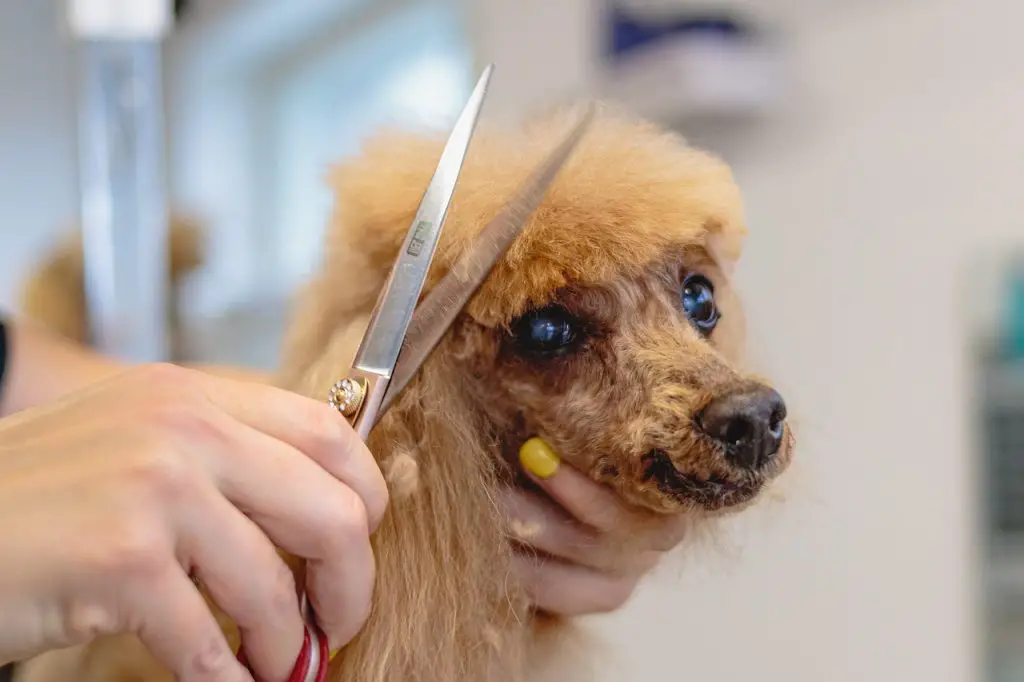
One of the most significant gaps in standard breeder advice is the failure to mention how a generation label directly impacts your bank account. As a researcher and Poodle owner, I’ve seen that the closer a dog is to a Poodle’s genetic makeup (like the F1b or F1bb), the higher the lifetime maintenance cost becomes.
When you choose a generation with more Poodle DNA, you aren’t just buying a “non-shedding” dog; you are subscribing to a lifelong professional grooming commitment. Because the hair on a high-percentage Poodle mix continues to grow rather than fall out, it requires intensive care to prevent painful matting.
2026 Grooming Cost & Maintenance Breakdown
Based on current 2026 data from professional grooming associations, here is how the different generations compare in terms of time and cost:
| Generation | Coat Type | Brushing Frequency | Professional Grooming | Avg. Yearly Cost |
| F1 | Wavy / Fleece | 2–3 times per week | Every 8–10 weeks | $650 – $800 |
| F1b / F1bb | Curly / Wool | Daily | Every 4–6 weeks | $1,200 – $1,800+ |
| F2 | Variable | 2–3 times per week | Every 8–12 weeks | $500 – $750 |
| Multigen | Wavy to Curly | 3–5 times per week | Every 6–8 weeks | $900 – $1,300 |
The “F1 Puppy Coat Blow”
If you bring home an F1 generation puppy, be prepared for a major transition around the 9-to-12-month mark. This is known as the “coat blow,” where the soft, easy-to-manage puppy fur is replaced by the adult coat.
During this phase, the shedding puppy hair often gets trapped in the emerging adult curls, creating massive “hidden” mats near the skin. If you aren’t brushing daily during this window, your groomer will likely be forced to do a full shave-down to keep the dog comfortable. To avoid this, I recommend starting a professional grooming schedule before your puppy is 6 months old to get them used to the process.
Sizing Predictability: Why Generations Affect the Scale
Aside from shedding, sizing is the most common surprise for new Doodle owners. If you are looking for a “Mini” or “Toy” mix, the generation you choose significantly impacts how likely the dog is to stay within that size range.
- F1 Sizing (The “Throwback” Risk): F1 mixes are prone to “throwback” genes. It is not uncommon for an F1 Mini Goldendoodle to grow much larger than both of its parents because it can inherit the larger bone structure of its non-Poodle grandparents.
- F1b and Multigen Sizing (The Safe Bet): These generations offer much more size predictability. Because the breeder is working with a higher percentage of Poodle DNA—often from a Toy or Miniature Poodle—they have more control over the genetic “dosage.”
If your living situation has a strict weight limit (such as an apartment or HOA), I always recommend an F1b or Multigen over an F1 or F2 to avoid a 50-pound surprise.
Frequently Asked Questions (FAQ) & Final Thoughts
To wrap up this guide, I’ve pulled together the most common questions I hear from readers who are trying to navigate the complex world of Doodle generations.
Which Poodle mix generation is the healthiest? Technically, the F1 generation often holds the title for the “healthiest” because it possesses the highest level of hybrid vigor. However, health is never a guarantee based on letters alone. Regardless of the generation, always ensure the breeder has performed OFA (Orthopedic Foundation for Animals) screenings on the parents for hips, elbows, and eyes.
Does a higher percentage of Poodle change the dog’s temperament? Yes. As the owner of a Standard Poodle, I can tell you that Poodles are high-energy, high-intelligence working dogs. An F1b or F1bb (which is 75% to 87.5% Poodle) will likely be more sensitive, more active, and require more mental stimulation than a 50/50 F1 mix.
Can I tell if an F2 puppy will shed just by looking at it? Not always at 8 weeks. While the “muzzle test” (looking for a mustache) is a great indicator, the safest way to avoid the “F2 Flat Coat Trap” is to see the DNA results for the RSPO2 gene as discussed in the previous section.
Final Thoughts: Choosing Your Perfect Mix
Navigating F1, F1b, and F2 labels is about more than just math—it’s about matching a dog’s genetic reality to your lifestyle. If you have severe allergies, the F1b, F1bb, or a high-quality Multigen are your only reliable options. If you prefer the “hybrid vigor” and a shaggier, more athletic look, the F1 is a classic choice, provided you can handle a bit of moderate shedding.
Before you make your final decision, I highly recommend exploring our other resources to see which specific breed fits these generations best:
- Explore the Gallery: Check out my 50 Best Poodle Mixes guide to see photos of these generations in action.
- Deep Dive: Browse my full Poodle Mixes category for breed-specific shedding and temperament reports.
By doing your research now, you ensure that the puppy you bring home is a perfect, healthy fit for your family for years to come.
Medical & Veterinary Disclaimer: PoodleReport.com is an informational resource for Poodle owners and enthusiasts. We are not veterinarians. The content on this website is not a substitute for professional veterinary care, diagnosis, or treatment. Always seek the advice of your veterinarian with any questions you may have regarding your pet’s medical condition, diet, or overall health.