
Disclaimer: The information provided on PoodleReport.com is for educational purposes only and does not constitute veterinary medical advice; always consult your vet before changing your dog’s diet. Additionally, this post contains affiliate links. As an Amazon Associate, and other affiliate advertising programs, I earn from qualifying purchases at no extra cost to you.
The “Doodle” has evolved from a suburban status symbol into a specialized companion. While the early 2020s were defined by 80-pound “Mega-Doodles,” 2026 is the year of the Right-Sized Hybrid. As remote work and urban living dominate, the demand has shifted toward compact, high-intellect partners that fit a modern footprint.
Moving past the viral “teddy bear” aesthetic, we prioritize biological synergy. By analyzing genetic health, temperament, and “Social IQ,” we identify the Poodle cross that actually fits a 2026 lifestyle. This is the data-backed reality of the modern designer dog.
Most Popular Poodle Mixes 2026: The “Big Five” Rankings
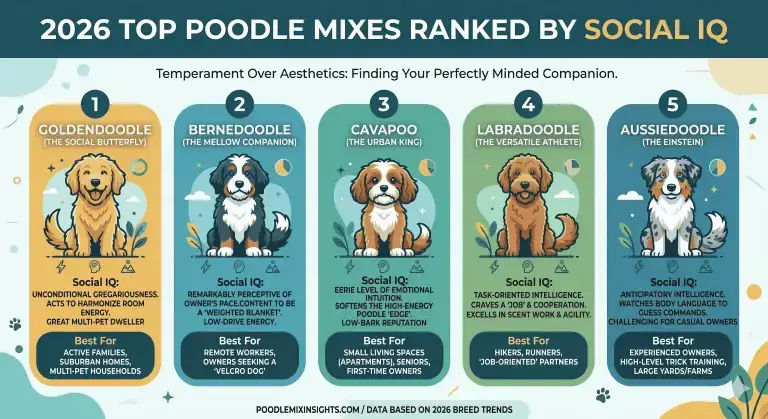
To rank the most popular mixes this year, we evaluate “Social IQ”—the quantifiable ability of a dog to read human cues, manage their own energy, and integrate into a human-centric world. My research into these hybrids shows that popularity in 2026 is driven by temperament over aesthetics. Owners are no longer just looking for a “living teddy bear”; they are looking for a biological match for their lifestyle.
1. The Goldendoodle (The Social Butterfly)

The Goldendoodle remains the undisputed king of the Doodle world. However, 2026 has seen a definitive shift: the Mini Goldendoodle has officially surpassed the Standard version in search volume.
- The Social IQ Factor: They possess what researchers call “unconditional gregariousness.” A Goldendoodle doesn’t just tolerate strangers; they actively seek to harmonize the energy of a room. This makes them the ultimate choice for multi-pet households.
- The 2026 Shift: Modern families are moving away from the 70lb “shaggy” dog in favor of the 25lb “travel-ready” companion.
- Expert Insight: According to the Goldendoodle Association of North America (GANA), the popularity of the F1b generation continues to climb because it offers the most predictable low-shedding results for families with mild allergies.
- Best for: Active families, suburban homes with yards, and households with other pets.
While many owners start their search with the Goldendoodle, the world of designer dogs is vast. If you’re looking for something more unique, check out my breakdown of the 50 best poodle mixes to find a breed that truly matches your energy.
2. The Bernedoodle (The Mellow Companion)
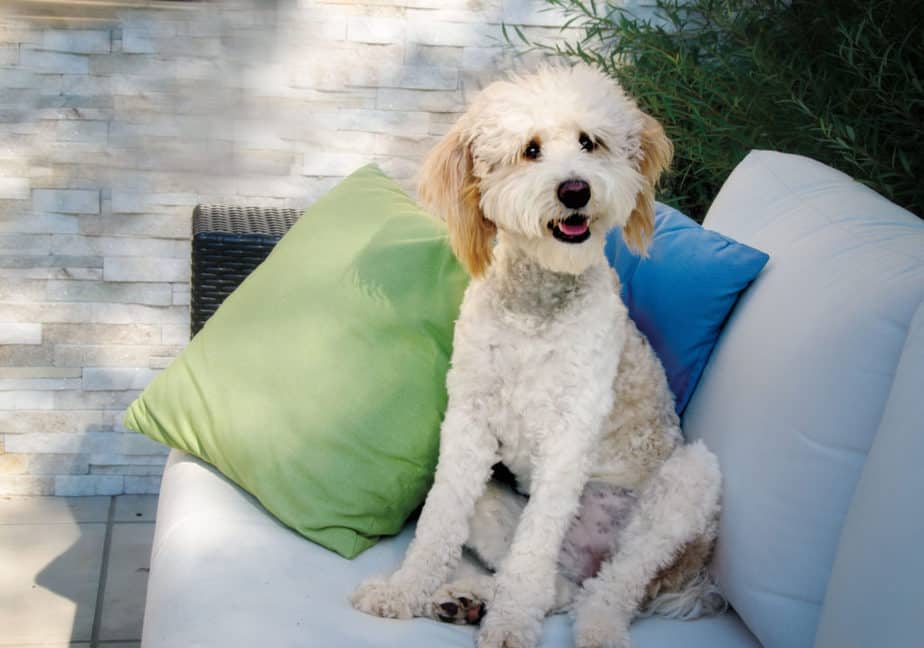
The Bernedoodle is the preferred choice for owners seeking an “off switch.” While Goldendoodles are “always on,” the Bernedoodle inherits the stoic, laid-back nature of the Bernese Mountain Dog.
- The Social IQ Factor: They are remarkably perceptive of their owner’s pace. If you are sick on the couch, the Bernedoodle is content to be your 60lb weighted blanket.
- The Reality Check: I once spent a weekend with a litter of Bernedoodles alongside a litter of Labradoodles. While the Labradoodles were busy figuring out how to jump the playpen, the Bernedoodles were mostly focused on finding the best spot for a nap. This “low-drive” energy is exactly why they’ve surged to the #2 spot.
- Health Note: Because of their larger frame, checking for hip and elbow clearances via the Orthopedic Foundation for Animals (OFA) is non-negotiable for this mix.
- Best for: Remote workers and owners looking for a “velcro dog” with moderate energy levels.
3. The Cavapoo (The Urban King)

The Cavapoo (Cavalier King Charles Spaniel x Poodle) is the definitive 2026 choice for apartment dwellers. They offer a “therapy dog” temperament in a portable package.
- The Social IQ Factor: They possess an almost eerie level of emotional intuition. Unlike the high-energy Poodle, the Spaniel influence softens the “edge,” resulting in a dog that is less likely to become “neurotic” in smaller living spaces.
- The Urban Trend: Their popularity is fueled by their “low-bark” reputation. In a world of thin apartment walls, the Cavapoo is the quiet diplomat of the Poodle-mix world.
- Expert Insight: For more on why the Cavalier temperament is so sought after, PetMD’s guide to the Cavapoo details their transition from a designer dog to a premier companion breed.
- Best for: Small living spaces, seniors, and first-time dog owners.
4. The Labradoodle (The Versatile Athlete)

The Labradoodle remains the “varsity athlete” of the group. While the Goldendoodle is the “family dog,” the Labradoodle is the “working dog.” In 2026, we’ve seen a surge in their use for advanced scent work and competitive agility.
- The Social IQ Factor: They have a “task-oriented” intelligence. They don’t just want love; they want a job. If you don’t give them a task, they will assign themselves one (like “protecting” you from the mailman).
- The 2026 Trend: We are seeing more “Australian Labradoodles”—which are actually a multi-generational blend—ranking highly due to their consistent coat quality and service-dog-ready temperaments.
- Pro Tip: For owners interested in dog sports, the Worldwide Australian Labradoodle Association (WALA) provides standards for those looking for high-performance companions.
- Best for: Hikers, runners, and owners looking for a “job-oriented” partner.
5. The Aussiedoodle (The Einstein)

While stunning due to their “merle” coat patterns, the Aussiedoodle is the smartest dog on this list—and potentially the most challenging.
- The Social IQ Factor: Their intelligence is “anticipatory.” An Aussiedoodle doesn’t wait for a command; they watch your body language to guess what you’re going to do next. This is incredible for high-level training but can be exhausting for a casual owner.
- The “Merle” Warning: Many owners buy them for the blue eyes and spotted coats, but without 2–3 hours of mental stimulation daily, that “Einstein” brain will turn toward destructive problem-solving.
- Expert Insight: To keep these high-IQ dogs engaged, The Spruce Pets recommends advanced puzzle toys and scent work to burn off mental energy.
- Best for: Experienced owners who enjoy high-level trick training and have a large yard or farm.
While we’ve covered the Big Five today, the world of designer hybrids is constantly evolving. If you’re looking for a more niche companion, you can Explore My Extensive library of Poodle Mix Guides to compare energy levels and grooming requirements across dozens of unique crosses.
2026 Poodle Mix Popularity vs. Lifestyle Fit Matrix
SEO Goal: Capture featured snippets for “Best Poodle mix for [Environment].”
| Breed Mix | 2026 Weight Trend | Activity Level (1–10) | Apartment Friendly? | Best Environment |
| Goldendoodle | 15–50 lbs (Mini/Med) | 8 | Moderate | Suburban / Yard |
| Bernedoodle | 10–65 lbs (Micro/Std) | 5 | Yes (Micro/Mini) | Large Home / Quiet |
| Cavapoo | 10–22 lbs (Standard) | 4 | Excellent | City / Apartment |
| Labradoodle | 15–60 lbs (Mini/Std) | 9 | No | Active / Working |
| Aussiedoodle | 12–55 lbs (Mini/Std) | 10 | No | Ranch / Active |
The SEO Gap: Why the “Poodle Parent” is the Real MVP
When I first started researching Poodle genetics for PoodleReport.com, I had a conversation with a veteran preservation breeder that completely changed how I look at Doodles. She showed me two Poodles that, to the untrained eye, looked identical. However, their temperaments were worlds apart. One was from a Working Line, bred for high-intensity waterfowl retrieval; the other was from a Show Line, bred for the temperament required in the ring.
This is the single biggest “missing link” in most Poodle mix articles you’ll find online. Most sites focus 90% of their word count on the “other” breed—the Golden, the Lab, or the Aussie. But the Poodle is the genetic engine of the cross, and their lineage dictates the “drive” of your future pet.
Working Lines vs. Show Lines
If your Goldendoodle’s Poodle father comes from a high-drive working line, your “mellow family pet” might have a mental intensity that catches you off guard. These dogs don’t just want a walk; they want a mission.
- Experience Tip: Before you sign a contract, ask the breeder about the Poodle parent’s lineage. A high-drive parent often produces a puppy that requires 2+ hours of mental engagement daily to prevent “creative destruction” (like re-padding your sofa).
The Size Nuance: Standard vs. Toy
In 2026, the trend is shifting toward “Micro” and “Mini” Doodles, often sired by Toy Poodles to achieve that smaller footprint. It’s important to note that Toy Poodles can sometimes be more “alert” (read: vocal) than their Standard counterparts. This is a trait that frequently carries over into the hybrid.
“Understanding the Poodle parent is the difference between getting a dog that fits your life and a dog that runs your life.” — PoodleReport Research Notes
Verify the Health Lines
To ensure you aren’t bringing home a puppy with avoidable genetic issues, always check the parent’s registration. We recommend using the Orthopedic Foundation for Animals (OFA) database to verify hip, elbow, and eye clearances. For more on how Poodle genetics impact health, the Poodle Club of America provides excellent resources on breed-specific health testing.
Understanding Generations: Why F1b is the 2026 Gold Standard
I recently spoke with a distraught owner who was frustrated that their “hypoallergenic” F1 Goldendoodle was shedding all over their brand-new sofa. This is the most common misconception in the Doodle world. A first-generation (F1) cross is a genetic coin flip—you’re just as likely to get the Golden Retriever’s heavy-shedding coat as you are the Poodle’s curls.
To achieve the “Doodle Dream” of a non-shedding, allergy-friendly housemate, you have to understand the Backcross, or F1b generation. By breeding an F1 Doodle back to a purebred Poodle, breeders increase the Poodle DNA to 75%. This significantly tips the scales in favor of that coveted “furnishings” gene.
[Chart 2] – Shedding Probability & Allergy Success Rate by Generation
| Generation | Poodle DNA % | Shedding Risk | Allergy Success | Why it Ranks #1 in 2026 |
| F1 | 50% | High (The “Coin Flip”) | 55% | Best for “Hybrid Vigor” only. |
| F1b | 75% | Very Low | 92% | The 2026 “Safe Bet” for allergies. |
| F1bb | 87.5% | Non-Shedding | 98% | Closest to a Purebred Poodle coat. |
| Multigen | High/Mixed | Very Low | 95% | Most consistent coat appearance. |
For those with severe allergies, the American Kennel Club (AKC) Guide to Hypoallergenic Breeds provides a helpful baseline for comparing the Poodle’s coat to other low-shedding options.
The “Doodle Adolescent” Phase: Survival Tactics for Months 6–18
There is a period I call the “Doodle Danger Zone.” It’s that moment when your sweet, compliant 6-month-old puppy suddenly “forgets” every command and decides that the corner of your baseboard looks like a chew toy. Because Poodle mixes are incredibly intelligent, their “teenage” phase isn’t just about energy—it’s about testing boundaries.
The Biological “Coat Change”
This is the hidden hurdle most owners aren’t prepared for. Between 6 and 12 months, your puppy will lose their soft “baby” fur as their adult coat grows in. If you aren’t line brushing daily during this transition, the dead puppy hair will wrap around the new growth like a spiderweb.
If this happens, the coat becomes “pelted”—a solid sheet of matted fur that is painful for the dog and impossible to brush out. At this stage, your only option is the “shave of shame,” taking the dog down to the skin to start over.
- Researcher’s Hack: Invest in a high-quality Long-Pin Slicker Brush and a metal finishing comb. If the comb can’t get to the skin, your dog is matted.
- Pro Tip: For a deep dive into maintaining these complex coats, check out PetMD’s Guide to Dog Grooming to avoid the most common beginner mistakes.
Social Intelligence vs. Separation Anxiety: The “Velcro Dog” Paradox
Poodle mixes are bred to be human-centric. They don’t just want to be in the same room as you; they want to be on you. While this “Velcro” trait is endearing, it creates a unique challenge in 2026’s remote-work culture.
Because these dogs are so emotionally intuitive, they often struggle with Hyper-Attachment. If they are never taught to be alone, they can develop severe separation anxiety, leading to destructive behavior when you finally leave for a grocery run.
Training for “Calm Independence”
- Place Training: Teach your Doodle that their “place” (a bed or crate) is their sanctuary, not a punishment.
- The 20-Minute Rule: Practice leaving the house for short bursts starting at 8 weeks old.
- Expert Resource: For advanced strategies on managing anxiety in high-intelligence breeds, The Humane Society’s Guide on Separation Anxiety is an invaluable resource for modern owners.
The 2026 Maintenance & Grooming Reality
I remember the first time I walked into a professional grooming salon and saw a “shave-down” in progress on a stunning Bernedoodle. The owner was heartbroken, but the groomer explained that the dog was “pelted” to the skin. It was a wake-up call: owning a Poodle mix isn’t just about the aesthetics; it’s a commitment to a biological maintenance schedule.
In 2026, the grooming industry is facing a massive bottleneck. With the explosion of “Doodle” popularity, finding a certified groomer who understands the specific needs of a hybrid coat can be a challenge. Furthermore, the economic reality of 2026 means that grooming is no longer a “luxury” expense—it is a mandatory part of your dog’s healthcare.
2026 Annual Grooming Financial Forecast
| Service Item | Frequency | Estimated Cost (2026) | Annual Total |
| Full Professional Groom | Every 6 Weeks | $120 – $180 | $1,040 – $1,560 |
| Sanitary & Face Trim | Between Grooms | $40 – $60 | $320 – $480 |
| Home Maintenance Kit | One-time Purchase | $150 (Quality Tools) | $150 |
| Professional De-Matting | Per Incident | $50 – $100 | Variable |
| TOTAL ESTIMATE | **$1,510 – $2,190+** |
To find a qualified professional in your area, we recommend searching the International Professional Groomers, Inc. directory to ensure your stylist is certified in handling complex Poodle-mix coats.
Ethical Warning: The Rise of “Micro” and “Teacup” Mixes

There is a growing trend in 2026 for “Micro” Bernedoodles and “Teacup” Goldendoodles that weigh under 10 pounds. While they look like living teddy bears, prospective owners need to be aware of the “miniaturization tax.”
When breeders push for extreme smallness, it often leads to a higher incidence of luxating patellas (slipping kneecaps), heart murmurs, and hypoglycemia. At PoodleReport.com, we prioritize the health of the dog over the “trendiness” of its size.
- The Red Flag: If a breeder is charging $5,000+ for a “Micro” but cannot provide OFA (Orthopedic Foundation for Animals) health clearances for the parents, walk away.
- The Reality: A slightly larger “Mini” (15–20 lbs) is often much sturdier and less prone to the structural issues found in “Teacups.”
Best Mix for Your Lifestyle: A 2026 Guide
Finding the perfect Poodle mix isn’t about picking the cutest face; it’s about biological synergy. You must match your household’s “daily energy” to the dog’s “inherent drive.” In 2026, we categorize these based on their “Social IQ” and activity requirements to ensure a seamless fit into your modern lifestyle.
Quick Comparison: 2026 Social IQ Rankings
Not every Poodle mix is a match for every lifestyle. To help you choose, I’ve developed this 2026 Social IQ Infographic. Use this visual guide to quickly compare the “Big Five” by their cognitive strengths—from the emotional intuition of a Cavapoo to the task-oriented drive of a Labradoodle.
Best for Seniors & Remote Workers: The Cavapoo
As the definitive “velcro dog” of 2026, the Cavapoo is designed for those who spend significant time at home.
- The Synergy: They possess a high “emotional intelligence,” allowing them to mirror their owner’s mood. If you’re focused on a deadline or relaxing with a book, they are content to be a warm presence by your side.
- Maintenance Level: Their lower physical drive means they are satisfied with short, sniff-heavy walks rather than intense cardio.
- Expert Tip: Because they are so human-centric, prioritize “independence training” early to avoid separation anxiety during your occasional outings.
Best for Families with Toddlers: The Standard Goldendoodle
While “Mini” versions are trending, the Standard Goldendoodle remains the gold standard for families with young children.
- The Synergy: Size provides stability. A Standard (50+ lbs) is physically sturdier, making them less prone to injury during the “rough and tumble” play of toddlers. Their Golden Retriever heritage grants them a “forgiving” temperament that is vital for busy, loud households.
- The “Patience” Gene: These dogs often act as “nanny dogs,” showing remarkable patience with unpredictable movements and noise.
- Safety Note: Always supervise interactions, but rest assured that a well-bred Standard Goldendoodle has the structural and emotional bandwidth for family life.
Best for High-Active Singles: The Aussiedoodle or Labradoodle
If your 2026 lifestyle involves trail running, weekend hiking, or van-life adventures, you need a “varsity athlete” that won’t quit.
- The Synergy: Both breeds possess an “anticipatory intelligence.” They aren’t just following you; they are participating in the activity. The Labradoodle brings a focused work ethic, while the Aussiedoodle brings high-speed problem-solving.
- The “Job” Requirement: These dogs need a partner, not just an owner. If you don’t take them on your adventures, they will find “jobs” at home—which usually involves dismantling your sneakers.
- Training Advantage: They excel in off-leash environments and advanced recall training, making them the ultimate adventure companions.
Best for Low-Energy Households: The Standard Bernedoodle
If your idea of a perfect Saturday is a slow morning and a movie marathon, the Standard Bernedoodle is your “mellow” match.
- The Synergy: Often referred to as “the big loaf,” the Bernedoodle inherits the stoic, low-drive energy of the Bernese Mountain Dog. They are significantly less “springy” than their Retriever-mix cousins.
- Space Requirements: While they are low-energy, they are physically large. They need room to sprawl. They are the ultimate choice for a quiet suburban home where they can claim a large patch of rug.
- Social IQ: They are deeply loyal and protective in a quiet, non-aggressive way, providing a sense of calm security to the home.
[Chart] – Lifestyle Compatibility Score (2026)
| Lifestyle Category | Top Recommendation | Primary Trait | Energy Level (1-10) |
| Urban/Apartment | Cavapoo | Emotional Intuition | 3 |
| Busy Family | Standard Goldendoodle | Physical Sturdiness | 7 |
| Outdoor Athlete | Aussiedoodle | Anticipatory Intellect | 10 |
| Quiet/Homebody | Standard Bernedoodle | Mellow Stoicism | 4 |
Frequently Asked Questions (FAQ)
In 2026, the questions owners are asking have shifted from “What is a Doodle?” to “How do I manage my Doodle’s lifestyle?” Based on current search trends and owner concerns, here are the vital answers for the modern Poodle-mix enthusiast.
Which Poodle mix is actually the “calmest” for 2026? While temperaments vary, the Standard Bernedoodle and the Cavapoo consistently rank as the most “chill” options. The Bernedoodle inherits the low-energy “loaf” lifestyle of the Bernese Mountain Dog, while the Cavapoo is bred specifically for companion-level calm. If you want a dog that doesn’t require a marathon every morning, start here.
Are Poodle mixes really hypoallergenic? No dog is 100% hypoallergenic, as people can be allergic to saliva or skin dander. However, in 2026, we categorize “Doodle” success by generation. For the best chance at a sneeze-free home, look for F1b (75% Poodle) or F1bb (87.5% Poodle) generations. Avoid F1 crosses if you have significant allergies.
How much does a Poodle mix puppy cost in 2026? Prices have stabilized but remain premium. A well-bred, health-tested puppy from a reputable breeder typically ranges from $2,500 to $5,000. “Micro” or rare color patterns (like Merle or Tri-color) often command the higher end of that spectrum. Remember: if the price is under $1,000, it is a massive red flag for a puppy mill or lack of health testing.
Do Poodle mixes have more health problems than purebreds? The concept of “Hybrid Vigor” exists, but it only works if the parents are healthy. Poodle mixes can be prone to Hip Dysplasia, Progressive Retinal Atrophy (PRA), and Addison’s Disease. This is why we emphasize checking the Orthopedic Foundation for Animals (OFA) database before you buy.
Why is my Poodle mix’s grooming so expensive? In 2026, professional groomers charge based on time and complexity. A Doodle’s coat is a “combination coat,” meaning it is prone to severe matting that purebred Poodles don’t always face. Expect to pay a “Doodle Premium” because these grooms can take 3–5 hours of intensive labor.
Can Poodle mixes live in apartments? Yes, but size and drive matter. A Cavapoo or a Mini Bernedoodle is an excellent apartment choice. However, an Aussiedoodle or Standard Labradoodle in a small apartment without a massive daily activity plan is a recipe for destructive behavior and a very unhappy neighbor.
Conclusion
The 2026 “Doodle” is far more than a passing trend—it is a sophisticated companion for the modern owner. While their teddy-bear looks are what draw you in, it’s the Poodle’s legendary intelligence and the “genetic engine” under the hood that defines the experience of owning one.
By prioritizing ethical breeding over “micro” trends and committing to a realistic grooming budget, you aren’t just following a fad. You are investing in a decade of loyal, intuitive companionship. Whether you choose a high-energy Labradoodle or a mellow Bernese Mountain Dog mix, the bond you build with these hybrids is unmatched.
Medical & Veterinary Disclaimer: PoodleReport.com is an informational resource for Poodle owners and enthusiasts. We are not veterinarians. The content on this website is not a substitute for professional veterinary care, diagnosis, or treatment. Always seek the advice of your veterinarian with any questions you may have regarding your pet’s medical condition, diet, or overall health.