

Disclaimer: The information provided on PoodleReport.com is for educational purposes only and does not constitute veterinary medical advice; always consult your vet before changing your dog’s diet. Additionally, this post contains affiliate links. As an Amazon Associate, and other affiliate advertising programs, I earn from qualifying purchases at no extra cost to you.
Dogs are great companions, but sometimes, they do things that leave us scratching our heads. One of those odd behaviors is eating things they aren’t supposed to eat. Paper products left within reach of your Poodle can become a real headache, not to mention a health threat to your pet.So why do poodles eat paper?
There are 4 main reasons why your poodle might be eating or shredding paper products:
- 1. Genetics
- 2. Boredom
- 3. Separation Anxiety
- 4. Pica and Dietary Gaps
In this article, we are going to dive into the different reasons why your poodle might be eating paper products and give you solutions to help break that habit along the way. If your dog is eating paper and napkins, keep reading!
Why Do Poodles Eat Paper? The 4 Core Realities
If you have ever walked into the living room to find your Poodle sitting proudly in a pile of shredded napkins, you already know how frustrating this habit can be. But why do they do it? When we look past the mess and dive into canine psychology,according to PetMD, there are four main reasons why your dog may be eating or chewing on paper products.
1. The “Retriever” Genetics: It is easy to forget beneath those stylish haircuts, but Poodles were originally bred as working water retrievers. They are naturally mouth-oriented dogs designed to gently hold, carry, and sometimes shred. The satisfying “rip” of a paper towel taps directly into that ancient, hardwired instinct to dissect a catch.
2. The High-Intelligence Tax (Boredom): Poodles consistently rank as the second smartest dog breed in the world. If you do not give their brain a job to do, they will invent one for themselves. Unfortunately, “shredding the mail” is a highly entertaining puzzle for an under-stimulated Poodle.
Researcher’s Tip: For many Poodles, boredom doesn’t just lead to paper snowstorms—it leads to a noisy house. If your dog is using their voice to get your attention as much as their teeth, see my evidence-based guide on How to Get a Poodle to Stop Barking.
3. Separation Anxiety: Ripping and chewing are naturally soothing behaviors for dogs. The repetitive motion releases endorphins in their brain. If your Poodle only destroys paper when you leave the house, they are likely using the napkins as a coping mechanism for their anxiety.
4. Pica and Dietary Gaps: There is a massive difference between a dog that shreds paper for fun and a dog that actively swallows it. If your Poodle is eating the paper, they may be suffering from Pica—a medical condition where dogs crave non-food items. This is often a red flag for an underlying gastrointestinal issue or a lack of sufficient fiber in their daily diet, which requires immediate veterinary attention.
f you seek signature Poodle intelligence without the massive physical footprint, focus your search exclusively on Miniature and Toy crossbreeds. Explore our full Poodle Behavior Guides to compare the specific barking levels and size realities of every small-scale doodle.
Shredding vs. Swallowing: A Crucial Difference
When trying to understand your Poodle’s behavior, you have to determine if they are playing or eating. There is a massive difference between a dog who shreds a napkin for fun and leaves the pieces on the rug, versus a dog who actively swallows the paper.
If your Poodle is swallowing the paper, they might be trying to soothe an upset stomach or seeking out dietary fiber. According to the Merck Veterinary Manual, actively eating non-food items can sometimes point to an underlying gastrointestinal issue or a nutritional deficiency. If you notice the paper is actually disappearing, it’s time to take a closer look at their diet!
Quick Diagnostic Guide: Play vs. Pica
Use this chart to quickly determine if your Poodle is just having fun or if it’s time to call the vet.
| Behavior | Normal “Retriever” Shredding (Play/Boredom) | Pica / Dietary Issue (Medical) |
| What happens to the paper? | Ripped into tiny pieces and left on the floor like confetti. | Swallowed whole or actively chewed and ingested. |
| Body Language | Wagging tail, playful pouncing, “play bow” stance. | Obsessive, secretive, hiding under furniture to eat it. |
| When does it happen? | Usually when left alone, bored, or trying to get your attention. | Happens constantly, even right after eating a full meal. |
| Other Items Targeted | Toys, cardboard boxes, sticks. | Dirt, rocks, drywall, feces, or your underwear. |
| Action Required | Pick up the paper, provide puzzle toys, and increase exercise. | Call your vet immediately to check for blockages or nutritional gaps. |
How to Stop Your Poodle from Eating Paper Products Fast
It is one thing to understand why your dog is treating your paper towels like a chew toy, but it is an entirely different challenge to actually stop it. When I was dealing with Angus’s paper-shredding phase, I quickly learned that yelling “drop it” from across the room doesn’t work. Because of a Poodle’s natural retrieving instincts, chasing them just turns the situation into a highly entertaining game of keep-away.
To permanently stop your Poodle from eating or shredding paper, you have to replace the bad habit with a healthy one. Here are the four proven steps to correct this behavior, along with the specific tools that actually work.
1. Environmental Management (The Immediate Fix)

The easiest way to stop a dog from eating paper is to remove the temptation entirely. It sounds simple, but managing their environment is step one.
- Upgrade Your Trash Cans: Swap out open wastebaskets for heavy, step-pedal trash cans with locking lids, especially in the bathroom and office. The [Simplehuman 50 Liter Stainless Steel Trash Can] is excellent for this because the foot-pedal design completely locks Poodles out of the trash.
- Shut the Doors and Block Hallways: If your Poodle targets toilet paper rolls, make it a strict house rule to keep bathroom doors fully closed. If you have open floor plans, setting up a sturdy [Baby Gate] can easily restrict their roaming area while you are out of the house.
- Clear the Surfaces: Do not leave mail, napkins, or tissue boxes on low coffee tables where a curious nose can easily reach them.
The 60-Second Paper-Proofing Audit
- [ ] Bathrooms: Are doors shut or is the TP roll out of reach?
- [ ] Home Office: Is the wastebasket tucked under a desk or lidded?
- [ ] Kitchen: Are napkins stored in a heavy dispenser rather than a stack?
- [ ] Entryway: Is the mail placed in a high tray immediately upon delivery?
2. The “Trade” Game for Retriever Instincts
If you catch your Poodle with a napkin in their mouth, never pry it out unless it is a life-threatening emergency. Instead, capitalize on their high intelligence and teach the “trade” game. Offer them a high-value, appropriate chew toy in exchange for the paper. When they drop the paper, praise them heavily.
To make the trade irresistible, you need chews that hold their attention. Here are a few highly durable options:
- Benebone Real Flavor Wishbone: Made with real bacon flavor, the curved shape makes it easy for Poodles to hold between their paws.
- Pet Parents Gnawtlers: These are 100% naturally shed elk antlers. They leave zero mess, have no odor, and are packed with natural marrow minerals.
- Eastblue Dog Chew Toy: If your Poodle is a heavy, aggressive chewer, this durable, non-toxic rubber toy helps clean their teeth while satisfying their urge to gnaw.
3. Drastically Increase Mental Stimulation
A tired Poodle is a good Poodle. However, physical exercise like walking isn’t always enough. Poodles need to work their brains to avoid boredom-induced destruction. Swap out their standard food bowl for an interactive puzzle feeder to make them “hunt” for their kibble.
- Puzzle Feeders: The StarMark Bob-A-Lot is a fantastic, inexpensive ways to force your Poodle to use their brain to dispense their food.
- Textured Chews: The Pineapple Indestructible Rubber Molar Toy acts as a puzzle and a teeth cleaner in one.
- Structured Learning: If you need step-by-step guidance on keeping their mind sharp, the Brain Training for Dogs course is a fantastic resource with a private member community for troubleshooting stubborn behaviors.
4. Soothe the Separation Anxiety
If the paper shredding only happens when you leave for work, anxiety is the culprit. You can help soothe a nervous dog by leaving a television or radio playing softly in the background to muffle outside noises. Additionally, confining them to a safe, dog-proofed area ensures they cannot self-soothe by destroying your house.
Crate training from a young age is one of the most effective ways to prevent anxiety-driven chewing. The MidWest Homes for Pets Folding Crate is easy to store and provides a secure, den-like environment. Just be sure to include a comfortable bed and a safe chew toy to keep them occupied while you are gone.
Researcher’s Note: In my study of the “Poodle Brain,” I’ve found that high-IQ breeds don’t just want to be with you—they want to work with you. If your Poodle is eating paper only when you leave, they are failing my Independence Protocol. Instead of just crating them, try giving them a “leaving-only” high-value puzzle toy to reframe your departure as a rewarding challenge rather than a loss.
For a deeper dive into my full step-by-step Independence Protocol and other cognitive training methods, visit my 2026 Poodle Behavior Guide.
The Quick Action Guide for Paper Chewers
If you are a visual learner—or if you just caught your Poodle in the act and need an immediate solution—I have put together this quick-reference guide. Feel free to save it to your phone or pin it to your favorite dog training board for the next time a napkin goes missing!
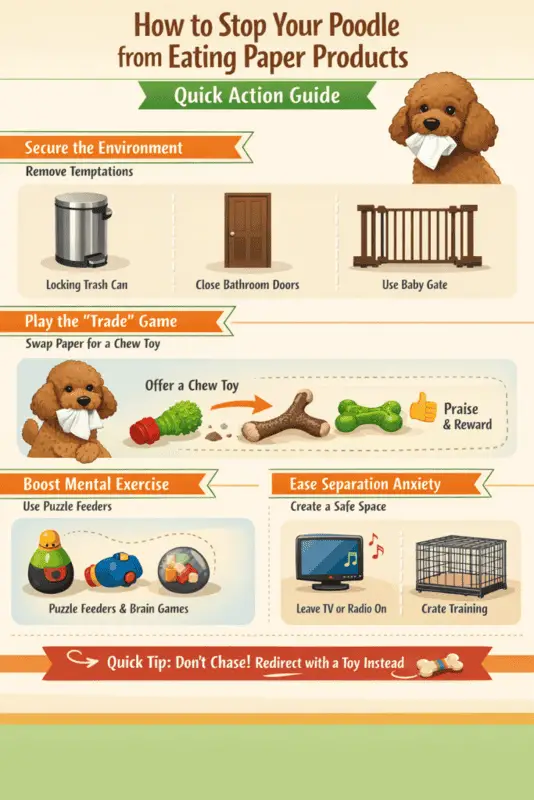
Tips to Keep Your Poodle Puppy From Eating Paper
While adult Poodles might shred paper out of boredom or anxiety, Poodle puppies are a completely different story. Puppies explore the world with their mouths, and when you combine that natural curiosity with the intense discomfort of teething, anything within reach becomes a potential target for their sore gums.
During the peak teething phase (usually between 4 and 6 months of age), the soft, easily shreddable texture of paper or cardboard is highly satisfying to a puppy. According to veterinary experts at PetMD, this behavior early is critical before it becomes a lifelong habit.
Here are the best ways to puppy-proof your paper products:
- Understand the “Old Shoe” Mistake: Never give a puppy an old shoe, a ripped sock, or a discarded cardboard box to play with. Poodles are incredibly smart, but they cannot distinguish between an “old” shoe and your brand-new sneakers, just like they cannot tell the difference between a piece of junk mail and your important tax documents. Only give them items specifically designated as dog toys.
- Keep a Puppy Chew on Hand at All Times: You must always have an acceptable alternative ready. Since puppy teeth are more fragile than adult teeth, avoid the super-hard antlers right now. Instead, offer softer, puppy-specific rubber chews (like a puppy Kong) that you can freeze to help soothe their inflamed gums.
- Interject and Distract (The Positive Pivot): When you catch your puppy actively pulling a napkin out of the trash, do not yell or snatch it aggressively. A sharp “Ah-ah!” to break their focus, followed immediately by enthusiastically squeaking a toy and running in the opposite direction, will trigger their retriever instinct to chase you instead of the paper. Once they drop the paper to grab the toy, reward them with heavy praise.
When It Stops Being a Game: Pica and Knowing When to Call the Vet
As we discussed earlier, there is a massive difference between a Poodle who shreds a napkin for fun and one who actively eats it. If your Poodle is actually swallowing the paper, they may be suffering from Pica.
Pica is a medical and behavioral condition where a dog compulsively eats non-food items. While it can be rooted in extreme anxiety, it is often a giant red flag for an underlying gastrointestinal issue or a dietary deficiency.
The Danger of the “Paper Blockage”
If a Poodle eats a significant amount of paper towel, it can clump together in their stomach. According to veterinary experts, this can lead to severe gastrointestinal irritation, painful ulcerations, or a complete and life-threatening intestinal blockage.
Red Alerts: When “Wait and See” is No Longer an Option
If you know your Poodle has ingested paper—especially dense products like paper towels or cardboard—you are officially on a 24-hour watch. While a Poodle’s digestive system is resilient, paper expands and clumps when wet, creating a “plug” in the digestive tract.
Call your vet immediately if you notice any of the following “Red Alert” symptoms:
- The “Silent” Retch: Poodles are prone to deep chests. If your dog is unsuccessfully trying to vomit (non-productive retching) or their abdomen feels tight and “drum-like,” this could be a sign of a blockage or a secondary case of Bloat. This is a 24-hour emergency.
- The “Prayer” Position: If your Poodle is stretching their front legs out while keeping their rear end in the air, they are in significant abdominal pain. This is often an attempt to take pressure off an intestinal obstruction.
- Persistent Vomiting: If your dog cannot keep water down for more than 4–6 hours, they likely have a “full-stop” blockage. Dehydration sets in rapidly for Toy and Miniature Poodles.
- Drastic Behavior Shifts: Poodles are highly communicative. If your usually velcro-dog is suddenly hiding in a dark corner, acting lethargic, or snapping when you touch their belly, they are likely experiencing internal distress.
- Dark or Tarry Stools: This indicates potential bleeding or ulceration in the upper GI tract caused by the friction of the non-food item.
What the Vet Will Do (The Researcher’s Perspective)
When you arrive, be prepared for more than just a physical exam. As a researcher into canine health, I’ve found that many owners are surprised by the diagnostic process:
- Abdominal Palpation: The vet will feel for “bunched” intestines or a solid mass.
- X-Rays (Radiographs): While paper doesn’t always show up clearly, vets look for “obstructive gas patterns.” If gas is building up behind a “plug” of paper, the X-ray will show distinct bloating in specific parts of the bowel.
- Barium Study: If the X-ray is inconclusive, your vet may have the dog swallow a specialized liquid (Barium) that shows up bright white on X-rays, allowing them to track exactly where the “transit” of food has stopped.
Expert Tip: If you have any leftover pieces of the paper they ate, bring them with you. Showing the vet the thickness and material (e.g., quilted paper towel vs. thin tissue) helps them determine the likelihood of the item passing naturally.
Frequently Asked Questions (FAQ)
Is toilet paper toxic to Poodles? Standard toilet paper and paper towels are not chemically toxic to dogs. However, the real danger is that paper expands when it gets wet. If a dog swallows too much of it, the paper can clump together and cause a severe intestinal blockage.
How do I safely get paper out of my Poodle’s mouth? Never chase a Poodle that has paper in its mouth! Because of their retriever instincts, chasing them turns it into a game of “keep-away,” and they are more likely to quickly swallow the paper so you can’t get it. Instead, use the “trade” command by offering a high-value treat (like a piece of chicken or a favorite chew toy) in exchange for the napkin.
At what age do Poodle puppies stop chewing paper? The intense puppy teething phase usually wraps up around 6 to 8 months of age. However, because Poodles are so intelligent, they will continue to shred paper well into adulthood if they are bored or under-stimulated.
Pro Tip: Remember that a puppy’s “chewing limit” is often tied to their “alone limit.” For a month-by-month schedule of unsupervised time for Poodle puppies, check out How Long Can Poodles Be Left Alone?
In Conclusion
It is perfectly normal to see your Poodle chew on paper or napkins—it is simply their ancient water-retriever instincts kicking in! The real worry only begins if they appear to be swallowing the paper instead of just making a mess. By managing their environment and keeping their brains busy with puzzle toys, you can save yourself the headache of cleaning up their confetti and keep your furry best friend safe.
Medical & Veterinary Disclaimer: PoodleReport.com is an informational resource for Poodle owners and enthusiasts. We are not veterinarians. The content on this website is not a substitute for professional veterinary care, diagnosis, or treatment. Always seek the advice of your veterinarian with any questions you may have regarding your pet’s medical condition, diet, or overall health.