

Disclaimer: The information provided on PoodleReport.com is for educational purposes only and does not constitute veterinary medical advice; always consult your vet before changing your dog’s diet. Additionally, this post contains affiliate links. As an Amazon Associate, and other affiliate advertising programs, I earn from qualifying purchases at no extra cost to you.
When most people picture a Poodle, they imagine a perfectly coiffed, delicate show dog posing on a pedestal. However, if you are considering bringing one into your home, you need to look past the haircut to the brilliant, athletic water retriever underneath.
Do Poodles make good pets? Yes. Poodles are widely considered one of the best companion pets in the world due to their exceptional intelligence, low-shedding coats, and deep loyalty. However, they require significant daily mental stimulation and high-maintenance grooming to truly thrive in a family environment.
In my many years of researching canine behavior and living with my Standard Poodle, Angus, I quickly learned that the “Poodle experience” is profoundly different from raising a Golden Retriever or a Labrador. According to the American Kennel Club’s official breed standard, these dogs were built for demanding physical work in the water. As a result, they don’t just want to live in your house; they are dogs that firmly believe they are people, and they expect to be actively involved in your daily routine.
In this guide, we are going to look past the generic advice to explore the true pros, cons, and psychological realities of owning a Toy, Miniature, or Standard Poodle. But if you’re looking to truly crack the code of these complicated companions, I have dedicated an entire, continually updated research hub to many Poodle Behavior Guides.
The Size Matrix: Choosing Your Variety
One of the most unique aspects of the Poodle is that it is the only breed that comes in three officially recognized sizes. Unlike other dogs where “teacup” or “giant” versions are considered unofficial mutations, the Toy, Miniature, and Standard Poodle all conform to the exact same biological blueprint set by the Poodle Club of America.
However, while their baseline genetics are the same, their daily lifestyle requirements are entirely different. Choosing the right size is the single most important factor in determining whether a Poodle will make a good pet for your specific household.
| Variety | Average Size | Best Household Fit | Primary Lifestyle Challenge |
| Toy | 4–6 lbs (Under 10″) | Quiet apartments, adults or older kids | Fragile bones; prone to alert barking |
| Miniature | 10–15 lbs (10″–15″) | Active families, adaptable to city/suburbs | High energy; requires strict boundary training |
| Standard | 40–70 lbs (Over 15″) | Homes with yards, active hikers/runners | High mental stimulation needs; space requirements |
The Toy and Miniature (The Apartment Athletes)
If you live in a smaller space, the Toy and Miniature varieties are excellent options. However, do not mistake their small stature for a low energy level. Miniatures, in particular, are essentially sports cars in compact frames. While they are a great size for cuddling on the couch, if they are not given daily tasks, they will often resort to excessive alert barking at every noise they hear outside your window. Toys are wonderfully affectionate but are physically fragile, making them a poor fit for households with chaotic, stumbling toddlers.
The Standard (The Resilient Retriever)
Standard Poodles are the original athletes of the family. Because they possess the bone structure of a working retriever, they are physically resilient and make phenomenal companions for active families with children. The trade-off is their size and mental capacity. A Standard Poodle takes up physical space on your sofa, requires larger (and more expensive) portions of food, and demands a massive amount of mental engagement to prevent them from completely outsmarting your household rules.
The Poodle Brain: Intelligence vs. Boredom
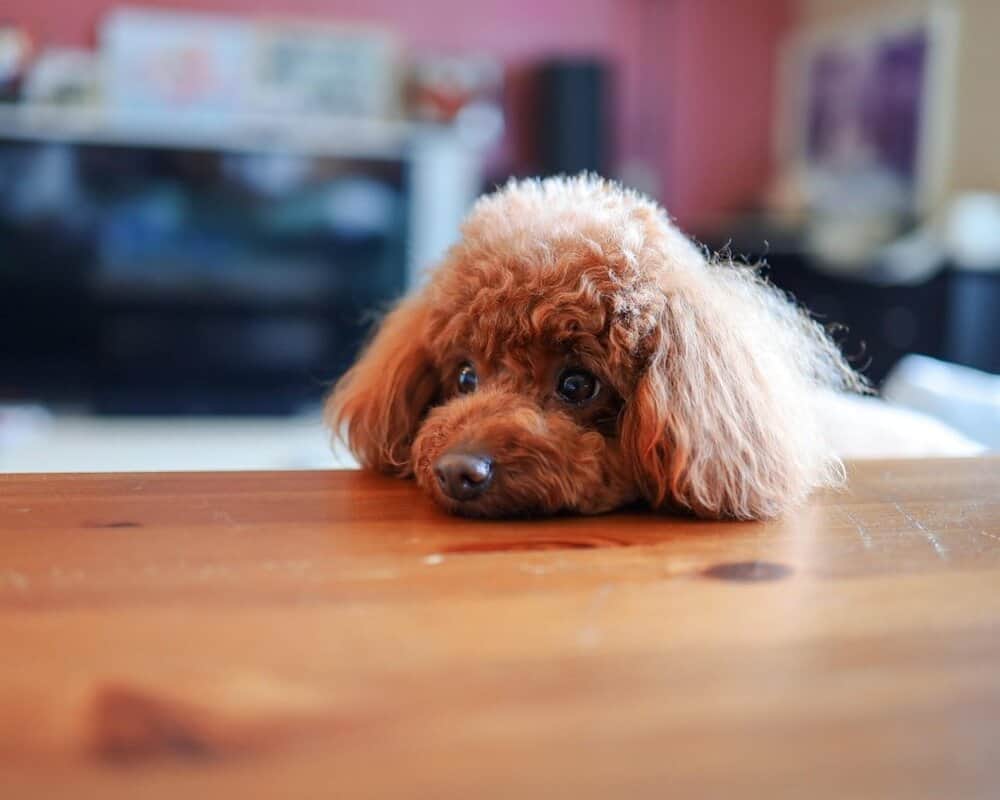
Everyone loves the idea of owning the “second smartest dog breed in the world” (landing just behind the Border Collie, according to the American Kennel Club’s intelligence rankings). It sounds like a massive pro—until your dog figures out how to open the refrigerator.
Having a genius-level dog is a double-edged sword. A bored Poodle is a destructive Poodle. Generic pet advice often tells you to “just take them for a long walk.” But here’s the reality of the Poodle brain: their physical stamina is matched only by their mental endurance. If you take a Standard Poodle on a three-mile run but do not engage their mind, they will come home, drink some water, and immediately begin dismantling your sofa out of sheer boredom. You cannot simply run the crazy out of them; you have to out-think them.
The “Negotiation-Based” Training Shift
Because they are so smart, Poodles do not respond well to repetitive, drill-sergeant-style obedience classes. If you ask a Poodle to “sit” ten times in a row, by the fifth time, they will likely just stare at you as if to say, “I already showed you I know how to do this. What’s the point?”
Understanding and proficiently navigating this intricate mind is fundamental. For a truly comprehensive look into why Poodles act the way they do, and how to effectively train and engage them, explore my Ultimate Guide to Poodle Behavior.
To successfully live with a Poodle, you have to shift your mindset to a “Negotiation-Based” approach:
- Mental Fatigue is the Goal: You must provide daily “jobs.” Ditch the standard food bowl for complex puzzle toys, teach them advanced trick chains, or set up indoor scent-tracking games (often called “Sniffaris”).
- The Emotional Sponge: Poodles are incredibly empathetic and read human body language perfectly. They do not respond to yelling or heavy-handed corrections. Harsh discipline will cause them to shut down, become anxious, or completely ignore you. You have to lead with calm, positive reinforcement.
When their mind is adequately challenged, a Poodle is a peaceful, hilarious, and affectionate presence in the house. When ignored, they will use that giant brain to become the world’s fluffiest supervillain.
The Hypoallergenic Reality Check: Time vs. Money
One of the biggest selling points for the breed—and the reason Poodle mixes are so wildly popular in 2026—is the claim that they are “hypoallergenic.”
Let’s be clear: no dog is 100% hypoallergenic. Allergies are often triggered by dander (dead skin cells) or saliva, not just hair. However, Poodles are universally recommended by the Asthma and Allergy Foundation of America because they have a single layer of continuously growing hair, rather than fur that sheds all over your house.
This lack of shedding is fantastic for your allergies and your vacuum cleaner. However, it is a massive trade-off for your wallet and your free time.
The Financial Reality of the Poodle Coat
Because their hair never stops growing, a Poodle will quickly turn into a walking, matted sheep if ignored. You cannot skip grooming appointments. Most owners drastically underestimate the annual cost of keeping a Poodle comfortable.
The 2026 Annual Grooming Cost Estimate]
| Poodle Size | Average Grooming Frequency | Estimated Annual Cost (2026) |
| Toy / Miniature | Every 4–6 Weeks | $600 – $900 |
| Standard | Every 4–8 Weeks | $1,200 – $1,800+ |
The Daily “Line Brushing” Commitment
Even if you pay a professional groomer every month, you are not off the hook at home. To prevent painful mats from forming at the skin level (which forces the groomer to shave your dog bald), you must learn the technique of “line brushing.”
This requires a high-quality slicker brush and a metal greyhound comb. You must part the hair down to the skin, brush out the section, and then check your work with the comb. For a Toy or Miniature, this might take 10 minutes every other day. For a Standard Poodle in a longer clip, you are looking at a 30-minute to an hour-long commitment several times a week.
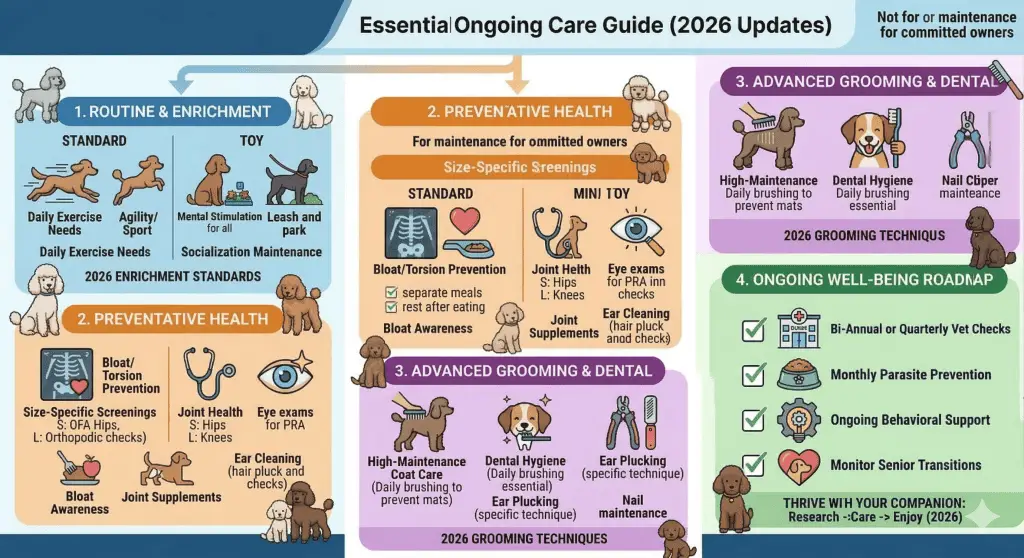
If you hate brushing dogs, or if you cannot budget for regular professional haircuts, a Poodle is absolutely not the right pet for you.
Temperament: The “One-Person Dog” Myth and Emotional Sponges
There is a persistent rumor floating around the dog park that Poodles are snobby, aloof, or strictly “one-person” dogs. If you are looking for a Golden Retriever personality—a dog that will joyfully tackle the pizza delivery guy the moment the door opens—a Poodle might catch you off guard.
Poodles are not snobs; they are just highly discerning. When a stranger enters the house, a well-adjusted Poodle will usually hang back, observe the situation, and decide if this new person is actually worth their time. According to the American Veterinary Medical Association (AVMA) guidelines on canine socialization, this cautious observation period is completely normal and often a hallmark of a highly intelligent breed assessing its environment.
The Family Dynamic
While they do tend to pick a “favorite” human in the household (almost always the person who facilitates the training, scent games, and meals), they are incredibly affectionate, goofy, and deeply devoted to their entire family.
However, that famous intellect comes with a catch: they are massive emotional sponges.
Poodles absorb the energy of the room. If your household is a chaotic environment with constant yelling, door-slamming, and highly unpredictable routines, a Poodle will quickly internalize that stress. This can lead to anxiety, excessive pacing, or even digestive issues. Conversely, in a structured, relatively calm home, they are peaceful, relaxed companions. They thrive on routine and clear expectations. If you want a dog that blindly rolls with the punches in a loud, chaotic environment, a Poodle might find your lifestyle a bit too overwhelming.
The Retriever Instinct: Why Your Socks Are Always Missing
If you look at a Poodle in a Continental clip—with the big puffs of hair on their joints and chest—it is easy to assume they were bred to be royal lap dogs. In reality, that ridiculous-looking haircut had a highly practical, working-class purpose.
The name “Poodle” comes from the German word pudelin, which translates to “to splash in the water.” Long before they were the official dog of France, Poodles were rugged, highly athletic duck hunters. That traditional haircut was designed by hunters to protect the dog’s vital organs and joints from freezing water while shaving the rest of the body to reduce drag as they swam.
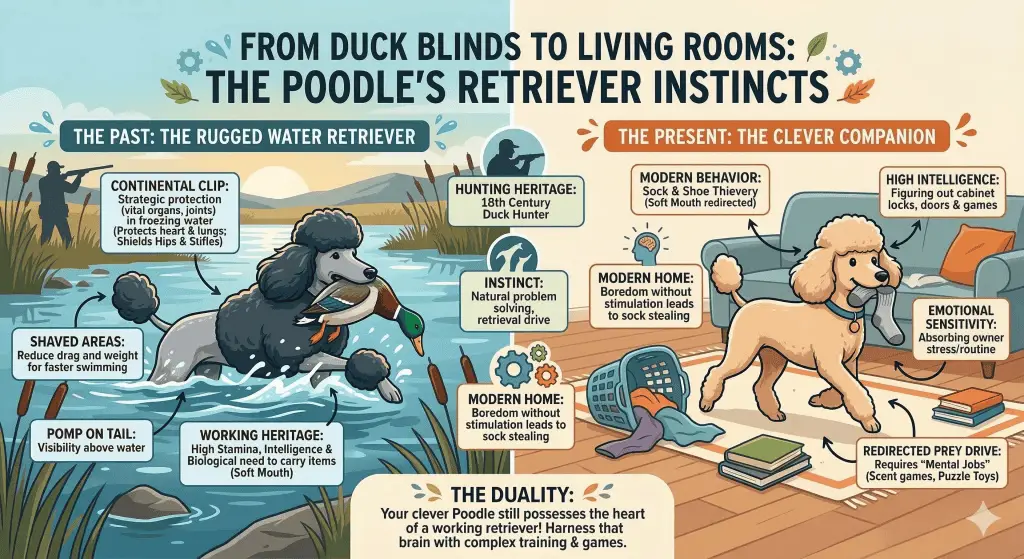
While your modern Poodle might never see a duck blind, that intense working heritage is still hardwired into their DNA. According to the American Kennel Club’s history of the breed, they are true water retrievers, which translates into two very specific household behaviors you must be prepared for.
The “Soft Mouth” and The Sock Thief Retrievers explore the world with their mouths. A Poodle has a biological need to carry things around the house. If you do not provide them with enough engaging toys, they will happily substitute your socks, shoes, or the television remote.
Because they are so smart, they quickly learn that stealing a prohibited item is a fantastic way to get you to stop what you are doing and play a game of chase. To survive this, you have to practice the “Trade-Up” game. If your Poodle steals a shoe, never chase them or pry it out of their mouth. Instead, cheerfully offer them a high-value treat in exchange. You have to negotiate with the retriever brain, not fight it.
The Hidden Prey Drive Because they are hunting dogs, Poodles have a surprisingly high prey drive. They are visually stimulated by fast-moving objects. A Standard Poodle will happily bolt after a squirrel, a rabbit in the yard, or a neighborhood bird. While they are generally wonderful with other household pets when socialized early, you have to be mindful of this instinct on walks and prioritize teaching a rock-solid “leave it” command.
Health and Longevity: A Long-Term Commitment
Compared to many other purebreds, Poodles are generally robust, healthy, and exceptionally long-lived dogs. If you bring a Toy or Miniature Poodle into your family, you are making a 14- to 18-year commitment. Even the massive Standard Poodles frequently live between 12 and 15 years, easily outlasting other large breeds like Great Danes or Mastiffs.
However, longevity does not mean they are immune to genetic health issues. A well-bred Poodle should come from parents who have undergone rigorous health testing, not just a basic veterinary checkup. According to the Orthopedic Foundation for Animals (OFA), reputable breeders must screen for specific, size-dependent conditions before ever producing a litter.
Essential Poodle Health Screenings by Size]
| Poodle Size | Primary Health Risk | Required OFA/Genetic Testing |
| Toy / Miniature | Luxating Patellas (trick knee) | Patellar Evaluation, PRA (Eye Exam) |
| Standard | Gastric Dilatation-Volvulus (Bloat) | Hip Dysplasia, Cardiac Evaluation |
The Standard Poodle and Bloat
If you choose a Standard Poodle, your absolute biggest daily health concern is Gastric Dilatation-Volvulus (GDV), commonly known as “bloat.” Because of their deep, narrow chests, their stomachs can fill with gas and twist upon themselves, which is a life-threatening emergency. As an owner, you must establish strict rules: enforce a 60-minute rest period after meals, use slow-feeder bowls, and avoid elevated feeding stations, which recent studies by the American Veterinary Medical Assocition (AVMA) suggest can actually increase the risk.
Frequently Asked Questions (FAQ)

Do Poodles bark a lot? It depends entirely on the size and their level of boredom. Standard Poodles possess a deep, booming bark but generally only use it to alert you when someone is at the door. Miniature and Toy Poodles, however, are prone to excessive “alert barking” at every squirrel, passing car, or leaf that blows across the lawn if they are not properly trained and mentally stimulated.
Are Poodles good with other pets? Yes, but it requires intentional management. Remember, Poodles are hunting retrievers with a strong prey drive for fast-moving objects. However, with early socialization and clear boundary training, they adapt beautifully to multi-pet households. For example, my own two rabbits, Mocha and Chino, are able to safely coexist with canine companions simply because strict household rules and mutual respect were established from day one.
Are Poodles cuddly? Absolutely, but usually on their own terms. While a Golden Retriever might demand constant physical affection from anyone who walks by, a Poodle is far more discerning. They prefer to lean heavily against their favorite person’s legs while you cook or curl up specifically on your side of the couch at the end of a long day.
Do Poodles smell bad? Because Poodles have hair instead of fur, they do not produce the typical “doggy odor” associated with heavy-shedding breeds. If your Poodle begins to smell, it is almost always an indicator of an underlying issue, such as a localized yeast infection in their heavily haired ears, dental disease, or a matted coat trapping dirt against their skin.
The Final Verdict: Are Poodles Good Pets?
Ultimately, asking if a Poodle makes a good pet is a bit like asking if a sports car makes a good daily commuter. It is an exceptional, high-performance companion, but it requires a very specific, dedicated owner behind the wheel.
If you are looking for a low-maintenance, “background” dog that requires nothing more than a bowl of kibble and a quick stroll around the block, a Poodle will likely drive you absolutely crazy. Their grooming demands are expensive, their emotional sensitivity requires a stable household, and their “Poodle Brain” demands a daily job to prevent them from becoming destructive, hyper-intelligent sock thieves.
However, if you are willing to put in the work, the payoff is unparalleled. By committing to “Negotiation-Based” training and engaging their incredible intellect with positive reinforcement—a methodology strongly endorsed by the Association of Professional Dog Trainers (APDT)—you unlock a dog that is essentially a brilliant, hilarious human in a curly suit.
They are fiercely loyal, deeply intuitive, and possess a level of empathy that makes them one of the greatest companions you could ever ask for. In my years of research and personal experience, earning the respect of a Poodle is certainly a challenge, but having that genius-level dog curled up on your side of the couch is worth every single penny spent at the groomer.
Medical & Veterinary Disclaimer: PoodleReport.com is an informational resource for Poodle owners and enthusiasts. We are not veterinarians. The content on this website is not a substitute for professional veterinary care, diagnosis, or treatment. Always seek the advice of your veterinarian with any questions you may have regarding your pet’s medical condition, diet, or overall health.