

Disclaimer: The information provided on PoodleReport.com is for educational purposes only and does not constitute veterinary medical advice; always consult your vet before changing your dog’s diet. Additionally, this post contains affiliate links. As an Amazon Associate, and other affiliate advertising programs, I earn from qualifying purchases at no extra cost to you.
Poodles are celebrated for their intelligence and elegance, but their history as specialized water retrievers means they possess a natural, deep-seated interest in small, fast-moving objects. For many owners, the question isn’t just “can they get along,” but rather, “how do I manage a centuries-old hunting instinct in a 2026 household?”
While Poodles are often more trainable than high-prey-drive terriers, they remain highly reactive to motion. A rabbit’s “zoomies” or sudden “binkies” can easily trigger a Poodle’s desire to chase. However, because Poodles are “soft-mouthed” retrievers rather than “hard-mouthed” hunters, they are uniquely capable of learning to coexist with smaller animals.
So Can Poodles Get Along With Rabbits?
Yes, Poodles and rabbits can live together safely, but it is a “conditional yes” that depends on rigorous training and specific environmental management. While their natural biology as water retrievers suggests a predator-prey dynamic, a Poodle’s high cognitive capacity allows them to override hunting instincts through structured socialization.
To safely manage a Poodle-rabbit household in 2026, we must look at the Predatory Motor Sequence—the hardwired chain of behaviors common to all canines. While all dogs have these instincts, they have been selectively “broken” or emphasized through centuries of breeding. If you are new to the breed’s unique quirks, exploring my Poodle Behavior Guides are a great place to start before tackling multi-species introductions.
Understanding the Poodle “Retriever” Drive
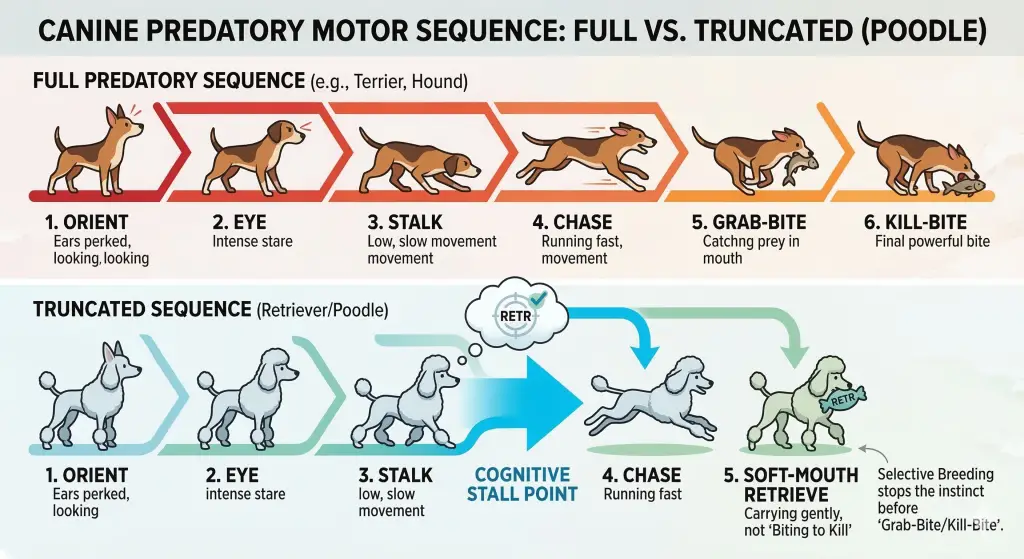
To safely manage a Poodle-rabbit household in 2026, we must look at the Predatory Motor Sequence—the hardwired chain of behaviors common to all canines. While all dogs have these instincts, they have been selectively “broken” or emphasized through centuries of breeding.
As a breed refined for water retrieval, the Poodle’s sequence is naturally truncated. While a terrier or hound is bred to complete the “Grab-Bite” or “Kill-Bite” phases, a Poodle typically focuses on the Orient, Eye, and Chase stages.
The Biological “Stall”
This is a critical distinction for owners. A Poodle is often looking to “retrieve” or “herd” rather than “hunt.” However, for a rabbit, being chased triggers the same life-threatening stress regardless of the dog’s intent. This biological distinction is a core topic in behavioral studies, such as those found in the Veterinary Information Network (VIN), which emphasizes that “drive” is manageable through cognitive training and consistent impulse control.
Why Intelligence Matters
Because Poodles possess such a high degree of “biddability” (the desire to work with a human), they are uniquely capable of learning to stop their motor sequence mid-chase. In my research and personal experience, the goal isn’t to “delete” the instinct, but to train the Poodle to look to the owner for permission before engaging with the environment.
The Hidden Risk: Stress-Induced GI Stasis
A significant oversight in many dog-centric guides is the physiological fragility of the rabbit. Even if a Poodle never makes physical contact, the psychological stress of being “stalked” or even watched too closely can trigger a lethal condition known as Gastrointestinal (GI) Stasis. When a rabbit enters a state of extreme fear or “predatory pressure,” its digestive system can slow down or stop entirely. According to the House Rabbit Society, GI stasis is a medical emergency where the lack of movement in the gut allows harmful bacteria to build up, which can become fatal within 24 hours.
In my research and my years spent observing Poodle behavior with my own dog, Angus, I noticed that even a Poodle who is “just curious” can exert enough pressure to terrify a small prey animal. Poodles tend to “stare” or “point” when they are interested—a behavior that a rabbit interprets as a predator preparing to strike.
The “Stress Contagion” Factor: The Poodle’s Intuitive Nature
A content gap in existing articles is the Poodle’s unique sensitivity to their owner’s emotions. Poodles are famously “velcro dogs” that mirror their handler’s stress levels. In a 2026 study of canine-human bonds, researchers noted that a handler’s elevated cortisol can trigger a dog’s “alert” state.
If you are nervous during an introduction, your Poodle interprets that tension as a signal that there is a threat or a high-value target nearby. This can accidentally kickstart the Predatory Motor Sequence (specifically the “Eye” and “Stalk” phases).
To be successful, the handler must practice “Neutral Energy.” If you cannot remain calm, your Poodle will view the rabbit as an object of high anxiety rather than a neutral housemate. This psychological loop is often the hidden reason why introductions fail even when the “steps” are followed correctly.
The Poodle Size Matrix: Toy, Miniature, and Standard Dynamics
Many multi-pet guides make the mistake of treating all dogs as a monolith. However, according to the American Kennel Club (AKC) breed standards, Poodles come in three distinct sizes. The safety dynamics—and who is actually at risk—change wildly depending on the variety you own.
The Poodle-Rabbit Size Risk Matrix
This chart provides a direct comparison of the three AKC-recognized Poodle sizes against potential risk factors when introducing them to a rabbit. By evaluating these key dynamics based on size, you can quickly assess the unique challenges and priorities for maintaining a safe multi-pet household.
| Poodle Size | Blunt Force Trauma | Peer Conflict (Rivalry) | Vulnerability to Rabbit Kicks |
| Standard Poodle (40-70 lbs) | HIGH RISK: Primary danger; accidental injury/collision even in play. | Low/Medium Risk: Significant size difference usually establishes clear roles. | Low Risk: Size offers protection against serious defensive kicks. |
| Miniature Poodle (10-15 lbs) | Medium Risk: Can still cause significant accidental injury. | HIGH RISK: Peer conflict; similar size may lead to territorial or resource disputes. | Medium Risk: Closer size makes them more vulnerable to rabbit kicks. |
| Toy Poodle (4-6 lbs) | Low Risk: Unlikely to cause major impact damage. | Medium Risk: Conflicts still possible, dynamic shifts; rabbit often has upper hand. | HIGH RISK: Primary danger; very vulnerable to powerful defensive rabbit kicks. |
Understanding your specific Poodle’s weight class is a mandatory step before any introduction.
Standard Poodles (40–70 lbs): The Risk of Blunt-Force Trauma
While Standard Poodles have the intelligence to learn impulse control, their sheer mass is the primary danger. Even if a Standard Poodle is playing and utilizes a “soft mouth,” a single playful paw swipe or an accidental collision during a “zoomie” can break a rabbit’s fragile spine. With a Standard, management is less about preventing a bite and entirely about preventing physical impact.
Miniature Poodles (10–15 lbs): The Peer-to-Peer Dynamic
Miniatures often share a similar weight class with medium-to-large rabbits, such as the Flemish Giant. This changes the dynamic from a traditional predator/prey relationship to potential peer competition. Because the size difference is negligible, a Miniature Poodle may view a large rabbit as a rival for resources (like toys or your attention) rather than prey, leading to territorial squabbles rather than a predatory chase.
Toy Poodles (4–6 lbs): The Vulnerable Predator
In a Toy Poodle household, the traditional roles can easily reverse. A frightened or territorial rabbit possesses powerful hind legs designed to deliver bone-breaking kicks to predators. A 5-pound Toy Poodle is highly susceptible to eye injuries, facial lacerations, or concussions if a rabbit decides to defend its space rather than flee. In these pairings, the dog’s safety must be monitored just as closely as the rabbit’s.
The Environmental Hierarchy: Designing a Safe Neutral Zone
In a 2026 multi-species home, “using a leash” is only half the battle. To prevent the high-arousal stares that lead to GI stasis, you must modify your physical environment. The goal is to create an Environmental Hierarchy where the rabbit always has the “high ground” or a visual break from the Poodle’s gaze.
Vertical Escape Routes
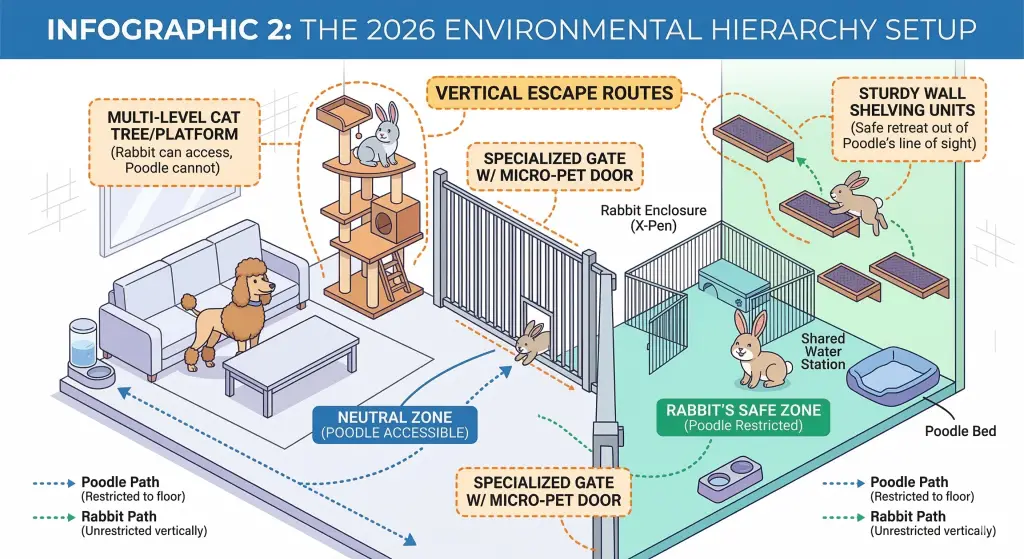
Poodles are world-class jumpers. A standard 30-inch baby gate is often just a minor hurdle for an athletic Standard Poodle. To ensure the rabbit feels secure, you must implement Vertical Escape Routes. These are platforms, sturdy cat trees, or shelving units that allow the rabbit to hop up and out of the Poodle’s direct line of sight.
When a rabbit can look down on a dog, their stress hormones remain significantly lower than when they are cornered on the floor.
2026 Gate Recommendations
Forget the plastic pressure-mounted gates of the past. For a Poodle-rabbit household, you need a “two-way” barrier system:
- Micro-Pet Doors: Use extra-tall metal gates that feature a small, rabbit-sized door at the bottom. This allows the rabbit to move freely between rooms while keeping the Poodle restricted.
- Solid-Bottom Barriers: If your Poodle is prone to “border patrolling” (pacing the gate), use a barrier with a solid bottom half. If the Poodle can’t see the rabbit’s feet moving, the “Chase” phase of their predatory sequence is less likely to trigger.
Establishing the “Safe Room”
The rabbit’s primary enclosure should be in a “low-traffic” zone for the Poodle. In my home, I found that placing the rabbit’s x-pen in a corner shielded by furniture reduced the “predatory pressure” significantly. This setup allows the Poodle to grow accustomed to the rabbit’s scent and sounds without the constant visual stimulation that leads to over-arousal.
By setting up these physical boundaries first, you ensure that when you move to the face-to-face training steps, both animals already feel a baseline of security in their shared space.
Life Stages: The Puppy Window vs. The Adult Poodle
When establishing a multi-species home, the age of your Poodle dictates your training strategy. The neuroplasticity of a dog’s brain changes dramatically as they mature, meaning a puppy and an adult Poodle require entirely different approaches to rabbit socialization.
The Puppy Socialization Window (8 to 16 Weeks)
If you are introducing a Poodle puppy to an established resident rabbit, you are at a distinct advantage. Canine behavioral research indicates a critical “socialization window” that closes around 16 weeks of age. During this period, a puppy’s brain is highly elastic, and they are forming their baseline understanding of what is “normal” in their environment.
If a Poodle puppy is raised alongside a rabbit during this window—and the interactions are strictly supervised to prevent the puppy from practicing chase behaviors—they are highly likely to categorize the rabbit as a “sibling” rather than a “target.”
The Adult Poodle: Managing Crystallized Instincts
Introducing a rabbit to an adult Poodle (especially a rescue with an unknown history) presents a higher level of difficulty. By adulthood, a Poodle’s predatory motor sequence is “crystallized.” Their brain has already wired itself to find the “Orient, Eye, and Chase” sequence highly rewarding.
With an adult, your goal is no longer socialization; it is impulse control and desensitization. You are not trying to convince the adult Poodle that the rabbit isn’t prey. Instead, you are teaching the Poodle that ignoring the prey is more rewarding (via high-value treats and praise) than chasing it. This requires significantly more time, strict physical barriers, and a zero-tolerance policy for staring or stalking.
The 7-Step Poodle-Rabbit Introduction Protocol
To safely bridge the gap between predator and prey, the introduction process must be measured in weeks, not hours. Poodles are renowned for their biddability—their innate desire to work in partnership with their human—which makes them better candidates for this process than more independent hunting breeds.
In my own expirience, I’ve found that success dosen’t come from forcing a friendship, but from rewarding a lack of interest. We want the Poodle to view the rabbit as a neutral part of the furniture, not a playmate.
The Step-by-Step Process
- Scent Swapping (Days 1–3): Before any visual contact, swap their bedding. Place a towel the rabbit has used in the Poodle’s crate and vice versa. This allows the Poodle to process the “prey” scent in a state of relaxation.
- Visual Barriers (Days 4–7): Allow the animals to see each other through a sturdy baby gate. Keep your Poodle on a leash even behind the gate. Reward the Poodle for looking at the rabbit and then looking back at you (the “Auto-Check-In”).
- The “Basket Muzzle” Insurance Policy: For the first face-to-face meeting, I recommend using a basket muzzle on your Poodle. This is not a sign of aggression; it is a 2026 safety standard that provides 100% insurance while you assess the dog’s “soft-mouth” instinct in close proximity.
- The “Look at That” (LAT) Technique: Use the LAT method developed by behaviorists to desensitize the Poodle. Every time the Poodle notices the rabbit moving and doesn’t lunge or whine, mark the behavior with a “Yes!” and a high-value treat. This creates a positive association with the rabbit’s movement.
- Parallel Proximity (Leashed): Bring the Poodle into the room while the rabbit is in its enclosure. Sit at a distance where the Poodle can remain calm. Gradually decrease the distance over several sessions, according to the American Kennel Club (AKC) guidelines for multi-pet households.
- Controlled Free-Roaming: Allow the rabbit to roam while the Poodle remains on a “drag lead” (a light leash trailing behind them). This allows you to step on the lead instantly if the Poodle’s predatory sequence (the “stare”) begins to escalate.
- Supervised Coexistence: Once both animals can settle and nap in the same room, you have reached the goal. However, the most important rule of 2026 safety is this: Never leave a Poodle and a rabbit together unsupervised. Regardless of how well they get along, an unexpected “binky” can trigger a chase instinct in seconds.
The 7-Step Desensitization Timeline
This timeline illustrates the progression of the introduction. Notice how the process moves safely from situations of maximum handler control (physical separation) toward low handler control (shared space).
| Step | Phase | Handler Control Level | The Setup |
| 1 | Scent Swapping | 🔴 Maximum Control | Complete physical and visual separation. |
| ↓ | |||
| 2 | Visual Barriers | 🔴 High Control | Leashed Poodle behind a sturdy gate. |
| ↓ | |||
| 3 | Basket Muzzle | 🟠 Moderate-High Control | First shared-room meeting; zero risk of bite. |
| ↓ | |||
| 4 | LAT Technique | 🟠 Moderate Control | Active training; leash held, rewarding calm behavior. |
| ↓ | |||
| 5 | Parallel Proximity | 🟡 Medium Control | Leashed dog, confined rabbit; decreasing the distance. |
| ↓ | |||
| 6 | Controlled Free-Roaming | 🟡 Low-Medium Control | Rabbit hops freely; dog wears a trailing “drag lead.” |
| ↓ | |||
| 7 | Supervised Coexistence | 🟢 Low Control (Passive) | Both animals free in the room. Note: Zero control (unsupervised) is never permitted. |
Cross-Species Resource Guarding: Managing the Shared Space
Much of the literature on multi-species households focuses exclusively on the “chase” instinct, completely ignoring what happens when the dog and rabbit are finally sitting quietly in the same room. The hidden danger in a successfully integrated home is Cross-Species Resource Guarding.
The Biological Clash: Grazers vs. Scavengers
Rabbits are natural grazers and foragers. An overly confident, free-roaming rabbit will happily hop over to a Poodle’s food bowl to investigate, or decide that the Poodle’s favorite orthopedic bed is the perfect place for a nap.
Canines, on the other hand, are opportunistic scavengers. While Poodles are not generally known as severe resource guarders compared to other breeds, any dog can experience possessive aggression over high-value items. According to behavioral guidelines from the American Society for the Prevention of Cruelty to Animals (ASPCA), a dog’s instinct to “snap” or issue a warning bite to protect their food or toys is a normal, hardwired canine behavior.
However, a standard “warning snap” from a Standard or Miniature Poodle can be instantly fatal to a rabbit.
Rules for Resource Management
To maintain peace in 2026, you must completely eliminate the opportunity for resource conflict.
- Strict Feeding Zones: Never feed your Poodle and rabbit in the same room. The rabbit’s hay and pellets should be entirely inaccessible to the dog, and the Poodle’s meals should be consumed behind a closed door or inside a crate.
- The “High-Value” Sweep: Before opening the rabbit’s enclosure for free-roam time, conduct a sweep of the room. Pick up all dog toys, especially high-value items like bully sticks, stuffed Kongs, or favorite plushies.
- Separate Resting Areas: Ensure both animals have a designated “safe zone” bed that the other is not allowed to access.
By removing the items that trigger possessive instincts, you allow the Poodle and the rabbit to coexist without feeling the need to compete.
Poodle Senses vs. Rabbit Burrows: The Auditory Trigger

Most guides focus on sight, but for a Poodle, sound is often the primary trigger. Rabbits are surprisingly noisy—the sound of them “zooming” through a plastic tunnel, scratching in a litter box, or the high-pitched “clatter” of a water bottle can trigger a Poodle’s retrieval instinct from three rooms away.
In my experience, I noticed that Angus would often ignore the rabbit while it was visible but become highly aroused by the sounds of movement he couldn’t see. To address this, a “Researcher” approach involves Auditory Desensitization. Record your rabbit’s noises and play them at a low volume while your Poodle is eating or relaxing. This breaks the association between “prey sounds” and the need to investigate, a technique supported by behavioral experts for managing high-intelligence hunting breeds.
Frequently Asked Questions
Can a Standard Poodle accidentally kill a rabbit? Yes. While Poodles are “soft-mouthed” retrievers, a Standard Poodle can weigh 50–70 pounds. Even a playful “paw swipe” or an over-eager attempt to “retrieve” the rabbit can cause fatal internal trauma or spinal injuries. Size management is the most critical safety factor in a multi-species home.
Do rabbits ever attack or bully Poodles? Surprisingly, yes. Large breeds like the Flemish Giant are often more confident and territorial than Toy or Miniature Poodles. An aggressive rabbit may lung, bite, or “kick-out” at a dog. In my research, I’ve seen that a defensive rabbit can easily injure a smaller Poodle’s eyes or snout, so the dog’s safety must also be a priority.
Does spaying or neutering affect how they get along? Absolutely. Hormones play a massive role in territorial aggression and prey drive. Intact male Poodles often exhibit a more intense “chase” drive, while unspayed female rabbits can be extremely territorial. For a peaceful 2026 household, ensure both animals are fixed to stabilize their chemical temperaments.
How long does the bonding process take? There is no fixed timeline, but a “Researcher” approach suggests a minimum of three to four weeks before even attempting a supervised free-roam session. Some pairings, depending on the individual Poodle’s drive and the rabbit’s history, may take months to reach a state of “neutrality.”
Can I ever leave them alone together? No. No matter how well they seem to get along, you should never leave a Poodle and a rabbit unsupervised. A sudden loud noise or a “binky” can trigger a dormant predatory sequence in a split second. Safety in 2026 means being present for every interaction.
Conclusion: The Reality of Poodles and Rabbits
Living with a Poodle and a rabbit is entirely possible, but it requires shedding the expectation of an instant, cartoon-style friendship. The key to a safe 2026 multi-species home lies in understanding the Poodle’s truncated predatory motor sequence and respecting the rabbit’s delicate physiological thresholds.
My experience observing and training Poodles has shown that their biddability is your greatest asset. You can train them to override their instincts, provided you put in the time to establish a neutral environment, vertical escape routes, and strict boundaries. Never rush the introduction process, always prioritize safety over socializing, and remember that quiet, neutral coexistence is the ultimate measure of success.
By approaching this dynamic as a well-informed researcher rather than just a hopeful pet owner, you can successfully manage both the retriever’s drive and the rabbit’s peace of mind.
Further Reading: Managing a high-drive retriever requires understanding how they think. To set your multi-species home up for success, be sure to check out the ultimate poodle behavior guide for a complete breakdown of canine cognitive training.
Medical & Veterinary Disclaimer: PoodleReport.com is an informational resource for Poodle owners and enthusiasts. We are not veterinarians. The content on this website is not a substitute for professional veterinary care, diagnosis, or treatment. Always seek the advice of your veterinarian with any questions you may have regarding your pet’s medical condition, diet, or overall health.