

Disclaimer: The information provided on PoodleReport.com is for educational purposes only and does not constitute veterinary medical advice; always consult your vet before changing your dog’s diet. Additionally, this post contains affiliate links. As an Amazon Associate, and other affiliate advertising programs, I earn from qualifying purchases at no extra cost to you.
Author’s Note: As a canine researcher and the owner of Angus, a 60-pound Standard Poodle who successfully navigates high-rise living, this guide skips the generic fluff. What follows is a tested, biological, and logistical framework for raising a well-adjusted Poodle in a high-density environment.
The Urban Poodle: Key Takeaways
- Size Isn’t Everything: Standard Poodles often make better apartment dogs than Toys because they possess a stronger neurological “off-switch” indoors.
- Transit Time Matters: If you live above the 5th floor, mathematically calculating the “elevator commute” is crucial for successful potty training.
- Scent Work Over Running: 15 minutes of indoor nose-work burns more cortisol and energy than a 2-mile walk on city pavement.
- Acoustic Engineering: High-pile rugs and white noise machines are non-negotiable tools to prevent neighbor complaints.
Table of Contents
- The “Den” Mentality: Biological Suitability
- Poodle Variety Dynamics: Fitting Your Floorplan
- The “Vertical Gauntlet”: Elevator and Lobby Etiquette
- Sonic Engineering: Mastering the Shared Wall
- The “City-Clean” Entryway Logistics
- Vertical Potty Logistics: The 10-Minute Commute
- Neuro-Level Enrichment: The “Indoor Athlete”
- Apartment Architecture: Designing for Your Poodle
- Environmental Overstimulation and “Window Watch”
- The Remote Worker’s Poodle: Zoom Etiquette
- Emergency Preparedness: The 15th-Floor Plan
- The “Nature Reset”: Managing Urban Burnout
- Frequently Asked Questions (FAQ)
1. The “Den” Mentality: Biological Suitability
The most persistent myth in the canine world is that a large dog fundamentally requires a sprawling, fenced-in backyard. However, when we look at canine biology and behavioral science, we find a different reality. Poodles—from the tiny 4-pound Toy variety to the impressive 65-pound Standard—are actually “den animals” by nature.
Can Poodles Live in Apartments?
Yes, Poodles can thrive in apartments. Despite their athletic history, Poodles are adaptable “den animals” with a highly sophisticated indoor off-switch. While Toy and Miniature varieties are natural fits for small floorplans, even a 60-pound Standard Poodle makes an excellent high-rise companion, provided their daily need for mental and physical exercise is met.
The Science of the “Off-Switch”
Unlike many high-drive working breeds that will obsessively pace when confined to small quarters, Poodles possess a highly sophisticated neurological “off-switch.” According to the American Kennel Club (AKC), Poodles are incredibly adaptable to their owner’s lifestyle. In an apartment setting, this translates to a dog that treats the indoors as a place for deep rest, and the outdoors as their designated place for physical exertion.
The Angus Perspective
For Angus, my resident Standard Poodle, an 800-square-foot floor plan is plenty of room to operate as a professional, highly evolved floor rug. As long as his brain and body are thoroughly engaged once we step outside the lobby, he has no desire to run laps around the kitchen island.
Understanding Vertical Space in Small Homes
In a smaller condo, a dog doesn’t just evaluate the available floor space; they also process vertical real estate. By providing varied resting spots—like a raised bed near a window or a comfortable crate tucked into a quiet corner—you effectively increase the dog’s perceived territory. A Poodle that can observe the world from a comfortable, elevated perch feels far less “trapped” than one confined strictly to the floor.
2. Poodle Variety Dynamics: Fitting Your Floorplan
While all Poodles share a remarkable adaptability, the specific variety you choose will dictate the unique logistical challenges you face in a multi-family building. The “best” size often depends on your building’s culture, your proximity to green space, and your tolerance for certain behaviors.
Toy and Miniature: The Vertical Specialists
Toy and Miniature Poodles are often considered the “Special Forces” of apartment living. Their compact size means that a simple 10-foot hallway can serve as a legitimate sprint track for evening “zoomies.” However, smaller Poodles are frequently more vigilant. Because they are smaller, the world is larger and scarier, meaning they may react to hallway noises with higher-pitched barks. These sharp frequencies have an unfortunate tendency to pierce through condo drywall much more effectively than a Standard’s deep woof.
The Standard Poodle Advantage
It might seem counterintuitive, but the Standard Poodle is often the calmest indoor companion of the three. Their larger size forces a more deliberate, slow movement pattern throughout the apartment. They are significantly less likely to get “underfoot” in a tight galley kitchen—a common tripping hazard with Toys—and they typically exhibit a much more stoic temperament when dealing with neighbor noise.
The “Tail Radius” Warning
The only true spatial drawback to a Standard Poodle is what I like to call the “Tail Radius.” A Standard’s tail during a happy moment is essentially a high-velocity feathered whip. If your apartment relies heavily on low coffee tables covered in fragile decor or expensive espresso cups, you will need to rethink your interior design.
| Feature | Toy Poodle | Miniature Poodle | Standard Poodle |
| Minimum Space | 400 sq ft (Studio) | 600 sq ft (1-Bedroom) | 800+ sq ft (Open Plan) |
| Bark Frequency | High (Vigilant/Alert) | Moderate | Low (Generally Stoic) |
| Stair Tolerance | Low (Needs carrying) | High | High (Watch joint health) |
| Tail Impact | Minimal to none | Minor coffee table risk | High-velocity clearing hazard |
3. The “Vertical Gauntlet”: Elevator and Lobby Etiquette
In a high-rise building, the elevator is the ultimate social gauntlet. It is a moving, enclosed metal box that smells intensely of seventeen different neighbors, three other dogs, and a lingering hint of someone’s heavily perfumed laundry detergent.
Training the “Middle” Command
When the elevator doors slide open to reveal a crowded lobby, a Standard Poodle can suddenly feel like a grand piano shoved into a phone booth. To mitigate this spatial awkwardness and keep the peace, we heavily rely on the “Middle” command.
By luring Angus to stand directly between my legs, facing forward, I turn a 60-pound animal into a compact piece of luggage. More importantly, my legs provide a “tactile hug” on his ribcage. This physical contact naturally lowers a dog’s cortisol levels, preventing them from feeling the need to defensively “guard” their corner of the elevator from an approaching neighbor.
Mastering elevator etiquette is just the tip of the iceberg when it comes to this breed’s complex psychology. If you want to decode their high-IQ antics—from hallway alert barking to kitchen counter-surfing—dive into my complete library of Poodle Behavior Guides for researcher-backed training solutions.
Achieving Lobby Neutrality
Apartment lobbies are massive sensory minefields, filled with delivery drivers, sliding doors, and jingling keys. The absolute best way to build social credit with your building management is to train your Poodle to be entirely neutral to these stimuli. A dog that ignores everyone is a dog that never generates a noise or nuisance complaint. If Angus is maintaining unbroken eye contact with me, he isn’t fixating on the overly enthusiastic Golden Retriever straining on its leash across the marble floor.
4. Sonic Engineering: Mastering the Shared Wall

If you live in a modern condo building, you are likely painfully aware that luxury finishes do not always equate to soundproofing. Many shared walls offer the acoustic protection of high-grade tissue paper. For a breed with hearing roughly four times as acute as ours, this constant influx of auditory data is exhausting.
The “Acoustic Gear” Strategy
Sound in a building doesn’t just travel through the air; it vibrates through the floorboards and leaks under the door frames. To combat this, you need specific environmental tools. Placing a white noise machine directly between your Poodle’s bed and the front door creates a sonic barrier that masks the sharp “clack-clack” of high heels in the hallway. Furthermore, investing in a heavy, weighted draft stopper for your front door effectively seals the gap where the majority of high-frequency sound enters your unit.
Managing the “Zoomie” Impact
If you own a Standard Poodle, you must also be considerate of the neighbors below you. A 60-pound dog leaping off a sofa sounds like a minor structural collapse to the person living downstairs. High-pile rugs layered over thick felt pads are non-negotiable. According to PetMD, environmental modifications like sound masking and padded flooring are the most effective tools for managing canine anxiety and neighbor relations in the city.
The “Thank You” Redirection Protocol
When your Poodle barks at a sudden noise in the hallway, they are simply executing their genetic duty as your Chief of Security. Scolding them rarely works; to a dog, yelling just sounds like you are barking along with them.
Instead, utilize the “Acknowledged and Dismissed” method. When Angus gives a sharp alert bark, I calmly walk over and check the peephole, validating his concern. I then look at him and say, “Thank you, Angus,” before redirecting him to his bed with a long-lasting chew. By doing this, I am communicating that I have assessed the threat (the pizza delivery guy), determined we are safe, and officially relieved him of his guard duty.
5. The “City-Clean” Entryway Logistics
Living in a high-rise means that “city grime” can rapidly become “couch grime.” A Poodle’s curly hair is an absolute magnet for urban contaminants, including sidewalk salt, motor oil, and whatever mystery liquid is pooling near the subway grate.
The 3-Step De-Grime Station
To prevent your apartment from smelling like wet asphalt, you must establish a strict entryway protocol.
- The Paw Dip: A portable, silicone paw cleaner filled with warm water is essential to remove abrasive grit and toxic de-icing salts from their footpads before they step onto your rugs.
- The Microfiber Wipe: Keep dedicated microfiber towels by the door to dry off their “undercarriage.” This belly area is where most urban dogs collect the dirty splash-back from wet city streets, which is the primary source of “doggy odor.”
- The Sanitary “City Clip”: Keeping your Poodle’s feet shaved clean is a researcher’s best trick. Long hair on the paws acts like a sponge for city dirt. Cleanly shaven feet dry in seconds and prevent you from having to mop your hardwood floors after every single walk.
🧼 Angus’s Apartment Grooming Hack: Never brush a dry Poodle in a small space. Always use a lightly misted detangling spray first. Brushing a dry coat breaks the hair and sends microscopic dander floating directly into your apartment’s HVAC system.
Small-Space Bathing Realities
Bathing a Standard Poodle in a standard-issue apartment bathtub is a logistical nightmare. If you let them air-dry, they will inevitably perform the “wet dog shake,” coating your bathroom walls, mirror, and ceiling in a fine mist of water and dander. Investing in a high-velocity pet dryer allows you to blast the water out of their coat while they are still safely contained inside the tub.
6. Vertical Potty Logistics: The 10-Minute Commute
If you live in a single-family home, a potty break takes fifteen seconds. If you live on the 20th floor of a high-rise, a “quick potty break” is a statistical impossibility. You must mathematically factor in “Transit Time.”
The Transit Time Math
Consider the logistics: it takes one minute to put on your shoes and harness the dog, four minutes waiting for the elevator to arrive, one minute to descend, and two minutes to walk through the lobby and reach the nearest patch of grass. That is an eight-minute commute just to use the restroom. Because of this, you must train your dog to signal their needs much earlier than a suburban dog, and you must utilize the “Hold it” command during the entirety of the elevator ride.
| Floor Range | Avg. Transit Time | Recommended Solution |
| Floors 1–5 | 3 Minutes | Standard leash walk |
| Floors 6–15 | 7 Minutes | Scheduled “Hold it” training |
| Floors 16–40 | 12+ Minutes | Balcony grass patch backup |
The Balcony “Safety Patch”
For late-night emergencies, blizzard conditions, or the dreaded scenario where the building’s elevators break down, every high-rise Poodle owner needs a backup plan. A hydroponic grass patch placed on the balcony is invaluable. Unlike synthetic plastic turf—which traps urine and quickly smells like a neglected kennel in the summer sun—real grass products (like those from Fresh Patch) use natural microbial action to break down odors, keeping your balcony sanitary and your neighbors happy.
7. Neuro-Level Enrichment: The “Indoor Athlete”
A highly intelligent Poodle without a designated “job” is a Poodle that will eventually decide your baseboards or designer pillows are the perfect chew toy. In a physically constrained space, mental exercise becomes your primary currency for a tired dog.
Scent Work as “Space Expansion”
Poodles possess an extraordinary olfactory bulb. By hiding high-value, smelly treats around your living room and asking them to “Find it,” you effectively force their brain to map the environment through scent rather than sight. This mental mapping is incredibly taxing. As noted by experts at Whole Dog Journal, fifteen minutes of intense sniffing and problem-solving lowers a dog’s heart rate and provides a deeper, more satisfying exhaustion than a two-mile power walk on pavement.
The Apartment Enrichment Pyramid
To keep Angus balanced, I follow a strict daily routine. Roughly 30% of his energy is burned through physical, leashed walks in the neighborhood. Another 40% is dedicated strictly to mental fatigue—using puzzle toys, snuffle mats, and practicing advanced obedience tricks in the living room. The remaining 30% is dedicated to passive resting, chewing on appropriate bones, and simply existing peacefully in his den.
8. Apartment Architecture: Designing for Your Poodle
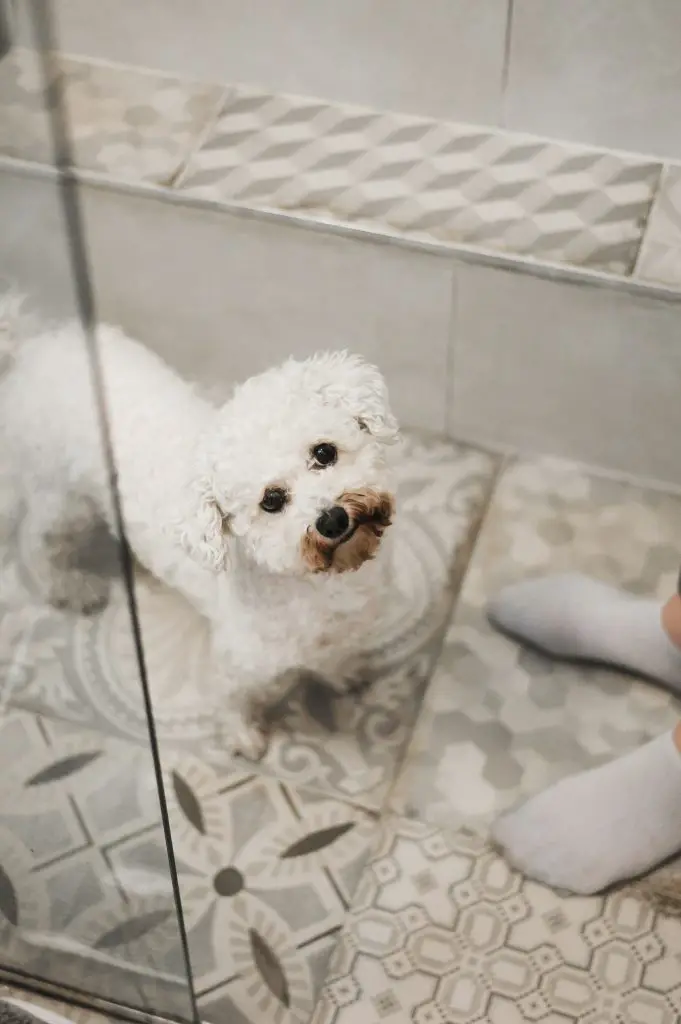
The way you layout your furniture and design your space can drastically reduce ambient stress for a large dog living in close quarters.
Flooring and Traction Hazards
Aesthetically pleasing hardwood and polished concrete floors are essentially ice rinks for a dog with furry footpads. “Poodle Skidding” is not just a nuisance; it is a leading cause of joint injuries, particularly Cranial Cruciate Ligament (CCL) tears. Placing heavy, rubber-backed runner rugs down your main hallways gives your dog the necessary traction to navigate corners safely without doing the splits.
Vertical Storage and Counter-Surfing
A Standard Poodle’s natural standing height allows them to reach most kitchen islands and dining tables with zero effort. In an apartment, you must build up. Ensure that all toxic foods—such as grapes, chocolate, and onions—are stored in overhead cabinets rather than lower pantries. If you leave a stick of butter on an apartment counter, a Standard Poodle will simply view it as a complimentary hors d’oeuvre.
9. Environmental Overstimulation and “Window Watch”
Modern condominiums often feature beautiful floor-to-ceiling windows. While humans love the natural light, for a Poodle, these windows function as “Poodle Television,” and the programming is often far too stimulating.
Visual Trigger Management
If your Poodle spends hours standing at the glass, intensely tracking every pedestrian, pigeon, and passing car with sharp barks, their cortisol levels are spiking. They believe they are “guarding” the perimeter of the den. Applying a simple frosted window film to the bottom 24 inches of the glass preserves your natural light but entirely removes the visual trigger. Out of sight truly means out of mind for a guarding breed.
High-Rise Syndrome Awareness
This is a grim but absolutely necessary topic for urban dwellers. Dogs can, and tragically do, fall from balconies. Poodles possess a very high prey drive. A pigeon landing on the railing of a 12th-floor balcony can trigger a sudden, instinctual leap before the dog’s brain can process the sheer drop. Never leave a Poodle unattended on a high-rise balcony, no matter how well-trained they are.
City life can push a dog’s sensory processing to the limit, but understanding their baseline psychology changes everything. To see exactly how I map the Poodle brain, read my deep-dive: The Ultimate Poodle Behavior Guide, where I break down the breed’s brilliant—and sometimes exhausting—mind from the ground up.
10. The Remote Worker’s Poodle: Zoom Etiquette
A significant portion of apartment dwellers now work from home. Managing a genius-level dog while trying to conduct a professional video call requires serious boundary strategy.
The “Office Rug” Protocol
Dogs thrive on contextual clues. I taught Angus that when the specific “Office Rug” near my desk is occupied, he is officially off-duty. By consistently giving him a long-lasting chew (like a bully stick or a frozen Kong) only when I am at my desk, he has learned to associate my work hours with his quiet, independent chew time. This ensures he isn’t trying to squeak a toy right next to the microphone during a quarterly review.
Preventing Separation Anxiety
When you live and work in the same 800 square feet, your Poodle can easily turn into a “Velcro dog,” following you from the kitchen to the bathroom. You must practice “mini-absences.” Make a habit of closing the door to your home office for thirty minutes a day while you are still inside the apartment. This teaches the dog that they can exist peacefully in the living room without having eyes on you at all times, which prevents severe separation anxiety when you actually do leave the building.
11. Emergency Preparedness: The 15th-Floor Plan

In a high-rise building, an emergency isn’t just a fire; it is a power grid failure, a water main break, or a broken elevator bank that traps you on an upper floor.
The Urban Go-Bag
Every apartment dog needs a dedicated Go-Bag hanging by the front door. This must include paw wax (to protect their footpads from shattered glass or burning asphalt during an evacuation), a reliable 10-foot lead for better control in chaotic, crowded stairwells, collapsible silicone bowls, and a three-day supply of their regular kibble.
The Stairwell Carry Protocol
If the fire alarms are blaring and the elevators shut down automatically, you are taking the stairs. If you live on the 20th floor and have a senior Standard Poodle with arthritis, walking down those concrete steps may be impossible for them. We highly recommend purchasing an emergency rescue harness—a device that literally allows you to strap your 60-pound dog to your back like a hiker’s backpack. It is not elegant, but it is a life-saving tool.
12. The “Nature Reset”: Managing Urban Burnout
Even the most well-adjusted, sophisticated urban Poodle occasionally hits a wall. The constant influx of sirens, barking neighbor dogs, and crowded lobbies causes “Stimulus Stacking,” where the dog’s stress hormones remain chronically elevated.
Recognizing the Signs of City Stress
If your normally quiet Poodle is suddenly pacing the apartment, reacting aggressively to familiar hallway noises, or abruptly “forgetting” their potty training, they are likely suffering from urban sensory overload. Their nervous system is simply fried.
The Cortisol Detox
To combat this, I strongly suggest implementing a “Nature Reset.” Once a month, take your Poodle completely out of the city environment. Renting a quiet cabin in the woods or spending a full day at an isolated, quiet beach allows their brain to “de-frag.” Giving them the freedom to run on dirt instead of concrete, and listen to the wind instead of garbage trucks, resets their baseline stress levels, ensuring they remain the calm, professional urbanite you need them to be.
13. Frequently Asked Questions (FAQ)
Q: Are Standard Poodles too “bouncy” to live above downstairs neighbors?
A: Poodles are exceptionally light on their feet, but their enthusiastic “zoomies” can indeed be loud. We recommend establishing designated play zones covered in high-pile rugs and thick felt pads to significantly dampen the vibration of a landing dog.
Q: Do Poodles tend to smell more in small, enclosed spaces?
A: No. Because Poodles possess hair instead of fur and produce very minimal dander and body oils, they are arguably the ideal “low-odor” breed for confined condominiums. Proper grooming is still required, but they do not emit that classic “hound smell.”
Q: Can a Standard Poodle handle an elevator breakdown if I live on a high floor?
A: For a young, healthy Standard Poodle like Angus, taking a few flights of stairs is manageable. However, for senior dogs or young puppies with developing joints, it is a significant risk. Always have an emergency lift harness ready.
Q: How do I definitively stop my Poodle from “guarding” the apartment door?
A: Stop scolding and start using the “Targeting” method. Give them a highly rewarding “Place” command on a designated rug placed at least 10 feet away from the front door. When they hear a noise, you want their automatic “job” to be retreating to the rug for a reward, rather than rushing the door to bark.
Conclusion: The Urban Poodle Verdict
To definitively answer the question: yes, Poodles can not only survive but truly thrive in apartment and condo settings.
The data and behavioral science point to a clear conclusion. Whether you share a 400-square-foot studio with a Toy Poodle or a 15th-floor condo with a Standard Poodle like Angus, success is rarely measured in square footage. Instead, it’s measured in mental stimulation, intentional routines, and your willingness to invest in a few high-pile acoustic rugs.
The high-rise Poodle is a brilliant, highly adaptable companion. They do not need a sprawling backyard to be fulfilled; they just need a “job,” a solid elevator etiquette protocol, and a dedicated owner who understands the biology of the breed. As long as you respect their intelligence, manage their sensory environment, and protect your low coffee tables from the dreaded “Tail Radius,” you will find that a Poodle makes one of the finest, cleanest, and most intuitive urban roommates available.
Medical & Veterinary Disclaimer: PoodleReport.com is an informational resource for Poodle owners and enthusiasts. We are not veterinarians. The content on this website is not a substitute for professional veterinary care, diagnosis, or treatment. Always seek the advice of your veterinarian with any questions you may have regarding your pet’s medical condition, diet, or overall health.