

Disclaimer: The information provided on PoodleReport.com is for educational purposes only and does not constitute veterinary medical advice; always consult your vet before changing your dog’s diet. Additionally, this post contains affiliate links. As an Amazon Associate, and other affiliate advertising programs, I earn from qualifying purchases at no extra cost to you.
Poodles are an exceptional family breed, uniquely versatile in three distinct sizes: Standard, Miniature, and Toy. Renowned for being energetic, highly intelligent, and remarkably easy to train, they are true “people dogs” that thrive on constant companionship rather than a kennel environment. To help them reach their full potential as confident companions, it is essential to begin socialization early, introducing them to a variety of people and other pets.
How long can Poodles be left alone? As a general rule, Poodles can be left alone for one hour for every month of age, up to a maximum of 8–9 hours for an adult. While a 3-month-old puppy reaches their physical limit at 3 hours, a mature Poodle has the bladder capacity to last a full workday.
However, because Poodles are high-intelligence, social athletes, their emotional threshold is often shorter than their physical one. To prevent separation anxiety, avoid consistently hitting the 9-hour mark without providing mental enrichment or a midday break. Understanding this balance between their physical limits and their “emotional battery” is key to a happy home.
Ready to decode your dog’s unique communication and behavioral needs? Visit my Poodle Behavior Guide to learn how to confidently manage separation anxiety, conquer reactive barking phases, and select the ultimate training methods for your specific Poodle.
The Quick-Start Guide: The “Poodle Clock”
When you bring a Poodle into your life, one of the first logistical hurdles you’ll face is the “Poodle Clock.” Unlike more independent breeds, Poodles are “proximity seekers”—they thrive on human interaction and mental engagement. While their physical ability to hold their bladder is one thing, their emotional capacity for solitude is quite another.
The Golden Rule: The 1-Hour Month-of-Age Marker
For Poodle puppies, the rule of thumb is straightforward: one hour of alone time for every month of age. This is primarily a biological limit based on bladder development. If you push a puppy past this mark, you aren’t just risking an accident; you are potentially creating “potty-training regression” by forcing them to soil their space.
| Poodle Age | Maximum Solitude Limit |
| 2 Months | 2 Hours |
| 3 Months | 3 Hours |
| 4 Months | 4 Hours |
| 5 Months | 5 Hours |
| 6 Months+ | 6–8 Hours (Maximum) |
The Adult Cap: Why 9 Hours is Too Long
By the time a Poodle reaches one year of age, they can physically hold their needs for 8 to 9 hours. However, as an owner and researcher, I strongly advise against making this the daily standard. Even a mature, 5-year-old Poodle—regardless of whether they are a Standard, Miniature, or Toy—should not consistently be left for a full 9-hour workday.
While an adult Poodle’s bladder can handle it, their “mental battery” for being alone is much shorter. Leaving an intelligent, high-energy athlete in a silent house for 9 hours is a recipe for stress-induced behaviors, such as obsessive licking or destructive chewing.
Expert Insight: It is important to distinguish between Physical Capacity and Emotional Endurance. Your Poodle might be able to physically “hold it” until you get home, but the psychological strain of total isolation often manifests as separation anxiety. Think of it this way: they can survive 8 hours alone, but they won’t thrive if that is their daily reality.
Size Matters: Solitude Across the Varieties
While the “Poodle Clock” provides a baseline, the three varieties—Standard, Miniature, and Toy—do not experience solitude in the exact same way. Their physical capacity and psychological temperaments create unique challenges for owners who work away from home.
Standard Poodles: The “Sturdy Solitary”
Standing over 15 inches tall and weighing up to 70 pounds, the Standard Poodle is a true athlete. Physically, they have the largest bladder capacity, making them the most capable of handling a standard workday. However, there is a catch: High-IQ Boredom.
Because Standards were originally bred as water retrievers, they have a high “work drive.” If left alone without a “job” or mental stimulation, they won’t just sleep; they will look for ways to entertain themselves. This often results in “industrial-scale” destruction—chewing through drywall or “rearranging” your furniture—not out of malice, but out of a desperate need for cognitive engagement.
Miniature Poodles: The “Attentive Shadow”
The Miniature Poodle (11–15 inches) often falls into the “Velcro dog” category. They are intensely attentive to their owners and highly sensitive to changes in routine. While they have moderate energy levels, their emotional battery for being alone is often lower than a Standard’s. They are the variety most likely to pace or vocalize (barking/howling) the moment they realize the house is empty.
Toy Poodles: The “High-Frequency Companion”
The Toy Poodle (under 10 inches) faces the most significant physical hurdles when left alone.
- Bladder Limits: Their tiny stature means a tiny bladder. Even as adults, many Toys struggle to hit the 8-hour mark consistently.
- The Hypoglycemia Risk: Unlike larger varieties, Toy Poodle puppies are prone to hypoglycemia (low blood sugar). If left alone for 5+ hours without access to a small snack or a puzzle feeder, their energy levels can crash dangerously.
- Social Sensitivity: Toys are bred almost exclusively for companionship. For them, isolation isn’t just boring; it can be physically stressful, leading to digestive upsets and “nervous” behaviors.
Solitude Profile by Variety
| Variety | Physical Limit | Primary Risk Factor | Solitude Temperament |
| Standard | High (8–9 hrs) | Destructive Boredom | Independent but “Work-Oriented” |
| Miniature | Medium (6–8 hrs) | Vocalization/Pacing | Sensitive and Attentive |
| Toy | Low (4–6 hrs) | Hypoglycemia/Anxiety | High-Needs Companion |
The “Angus” Case Study: Lessons from a Standard Poodle
To truly understand the Poodle’s relationship with solitude, I often look back at my experience with my Standard Poodle, Angus. When I first brought him home, I fell into the common trap of assuming that because he was a large, athletic dog, he would naturally be fine while I was away at work.
What I discovered was that for a Poodle, “physical independence” and “emotional security” are two very different things.
The High-IQ Hurdle
Angus was incredibly intelligent, but that intelligence was a double-edged sword when he was left alone. Without a task to focus on, his boredom quickly manifested as destructive “projects.” I vividly remember coming home to find he had systematically unspooled a roll of paper towels and “decorated” the entire living room—not out of spite, but because his brilliant mind was starving for stimulation.
The “15-Minute Rule” for Success
Through months of trial and error, I developed what I call the 15-Minute Rule. I realized that Angus’s anxiety spiked the moment I walked out the door, but if he could settle within the first 15 minutes, he was usually calm for the rest of the day.
To help him succeed, I moved away from “generic care” and implemented a specific routine:
- The Morning Burn: A 20-minute focused training session (mental work) followed by a walk (physical work).
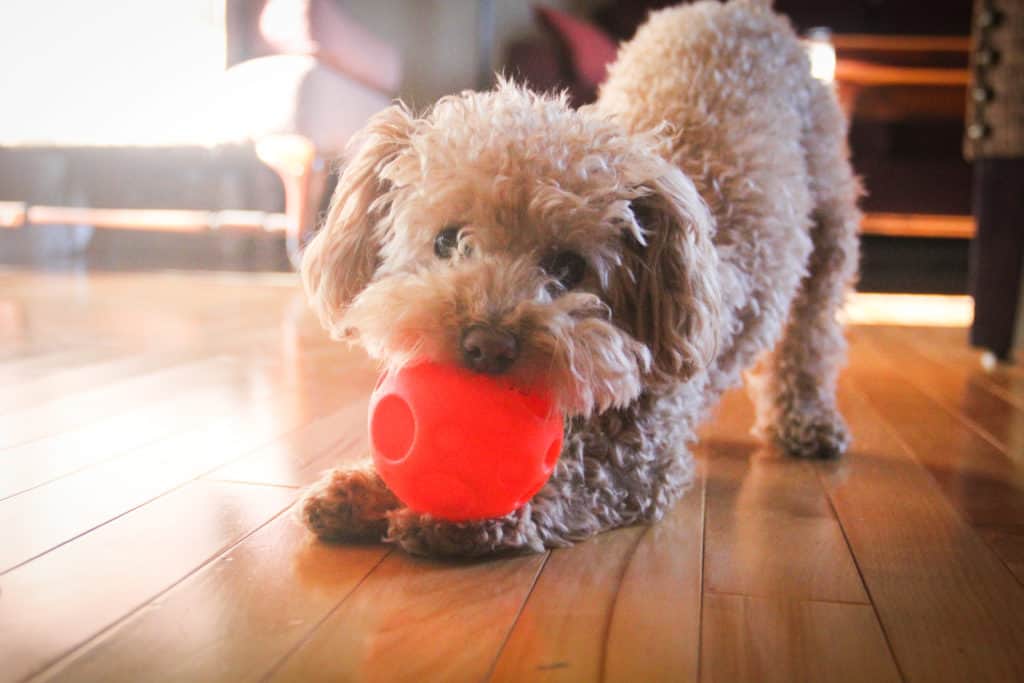
- The High-Value Distraction: I never left without giving him a frozen puzzle toy. This diverted his focus during that critical 15-minute “anxiety window” right after I departed.
- The Neutral Exit: I stopped the long, emotional goodbyes. By making my departure a non-event, I signaled to Angus that my leaving wasn’t a tragedy—it was just part of the day.
Why This Experience Matters for You
My time with Angus taught me that you cannot “force” a Poodle to be okay with being alone. Instead, you have to train the calm. Whether you share your home with a 70-pound Standard or a 6-pound Toy, the goal is the same: providing enough mental and physical “exhaustion” so that your absence becomes their designated nap time.
A Personal Note: My journey with Angus is what eventually led me to create Poodle Report. I wanted to cut through the generic advice and provide owners with the breed-specific insights—like the importance of bioavailable proteins and mental enrichment—that actually make a difference in a Poodle’s quality of life.
Diagnostic: Is it Boredom or Separation Anxiety?
One of the most common questions I get from Poodle owners is: “How do I know if my dog is actually anxious or just bored?” Because Poodles are so intelligent, they are “master orchestrators” of their environment. However, the treatment for a bored Poodle is very different from the treatment for a truly anxious one.
To help you identify what’s happening while you’re away, use this comparison guide based on behavioral markers and the timing of the behavior.
Boredom vs. Separation Anxiety: The Comparison
| Feature | Destructive Boredom | True Separation Anxiety |
| Timing | Occurs later in the day (3+ hours in). | Occurs within 15 minutes of your exit. |
| Behavior Type | “Fun” destruction: shredding paper, de-stuffing toys. | “Panic” destruction: clawing at door frames, chewing windowsills. |
| Physical Signs | Normal breathing, often found napping when you return. | Excessive drooling, panting, or “shaking” upon your return. |
| Vocalization | Occasional “demand” barking at a passing squirrel. | Non-stop howling, high-pitched whining, or frantic yiping. |
| Elimination | Rare (if house-trained and within time limits). | “Panic accidents” even if they just went outside. |
The “Poodle IQ” Factor
Poodles are famously ranked as the world’s second-smartest dog breed. This intelligence means they don’t just “sit” and wait; they anticipate.
If your Poodle is bored, they are looking for a job. They might “rearrange” your shoes or find a way to open a cabinet. This is a sign that they need more mental stimulation before you leave.
If your Poodle has separation anxiety, they are in a state of physiological panic. This isn’t about being “naughty”—it’s a mental health crisis. As I learned with Angus, identifying this early is the key to preventing long-term stress-induced health issues.
Symptoms of Separation Anxiety in Dogs
If you’ve determined it’s more than just boredom, look for these specific red flags:
- Excessive Barking or Crying: Often loud and persistent.
- Destructive Behavior: Focused on “exit points” like doors and windows.
- Housebreaking Accidents: Even in a fully trained adult.
- Wild Behavior During Departures: Frantic jumping or nipping as you grab your keys.
- Over-Excitement Upon Return: A “velcro” reaction where the dog won’t leave your side for an hour after you get home.
I recently wrote an in-depth article on how to stop separation anxiety in poodles. In it, you’ll learn how to identify these anxious behaviors and discover fifteen science-backed ways to help fix them.
Training for Success: The “Key-Jingle” Protocol
One of the biggest mistakes we make as owners is unintentionally “announcing” our departure. Poodles, with their high cognitive function, are experts at pattern recognition. They know that when you pick up your car keys, put on your “work shoes,” or grab your briefcase, the house is about to go silent. These are known as Departure Cues, and for an anxious Poodle, they are the starting gun for a panic attack.
Breaking the “Sequence of Anxiety”
To help your Poodle remain calm, you must break the association between your preparation and your exit. I call this the Key-Jingle Protocol. The goal is to make these cues “meaningless” to your dog.
The Step-by-Step Desensitization Process:
- Trigger the Cue: Pick up your keys or put on your coat at a time when you have no intention of leaving.
- Neutralize the Response: Instead of walking to the door, go sit on the couch and watch TV or start a load of laundry.
- Repeat Daily: Do this until your Poodle no longer lifts their head when they hear the keys jingle. You are teaching them that “keys” don’t always equal “goodbye.”
The Power of a “Neutral Exit”
As tempting as it is to give your Poodle a big, loving goodbye with hugs and kisses, it is actually one of the most stressful things you can do. A dramatic goodbye draws a giant circle around the fact that you are leaving, increasing their cortisol levels right as the door closes.
The best thing you can do for your dog is to act as if nothing is going on.
- 15 Minutes Before: Place your Poodle in the area where they will spend their time. Give them a high-value distraction, like a frozen puzzle toy or a long-lasting chew.
- The Quiet Slip-Out: Make sure they have all their needs met, and then simply slip out of the door while they are distracted by their “job.” No eye contact, no “Be a good boy,” no fanfare.
Behavioral Support Tools
If these steps feel overwhelming, or if your Poodle’s anxiety is deeply rooted, I highly recommend a structured training system. I found a fantastic video training program called Brain Training for Dogs.
Using this system, I was able to identify specific triggers that caused anxiety in my own dogs and replace those fearful reactions with “thinking tasks.” It’s an incredibly cost-effective way to get professional-level results at home.
By mastering the exit, you aren’t just leaving the house—you are leaving your Poodle with the gift of a calm mind.
The Proper Environment: Poodle Solitude Setup
The most important thing to help your Poodle with separation anxiety is giving them the proper environment during the day. Many people turn to a crate during the day, but leaving a dog in a confined space for long periods of time can count as borderline neglect.
Poodles should be house-trained before they are left alone and, ideally, given a space to roam around. A “poodle-proofed” room or a large playpen is often much better for their mental health than a tight crate.
Guidelines for a “Calm Home” Environment
To keep your Poodle comfortable in your absence, focus on sensory enrichment:
- Audio Comfort: Leave the TV on for background noise or play calming music. The sound of human voices can comfort and entertain them.
- Visual Stimulation: Keep the window blinds open so they can watch the outside world. However, if your Poodle is a “reactive barker,” consider using sheer curtains that let in light but blur the movement of passersby.
- Lighting: Leave some lights on. A dark home feels lonelier and can increase a dog’s sense of isolation.
- Essentials: Always ensure they have fresh, clean water and a comfortable sleeping area.
The High-IQ Toolkit: Mental Enrichment
Because Poodles are “thinking” dogs, they need more than just a bed; they need a challenge. If they don’t have a task, they will invent one (usually involving your shoes).
- Level 3 Puzzles: Since Poodles are the “world’s second smartest breed,” standard toys are often solved in minutes. Look for advanced interactive puzzles that require multiple steps to find a treat.
- Snuffle Mats: These mimic the “foraging” instinct, forcing your Poodle to use their nose to find hidden dry food. Ten minutes of sniffing can be as tiring as a thirty-minute walk.
- Long-Lasting Chews: While I recommend monitoring your dog with new chews, safe options like high-quality dental chews can keep a Poodle occupied during that critical first 30 minutes of solitude.
A Note on Crate Training
While it is preferable not to keep a Poodle in a crate for several hours, if you do need to do this, make sure the crate is large enough for them to move around in. If it is not tall enough for them to stand comfortably, they will be forced to lie down for hours. This is highly discouraged by veterinarians and can lead to joint stiffness, especially in Standard Poodles.
Professional Support & The “Safety Net”
Even with the best preparation, there are times when a Poodle’s need for companionship exceeds what a standard 9-to-5 schedule can provide. Because of their high intelligence and social sensitivity, Poodles are among the top five breeds most likely to develop food-related skin sensitivities and stress-induced digestive upsets when their routine is compromised.
When “home alone” time starts impacting your dog’s health or happiness, it’s time to look at professional safety nets.
External Support: Walkers and Daycare
If your Poodle consistently hits that 8–9 hour limit, consider these two primary options:
- The Professional Dog Walker: This is often the best choice for Standard Poodles. A 30-minute midday visit provides a “bladder reset” and the physical exertion they crave.
- Doggie Daycare: Excellent for social Miniature and Toy Poodles. However, ensure the facility understands Poodle temperament; because they are “people dogs,” some Poodles prefer a small-group setting over a chaotic “free-for-all” with 50 other dogs.
The Health Safety Net: Managing Stress-Related Issues
Separation anxiety isn’t just a behavioral problem; it can manifest physically. Chronic stress in Poodles can lead to weakened immune systems, obsessive licking (leading to “hot spots”), and gastrointestinal issues.
To ensure your Poodle has access to the best care—especially if stress leads to an emergency—I recommend these specific resources:
- Lemonade Pet Insurance: High-level veterinary care can be expensive. Having Lemonade was a lifesaver for me when my dog, Angus, was diagnosed with health challenges. It allows you to focus on your dog’s recovery rather than the bill.
- Pawp.com: This is a game-changer for “home alone” worries. Pawp gives you 24/7 access to licensed vets via video call. If you see your Poodle pacing or panting on your pet camera, you can consult a vet instantly to determine if it’s an emergency or just a flare-up of anxiety.
- Pet Plate: Stress often causes Poodles to become “picky eaters.” Providing high-quality, bioavailable nutrition through a service like Pet Plate ensures they maintain their weight and energy levels even during stressful transitions.

Expert Tip: The Exercise Buffer
For Standard Poodles specifically, if you are using a midday walker, remember the “Exercise Buffer.” Restrict heavy running or jumping for 60 minutes before and after every meal to reduce the risk of Bloat (GDV), a serious condition that can be triggered by stress and activity in deep-chested breeds.
Poodle Solitude: Frequently Asked Questions
1. Do Poodles get depressed when left alone?
While Poodles are highly resilient, they are “profoundly social” dogs. If consistently left alone for 9+ hours without mental stimulation, they can develop symptoms of canine depression, including lethargy, loss of appetite, and a lack of interest in play. Because Poodles are the world’s second-smartest breed, their need for “cognitive companionship” is higher than that of more independent breeds.
2. Can two Poodles be left alone together?
Having a second dog can significantly reduce “loneliness,” but it is rarely a cure for true separation anxiety, which is specifically a panic over the owner’s absence. However, for a bored Poodle, a companion can provide the social “buffer” needed to stay calm. If you have two, ensure they both have individual high-IQ toys to prevent resource guarding while you are away.
3. Is a crate or a playpen better for a Poodle puppy?
For Poodle puppies, a playpen (or “long-term confinement area”) is generally superior to a crate for long stretches. A playpen allows room for a bed, a water bowl, and a “potty patch,” which is essential for Toy and Miniature Poodles who cannot physically hold their bladder for a full workday.
4. Why does my Poodle howl only when I leave?
Howling is an ancestral “location marker.” In the wild, canines howl to help lost pack members find their way back. If your Poodle howls when you leave, they are literally trying to “call you home.” This is a primary sign of separation-related distress and suggests you should begin the Key-Jingle Protocol mentioned above.
5. Can Poodles live in apartments if I work all day?
Yes, Poodles make excellent apartment dogs because they are generally quiet indoors—provided their exercise needs are met. If you live in an apartment and work all day, a midday walker is highly recommended. Standard Poodles, in particular, need that “metabolic reset” to remain calm in smaller living spaces.
Conclusion: Quality Over Quantity
Ultimately, the question of whether a Poodle can be left alone isn’t just about their bladder capacity; it is about their quality of life. As one of the world’s most intelligent and social breeds, Poodles don’t just “pass the time”—they experience it deeply. Whether you share your home with a 70-pound Standard or a 6-pound Toy, your absence is a significant part of their daily narrative.
By prioritizing a diet tailored to their unique physiology and providing a high-IQ “toolkit” for solitude, you are doing more than just filling a bowl or a toy; you are providing a foundation for their long-term health and cognitive sharpness.
Poodle Home-Alone Master Checklist
Keep your Poodle in peak mental and physical condition with these daily and weekly habits:
Daily Maintenance
- [ ] The 15-Minute Rule: Ensure your Poodle is settled with a high-value distraction before you step out.
- [ ] The “Neutral Exit”: Avoid emotional goodbyes to keep their cortisol levels low.
- [ ] Fresh Hydration: Clean water bowls daily to prevent kidney stones, especially for Toy varieties.
- [ ] The Exercise Buffer: (Standards Only) Restrict heavy exercise for 60 minutes before and after every meal to reduce the risk of Bloat (GDV).
Weekly Health & Environment Checks
- [ ] The Rib Test: Perform a hands-on check; you should easily feel the ribs under a thin layer of skin to ensure they aren’t gaining weight from “boredom treats.”
- [ ] Skin & Ear Check: Look for redness or “rusty” paw staining—common early indicators of stress-related or food-related sensitivities.
- [ ] Label Audit: Verify that a named animal protein (like Lamb or Salmon) remains the first ingredient in their food to support their high metabolic needs.
Discover the Poodle Behavior Resource Hub
Unlock your dog’s keen intellect and solve complex communication hurdles with training strategies developed specifically for the Poodle mind. Head over to our [Poodle Behavior & Training Manual] for research-based routines and cognitive solutions, or explore these curated topics:
- 2026 Poodle Behavior Guide: Proven Research-Based Training
- How to Get a Poodle to Stop Barking: The Ultimate Guide [2026 Update]
- Do Poodles Like Water? The Ultimate Swimming & Safety Guide
- Do Poodles Howl? The Cause, It’s Meaning, and When to Worry
Medical Disclaimer & Veterinary Consultation
Important Safety Note: While this guide provides researched nutritional insights, it is not a substitute for professional medical advice. Every dog’s biological profile and digestive sensitivity is unique. You must always consult your veterinarian before introducing cheese or any new human foods into your Poodle’s routine. Your vet is the only resource capable of determining if a specific treat is safe for your dog’s unique health history, ensuring their diet remains balanced, healthy, and free from risk.